
What is an ASA triangle?
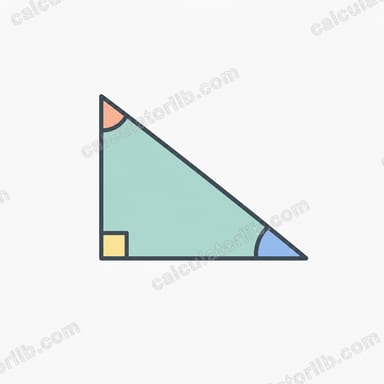
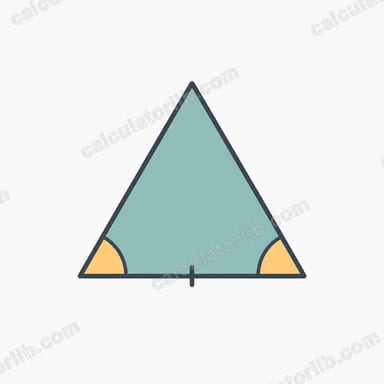
An ASA (Angle-Side-Angle) triangle is defined by two angles and the side that lies between them (the included side). Because the three angles of any triangle add up to 180°, knowing two angles immediately gives the third. With all three angles and one side known, the law of sines uniquely determines the remaining two sides — so an ASA triangle always has exactly one solution.
How to use this calculator
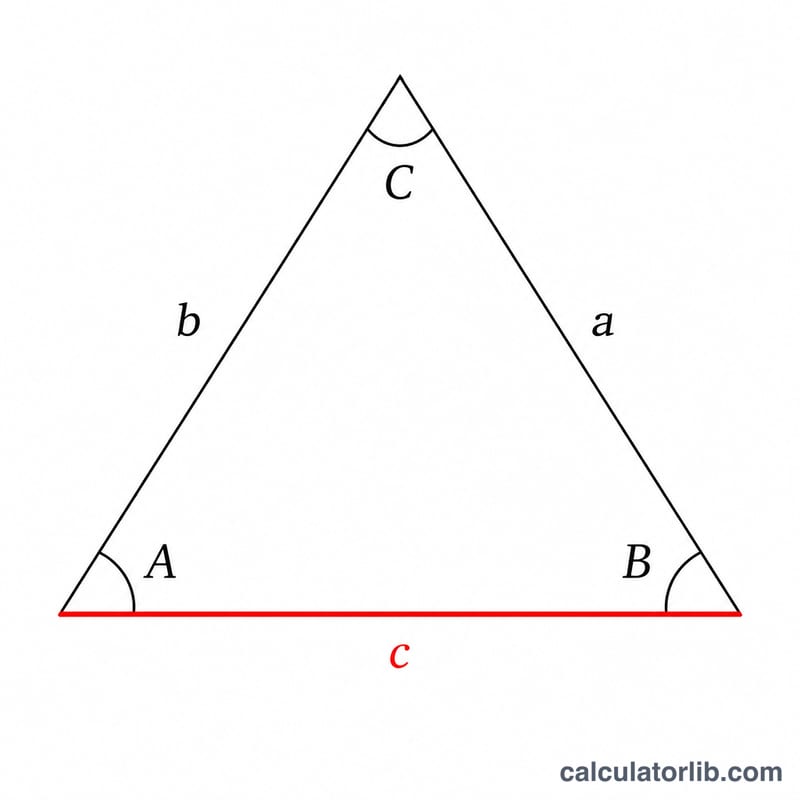
Enter Angle A, the included side c, and Angle B. Angle A and Angle B are the two angles at the ends of side c. The calculator returns the third angle C, the lengths of sides a and b, the perimeter, and the area. All angles are in degrees.
The formula explained
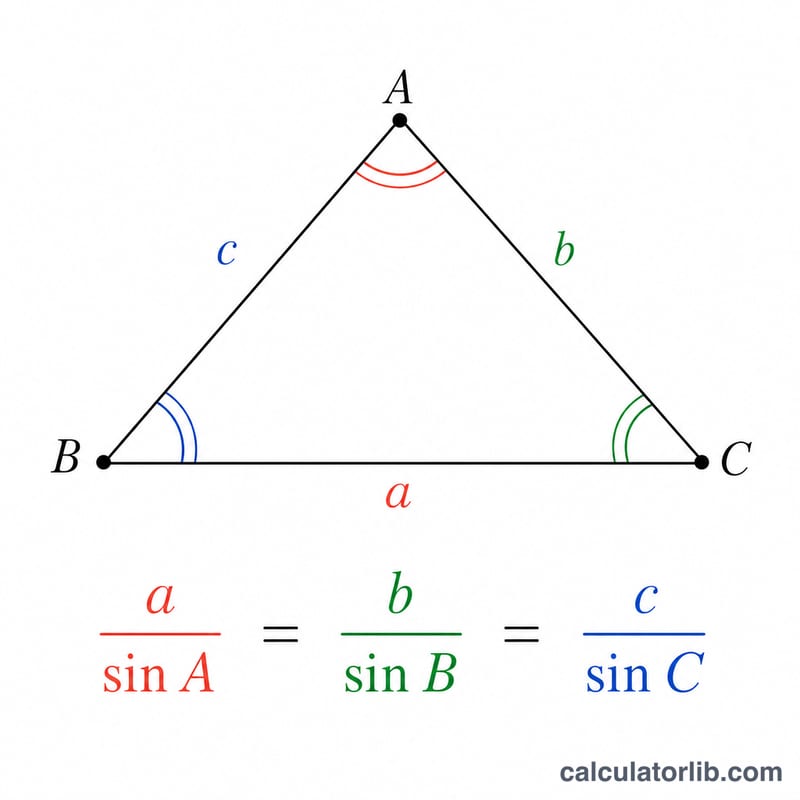
First the third angle is found with \(C = 180^{\circ} - A - B\). Then the law of sines, \(\frac{a}{\sin A} = \frac{b}{\sin B} = \frac{c}{\sin C}\), is rearranged to solve for the unknown sides: $$a = c\,\frac{\sin A}{\sin C}, \qquad b = c\,\frac{\sin B}{\sin C}.$$ The area uses $$\text{Area} = \tfrac{1}{2}\,a\,b\,\sin C.$$
Worked example
Suppose A = 40°, B = 60°, and the included side c = 10. Then \(C = 180 - 40 - 60 = 80^{\circ}\). Using the law of sines: $$a = 10\cdot\frac{\sin 40^{\circ}}{\sin 80^{\circ}} \approx 10\cdot\frac{0.6428}{0.9848} \approx 6.527,$$ and $$b = 10\cdot\frac{\sin 60^{\circ}}{\sin 80^{\circ}} \approx 10\cdot\frac{0.8660}{0.9848} \approx 8.794.$$ The perimeter is about 25.32 and the area \(\approx \tfrac{1}{2}\cdot 6.527\cdot 8.794\cdot 0.9848 \approx 28.26\).
Key Terms & Variables
| Term | Calculator field / symbol | Definition |
|---|---|---|
| ASA triangle | — | A triangle specified by two angles and the side between them (Angle–Side–Angle). This data always determines a unique triangle. |
| Angle A | angleA (\(A\)) |
The first known interior angle, in degrees. It lies opposite side \(a\). |
| Angle B | angleB (\(B\)) |
The second known interior angle, in degrees. It lies opposite side \(b\). |
| Included side c | sideC (\(c\)) |
The side that joins angles A and B — the "S" between the two known angles. It lies opposite the computed angle \(C\). |
| Angle C | \(C\) | The third angle, found from the angle-sum rule \(C = 180^\circ - A - B\). |
| Opposite side | \(a, b, c\) | The side facing a given angle. By convention side \(a\) is opposite \(A\), side \(b\) opposite \(B\), and side \(c\) opposite \(C\). |
| Law of sines | — | The relationship \(\dfrac{a}{\sin A} = \dfrac{b}{\sin B} = \dfrac{c}{\sin C}\), used to solve for the unknown sides once all three angles are known. |
| Perimeter | \(P\) | The total distance around the triangle, \(P = a + b + c\). |
| Area | — | The enclosed region, computed as \(\text{Area} = \tfrac12\,a\,b\,\sin C\) (any angle with its two adjacent sides may be used). |
FAQ
Does ASA always have a unique solution? Yes. Unlike SSA, the ASA configuration is never ambiguous — the angles fix the shape and the side fixes the scale.
What if A + B ≥ 180°? Then no valid triangle exists, because the third angle would be zero or negative. Make sure A + B is less than 180°.
Which side is the included side? The included side c is the one connecting the vertices of angles A and B.