
What Is Pipe Cross-Sectional Area?
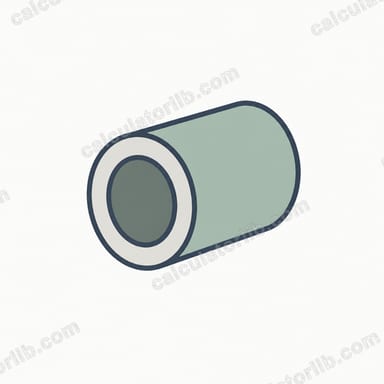
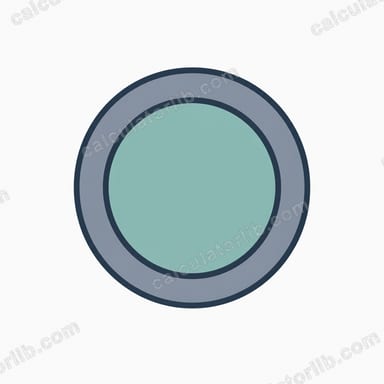
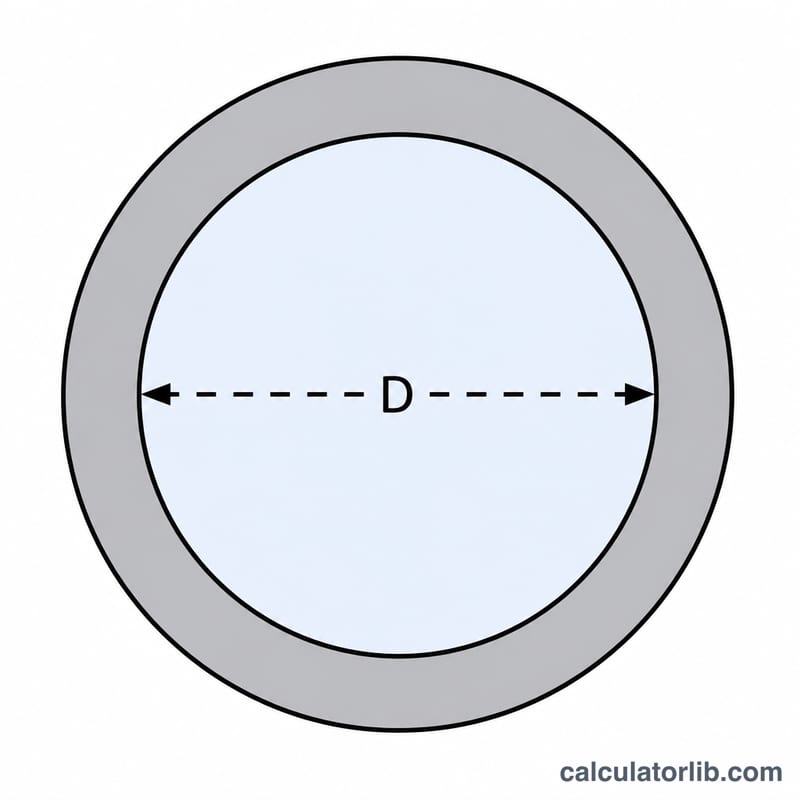
The cross-sectional area of a pipe is the area of the circular opening through which fluid flows, measured perpendicular to the pipe axis. It is calculated from the pipe's inside diameter (the bore), not its outside diameter, because the bore is what determines flow capacity. This is a fundamental quantity in fluid mechanics, plumbing, HVAC, and process engineering — it links flow velocity to volumetric flow rate via \(Q = A \times v\).
How to Use This Calculator
Enter the pipe's inside diameter and select your unit (mm, cm, inches, or meters). The calculator returns the cross-sectional area, the radius, and the bore circumference. The area is expressed in the square of the chosen unit. Always use the internal diameter — for a nominal-size pipe, subtract twice the wall thickness from the outside diameter.
The Formula Explained
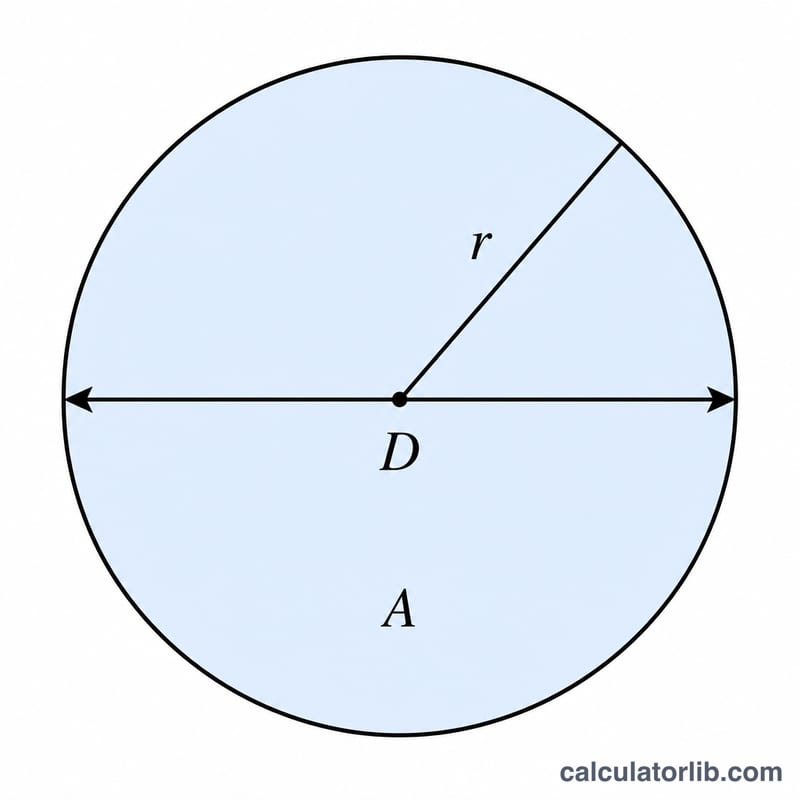
A circle's area is \(A = \pi r^{2}\), and since the radius \(r\) equals \(D/2\), substituting gives $$A = \pi \left(\frac{D}{2}\right)^{2} = \frac{\pi D^{2}}{4}.$$ Using the diameter directly is convenient because pipe sizes are usually specified by diameter. The constant \(\pi/4 \approx 0.7854\), so a quick estimate is \(A \approx 0.7854 \times D^{2}\).
Worked Example
For a pipe with an inside diameter of 50 mm: $$A = \frac{\pi \times 50^{2}}{4} = \frac{3.14159 \times 2500}{4} = 1963.495 \text{ mm}^{2}.$$ The radius is 25 mm and the circumference is \(\pi \times 50 = 157.08\) mm.
FAQ
Should I use inside or outside diameter? Use the inside diameter (bore) for flow-area calculations; outside diameter overstates the area.
What are the area units? The area comes out in the square of whatever length unit you enter — mm gives mm², inches give in², and so on.
Can I use this for flow rate? Yes — multiply the cross-sectional area by the fluid velocity to get volumetric flow rate (\(Q = A \times v\)), keeping units consistent.