
What Is SCFM to ACFM Conversion?
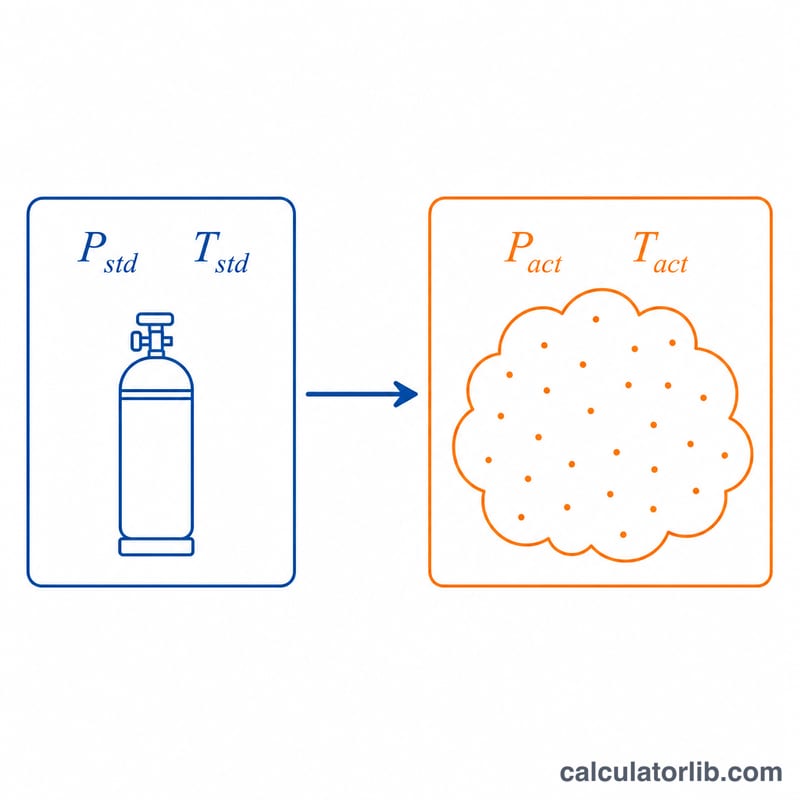
SCFM (Standard Cubic Feet per Minute) describes airflow at a fixed reference condition, while ACFM (Actual Cubic Feet per Minute) describes the real volumetric flow at the operating pressure and temperature of your system. Because gas expands and compresses with changing pressure and temperature, the same mass of air occupies a different volume on site than at standard conditions. This calculator converts a rated SCFM value into the true ACFM you will see at the compressor, blower, dust collector, or HVAC duct.
How to Use It
Enter the standard flow rate (SCFM) and the standard reference condition used by your equipment manufacturer — commonly 14.696 psia and 68°F. Then enter the actual pressure and actual temperature at the point of operation. The calculator converts both temperatures to the absolute Rankine scale and returns the ACFM.
The Formula Explained
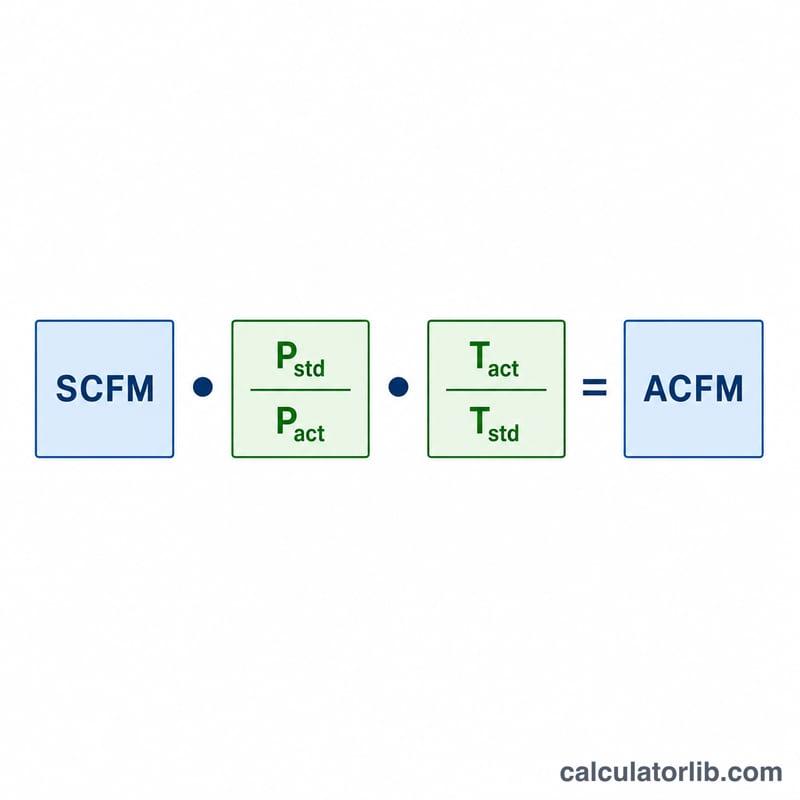
The conversion is $$\text{ACFM} = \text{SCFM} \times \frac{\text{P}_{std}}{\text{P}_{act}} \times \frac{\text{T}_{act} + 459.67}{\text{T}_{std} + 459.67}$$ Higher actual pressure compresses the gas, lowering ACFM, while higher actual temperature expands it, raising ACFM. Temperatures are converted to Rankine (\(\text{T}_R = \text{T}_F + 459.67\)) because the ideal gas law requires absolute units.
Worked Example
Suppose you have 100 SCFM defined at 14.696 psia and 68°F (527.67°R), operating at 20 psia and 100°F (559.67°R). Then $$\text{ACFM} = 100 \times \frac{14.696}{20} \times \frac{559.67}{527.67} = 100 \times 0.7348 \times 1.06064 = 77.94 \text{ ACFM}$$ The higher pressure compressed the air more than the warmer temperature expanded it, so actual flow is below standard.
FAQ
What standard conditions should I use? CAGI commonly uses 14.696 psia and 68°F. Other industries use 60°F or 70°F — always match your equipment data sheet.
Why convert to Rankine? Gas volume depends on absolute temperature. Using plain Fahrenheit would give wrong ratios, so we add 459.67 to convert.
Does humidity matter? This calculator assumes dry air. For high-moisture streams, partial water vapor pressure can shift results slightly.