
What this calculator does
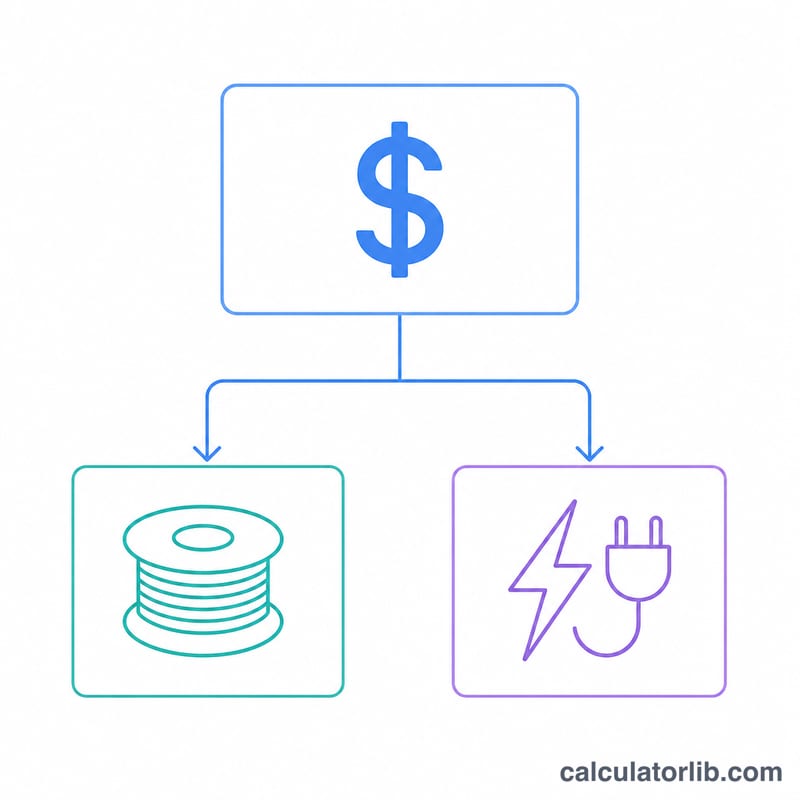
The 3D Printing Time & Cost Calculator estimates how much a single print actually costs to produce. It combines the two biggest direct costs — the filament you consume and the electricity your printer draws while running. Enter the grams of filament, your spool price, the print duration and printer wattage, and you get an instant per-print figure in your own currency.
How to use it
Your slicer (Cura, PrusaSlicer, Bambu Studio, etc.) reports both the filament weight and the estimated print time after slicing — copy those two numbers in. Filament price is whatever you paid per 1 kg spool. Printer power is the average draw in watts; a typical FDM printer pulls 100–200 W including a heated bed, while large or high-temp machines draw more. Electricity rate is your utility's price per kWh.
The formula explained
$$\text{Cost} = \frac{\text{filament}_g}{1000}\times\text{price}_{kg} + t_h\times\frac{P_W}{1000}\times r$$ The first term converts grams to kilograms and multiplies by the spool price. The second term converts watts to kilowatts, multiplies by hours to get kilowatt-hours, then multiplies by your electricity rate. The two are summed for total cost.
Worked example
A print uses 50 g of filament from a $25/kg spool, runs for 4 hours on a 150 W printer, with electricity at $0.15/kWh. Material = \((50/1000) \times 25 = \$1.25\). Energy = \(4 \times 0.15\ \text{kW} = 0.6\ \text{kWh}\), so electricity = \(0.6 \times 0.15 = \$0.09\). Total = \(\$1.34\).

Typical Filament Prices & Printer Wattage by Type
The two cost drivers in any print are the material consumed (grams of filament multiplied by the per-kilogram price) and the electricity used (printer wattage running for the print duration). The tables below give representative ballpark figures you can drop into the calculator. Prices are typical retail ranges for 1 kg spools and vary by brand, color and region; wattage is the average draw over a print, which is well below the peak rating because the heated bed and hotend cycle on and off.
| Filament type | Typical price per kg | Notes |
|---|---|---|
| PLA | 20–30 | Easiest to print, lowest cost, low temperatures |
| PETG | 22–35 | Tougher, water/UV resistant, good for functional parts |
| ABS | 20–30 | Heat resistant, needs enclosure & ventilation |
| ASA | 30–45 | UV-stable ABS alternative for outdoor use |
| TPU (flexible) | 30–50 | Prints slowly, elastic parts |
| Nylon (PA) | 40–70 | High strength, hygroscopic, must be dried |
| Printer class | Typical average power draw (W) | Notes |
|---|---|---|
| Small FDM (unheated/small bed) | 40–80 | Compact hobby machines |
| Heated-bed desktop FDM | 100–150 | Most common consumer printers; bed dominates draw |
| Large-format / enclosed FDM | 150–350 | Big heated bed + chamber heating |
| Resin (LCD/MSLA) | 30–120 | LCD + UV array; relatively low draw |
For reference, electricity rates commonly fall between 0.10 and 0.35 per kWh depending on country and tariff. Use your actual rate from a recent utility bill for the most accurate result.
FAQ
Does this include printer wear or failures? No — it covers direct material and electricity only. Many makers add a buffer of 10–20% for nozzle/belt wear, failed prints and labor.
What wattage should I enter? Use the average running draw, not the peak. Heated-bed machines spike at startup but average lower; 100–200 W is typical for desktop FDM.
Which currency does it use? Any — the tool is currency-agnostic. Just keep your spool price, electricity rate and result in the same currency.