
What Is Scrap Rate?
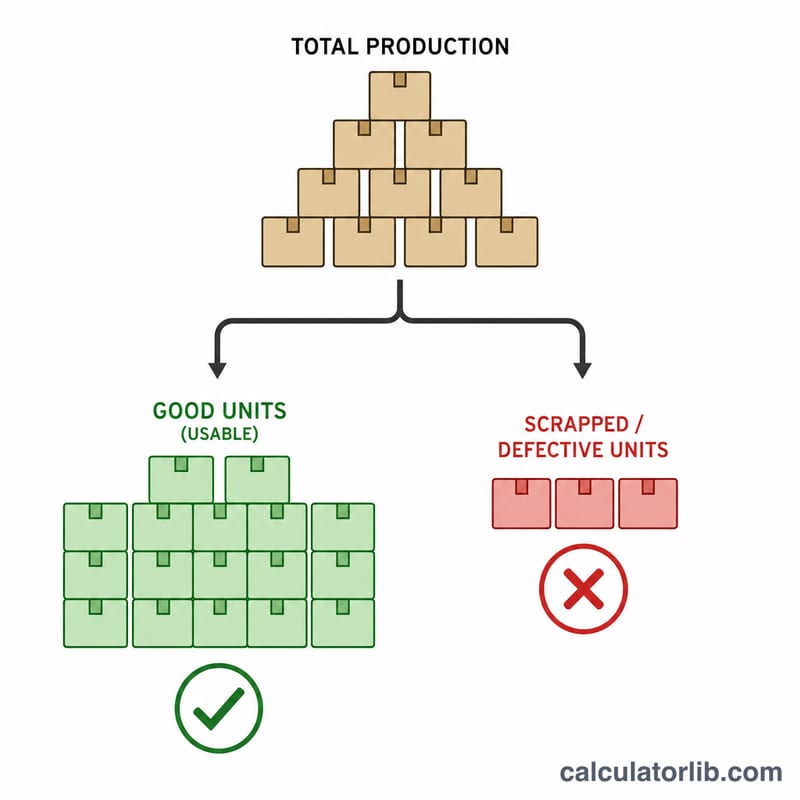
Scrap rate is a key manufacturing quality metric that measures the proportion of produced units that must be discarded because they fail to meet quality standards. Expressed as a percentage, it tells you how much of your production output is wasted. A lower scrap rate means better process efficiency, less material waste, and higher profitability.
How to Use This Calculator
Enter the number of scrapped units (defective parts that cannot be reworked or sold) and the total units produced during the same period or run. The calculator instantly returns your scrap rate as a percentage, the number of good units, and the complementary yield rate.
The Formula Explained
The scrap rate is calculated as:
$$\text{Scrap Rate \%} = \frac{\text{Scrapped Units}}{\text{Total Units Produced}} \times 100$$
Dividing scrapped units by total production gives the fraction wasted; multiplying by 100 converts it to a percentage. The yield rate is simply \(100\% - \text{Scrap Rate}\), representing the share of output that is usable.
Worked Example
Suppose a production line makes 1,000 units in a shift, and 50 of them are scrapped. The scrap rate is \(50 \div 1{,}000 \times 100 = \textbf{5\%}\). That leaves 950 good units and a yield rate of 95%. Tracking this number over time helps you spot process drift before it becomes costly.
FAQ
What is a good scrap rate? It varies by industry, but many manufacturers target under 2–5%. High-precision or high-volume operations often aim much lower.
Is scrap rate the same as defect rate? Not always. Defect rate counts all faulty units, including those that can be reworked. Scrap rate counts only units that are permanently discarded.
How can I reduce my scrap rate? Improve process control, calibrate equipment, train operators, and analyze root causes of defects using methods like Six Sigma or statistical process control.