
What is baker's percentage?
Baker's percentage (also called baker's math) is the standard way bakers express a bread recipe. Instead of fractions of a total, every ingredient is written as a percentage of the total flour weight. Flour is always 100%, and each other ingredient — water, salt, yeast, fats, sugar — is scaled relative to it. This makes recipes easy to scale up or down, and lets you compare formulas at a glance regardless of batch size.
How to use this calculator
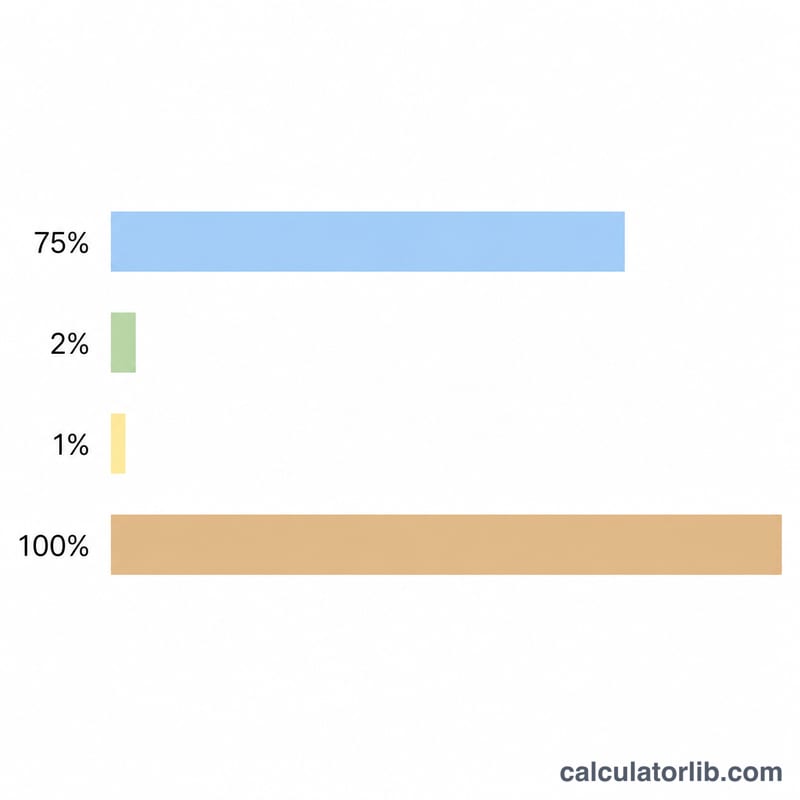
Enter the weight (in grams) of your flour, water, salt, yeast or starter, and any other ingredients. The calculator divides each weight by the flour weight and multiplies by 100. It also reports the total dough weight and the overall hydration, which is simply the water percentage — the single most important number for dough texture and crumb.
The formula explained
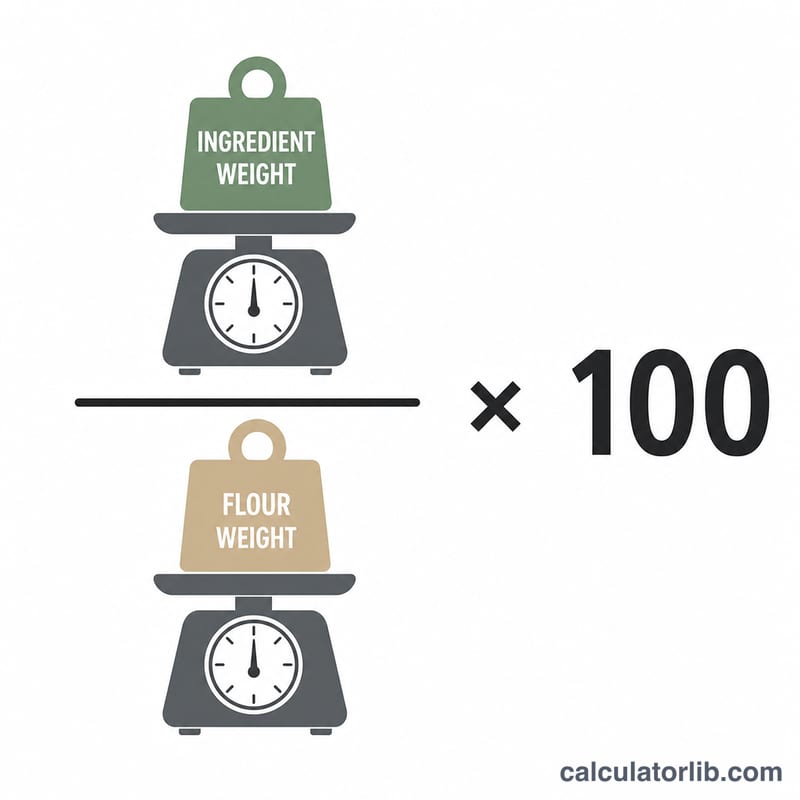
The core equation is $$\text{Ingredient \%} = \frac{\text{Ingredient weight}}{\text{Flour weight}} \times 100$$. Because flour is the reference, its percentage is always 100%. A "total formula percentage" above 100% is normal — it is the sum of all ingredients relative to flour and tells you how much dough one unit of flour produces.
Worked example
Suppose you use 500 g flour, 350 g water, 10 g salt and 5 g yeast. Water = $$350 \div 500 \times 100 = 70\%$$ hydration. Salt = \(10 \div 500 \times 100 = 2\%\). Yeast = \(5 \div 500 \times 100 = 1\%\). Total dough weight = 865 g, and the total formula percentage is \(865 \div 500 \times 100 = 173\%\).
Typical Baker's Percentages by Ingredient
In baker's percentages, every ingredient is expressed as a percentage of the total flour weight, which is always defined as 100%. This makes recipes easy to scale and compare regardless of batch size. The formula is:
$$\text{Ingredient \%} = \frac{\text{Ingredient weight}}{\text{Flour weight}} \times 100$$The ranges below cover most yeasted and naturally leavened breads.
| Ingredient | Typical Baker's % | Notes / Use Case |
|---|---|---|
| Flour | 100% (reference) | Always the baseline; all other ingredients measured against it |
| Water (hydration) | 60–85% | Lower for sandwich loaves, higher for ciabatta and rustic breads |
| Salt | 1.8–2.2% | Flavor and gluten control; ~2% is the standard target |
| Instant (dry) yeast | 0.5–1% | Use less for slow, cold ferments; more for quick rises |
| Fresh (cake) yeast | 1.5–3% | Roughly 3× the weight of instant yeast for the same activity |
| Sourdough starter | 15–30% | Replaces commercial yeast; also adds flour and water to the mix |
| Fats (oil, butter) | 3–10% | Softens crumb and extends shelf life (enriched doughs) |
| Sugar | 0–25% (varies) | Low for lean breads, high for sweet/enriched doughs like brioche |
For example, a dough with 1000 g flour and 700 g water has a hydration of 70%.
Hydration Levels Across Bread Types
Hydration — the water weight as a percentage of flour weight — is the single biggest driver of crumb structure and how the dough feels in your hands. Higher hydration generally yields a more open, irregular crumb but stickier, harder-to-handle dough.
| Bread Type | Typical Hydration | Crumb Characteristics | Handling Difficulty |
|---|---|---|---|
| Sandwich loaf (pan bread) | 60–65% | Tight, soft, even crumb; good for slicing | Easy — firm, manageable dough |
| Baguette | 65–70% | Moderately open with crisp crust | Moderate |
| Sourdough boule | 70–78% | Open, irregular holes; chewy crumb | Moderate to challenging |
| Ciabatta | 75–85% | Very open, large holes; light and airy | Difficult — slack, sticky dough |
| Focaccia | 75–85% | Soft, airy, oil-rich crumb | Moderate — poured/pressed rather than kneaded |
A classic sandwich loaf at 500 g flour and 320 g water sits at a comfortable 64% hydration, while a ciabatta at 500 g flour with 400 g water reaches 80%.
Practical Baking Recommendations
- Anchor salt near 2% of flour. For 1000 g flour, that is about 20 g salt. Below ~1.5% bread tastes flat; above ~2.5% it slows fermentation and can taste harsh.
- Adjust water in small increments. Change hydration by 2–3% at a time and note how the dough feels. Small water differences have a large effect on handling, so make one change per bake.
- Account for flour absorption. Whole wheat, rye and high-protein bread flours absorb more water than all-purpose flour. Whole-grain doughs often need 5–10% more water to reach the same workable consistency; let the dough rest (autolyse) so the bran fully hydrates before judging.
- Scale a recipe by setting a new flour weight. Because every ingredient is a percentage of flour, pick your target flour amount, then multiply each percentage by it. At 75% hydration, 800 g flour calls for 75% hydration from 600 g water, plus 2% salt (16 g) and 1% yeast (8 g).
- Include starter flour and water in the totals. If you build dough with a sourdough starter, count the flour and water it contains toward your overall hydration for an accurate reading.
- Weigh, don't scoop. Baker's percentages only work reliably with a digital scale in grams; volume measures introduce too much variation.
These are general baking guidelines; exact percentages depend on your flour, climate and equipment, so use them as starting points and adjust to your results.
FAQ
What hydration should I aim for? Around 60–65% gives a tight crumb (sandwich loaves), 70–75% is typical for rustic and sourdough breads, and 80%+ produces an open, airy crumb that is harder to handle.
Why is flour always 100%? Flour is the baseline ingredient, so making it the reference lets you scale any recipe by simply choosing a new flour weight and keeping the percentages fixed.
Can I add multiple flours? Yes — in true baker's math the combined weight of all flours equals 100%. Sum your flours into the "Flour weight" field for an accurate hydration figure.