
What Is the CNC Spindle Speed Calculator?
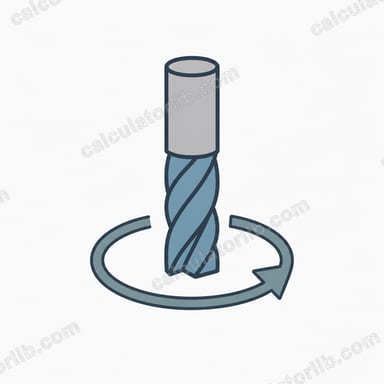
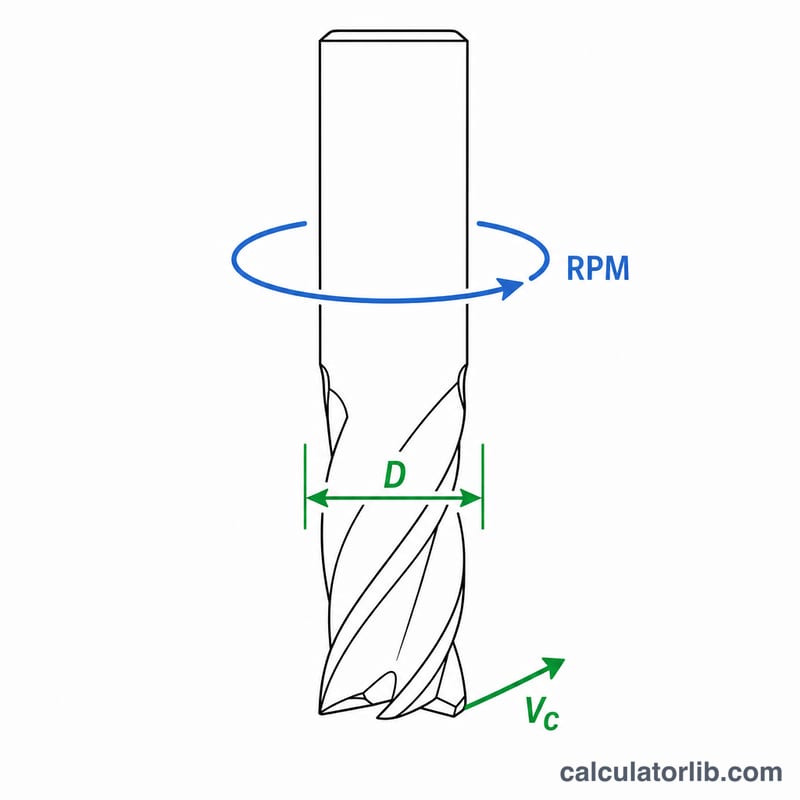
This calculator determines the correct spindle speed (RPM) for a milling, turning, or drilling operation based on the recommended cutting speed for your material and the diameter of your tool or workpiece. Choosing the right RPM is one of the most important steps in machining — it protects your tools, improves surface finish, and keeps your spindle and material from overheating.
How to Use It
Enter two values: the cutting speed in SFM (surface feet per minute, typically taken from a tooling chart for your material and tool combination) and the tool diameter in inches. The calculator instantly returns the spindle speed in RPM. For milling and drilling, the diameter is the tool diameter; for turning on a lathe, use the workpiece diameter.
The Formula Explained
The relationship is derived from converting linear surface speed into rotational speed:
$$\text{RPM} = \frac{\text{SFM} \times 12}{\pi \times D}$$
SFM is multiplied by 12 to convert feet to inches, then divided by the circumference of the tool (\(\pi \times D\) in inches). The result is how many revolutions per minute produce the desired surface cutting speed.
Worked Example
Suppose you are milling aluminum with a recommended cutting speed of 300 SFM using a 0.5-inch end mill. $$\text{RPM} = \frac{300 \times 12}{\pi \times 0.5} = \frac{3600}{1.5708} \approx 2{,}292 \text{ RPM}$$ Set your spindle to roughly 2,300 RPM and adjust based on chip load and finish.
FAQ
What is SFM? Surface feet per minute is the linear speed at which the cutting edge moves across the material. It is a material-and-tool property found in machining charts.
Why divide by π × diameter? Because \(\pi \times D\) is the circumference of the tool. Dividing the linear speed by the circumference gives the number of full rotations per minute.
Does this work for metric? This version uses inches and SFM (imperial). For metric, use \(\text{RPM} = \frac{1000 \times V_c}{\pi \times D}\) where \(V_c\) is in m/min and \(D\) in mm.