

What Is Labor Cost Percentage?
Labor cost percentage measures how much of your total sales is consumed by labor expenses — wages, salaries, payroll taxes, and benefits. It is one of the most important operating metrics for restaurants, retail stores, and service businesses, where labor is often the single largest controllable cost. Tracking this ratio over time helps you spot overstaffing, scheduling problems, or pricing issues before they erode your margins.
How to Use This Calculator
Enter your total labor cost for the period (the sum of all wages, payroll taxes, and benefits) and your total sales or revenue for the same period. The calculator instantly returns your labor cost percentage along with the remaining non-labor amount. Use matching time frames — for example, a single week, month, or quarter — for an accurate ratio.
The Formula Explained
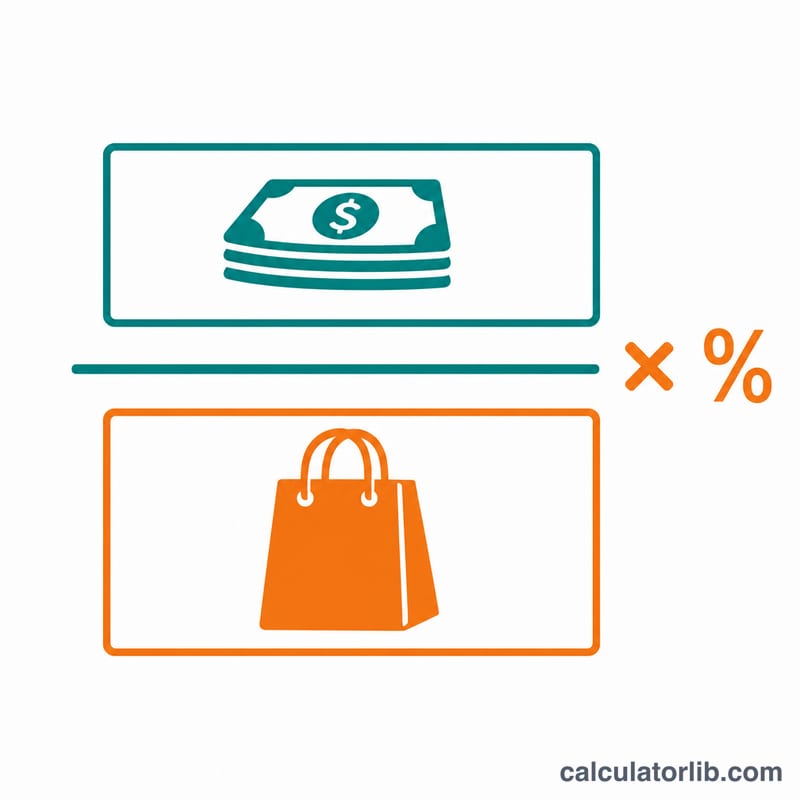
The calculation is simple division turned into a percentage:
$$\text{Labor \%} = \frac{\text{Total Labor Cost}}{\text{Total Sales}} \times 100$$
A lower percentage means more of your revenue stays in the business. Many restaurants target 25–35%, while quick-service and retail operations often aim lower.
Worked Example
Suppose a café pays $15,000 in total labor for a month and brings in $50,000 in sales. The labor cost percentage is $$15{,}000 \div 50{,}000 \times 100 = 30\%$$ That means 30 cents of every sales dollar goes toward labor, leaving $35,000 for food, rent, utilities, and profit.
FAQ
What is a good labor cost percentage? It varies by industry. Full-service restaurants typically run 30–35%, fast food around 25%, and retail often under 20%. Compare against benchmarks for your specific sector.
Should I include payroll taxes and benefits? Yes. For a true picture, total labor cost should include gross wages plus employer payroll taxes, insurance, and benefits — not just take-home pay.
How can I lower my labor percentage? Improve scheduling to match staffing with demand, increase sales per labor hour, reduce overtime, and review pricing. Even small efficiency gains compound over a year.