
What this calculator does
The Weekday Count in Date Range Calculator tells you how many Mondays, Tuesdays, Wednesdays, Thursdays, Fridays, Saturdays and Sundays fall between two dates, counting both endpoints (inclusive). It also reports the total number of days in the period. This is handy for shift planning, payroll, counting working days, or simply answering "how many Fridays are there this year?"
How to use it
Pick a start date and an end date using the year, month and day fields. Leave the calendar set to "Western (CE/Gregorian)" for ordinary dates. An optional Japanese-era mode (Meiji, Taisho, Showa, Heisei, Reiwa) is offered as a convenience: when chosen, the year you enter is treated as the era-year and converted to its Gregorian equivalent before any math is done. The underlying date arithmetic is universal and not specific to any country.
The formula
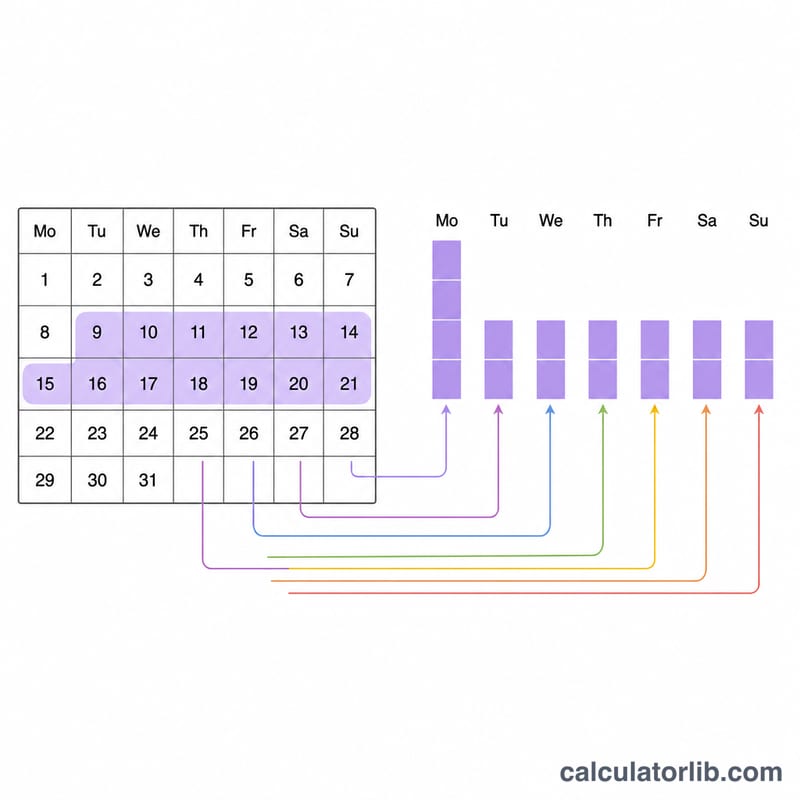
Each date is converted to a day serial number. The inclusive day count is \(\text{totalDays} = \text{endSerial} - \text{startSerial} + 1\). Since a week has seven days, every weekday occurs at least \(\text{baseline} = \text{totalDays} \mathbin{\text{div}} 7\) times. The leftover \(\text{remainder} = \text{totalDays} \bmod 7\) days are the extra occurrences; they are assigned consecutively starting from the start date's weekday. The weekday of any Gregorian date is found with Sakamoto's algorithm.
$$\begin{gathered} \text{Count}(w) = \left\lfloor \frac{N}{7} \right\rfloor + \bigl[\,(w - w_0) \bmod 7 < (N \bmod 7)\,\bigr] \\[1.5em] \text{where}\quad \left\{ \begin{aligned} N &= (\text{Serial}_{\text{end}} - \text{Serial}_{\text{start}}) + 1 \\ \text{start} &= \text{Start Yr}/\text{Mo}/\text{Day} \\ \text{end} &= \text{End Yr}/\text{Mo}/\text{Day} \\ w_0 &= \text{weekday of start date} \end{aligned} \right. \end{gathered}$$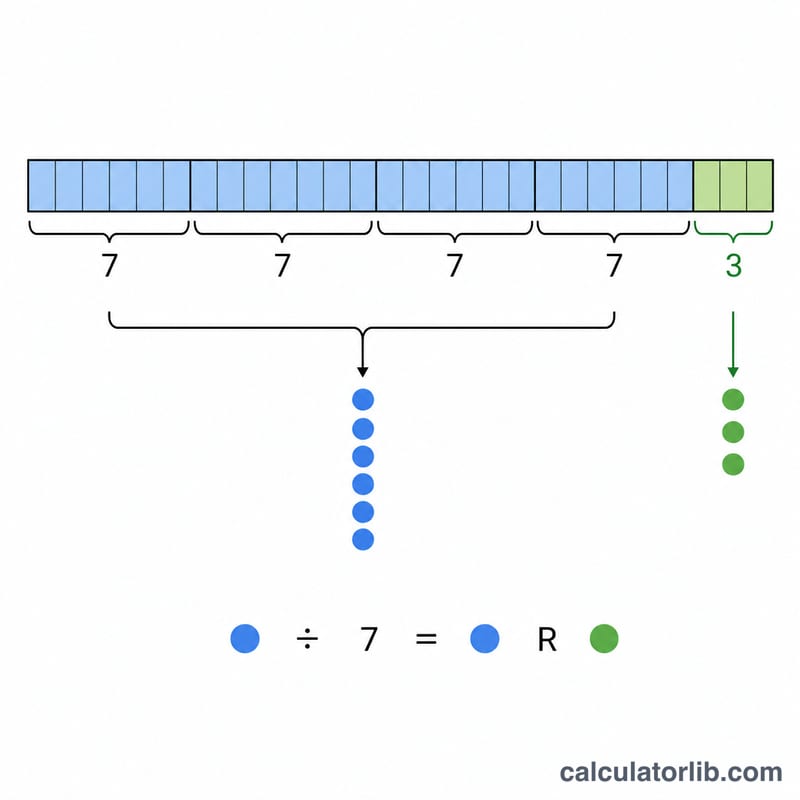
Worked example
From 2024-01-01 (a Monday) to 2024-12-31 (a Tuesday): 2024 is a leap year, so \(\text{totalDays} = 366\).
$$\text{baseline} = 366 \div 7 = 52, \quad \text{remainder} = 366 \bmod 7 = 2$$Starting at Monday, the first two weekdays (Monday and Tuesday) each get \(+1\). Result: 53 Mondays, 53 Tuesdays, and 52 of every other weekday — which sum to 366.
FAQ
Is the count inclusive? Yes — both the start and end dates are included. A single day (start = end) gives a total of 1.
What if the start date is after the end date? The dates are swapped automatically so the total is always positive.
Which calendar is used? The proleptic Gregorian calendar throughout. For modern dates this matches the everyday civil calendar exactly; very old dates before 1582 may differ from historical Julian records.