
What Is the Latus Rectum?
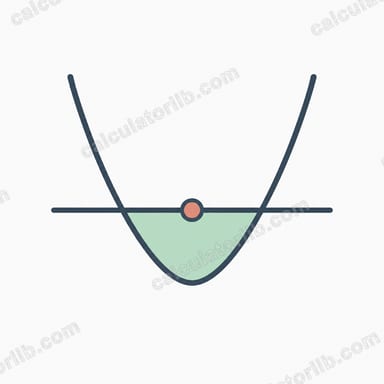
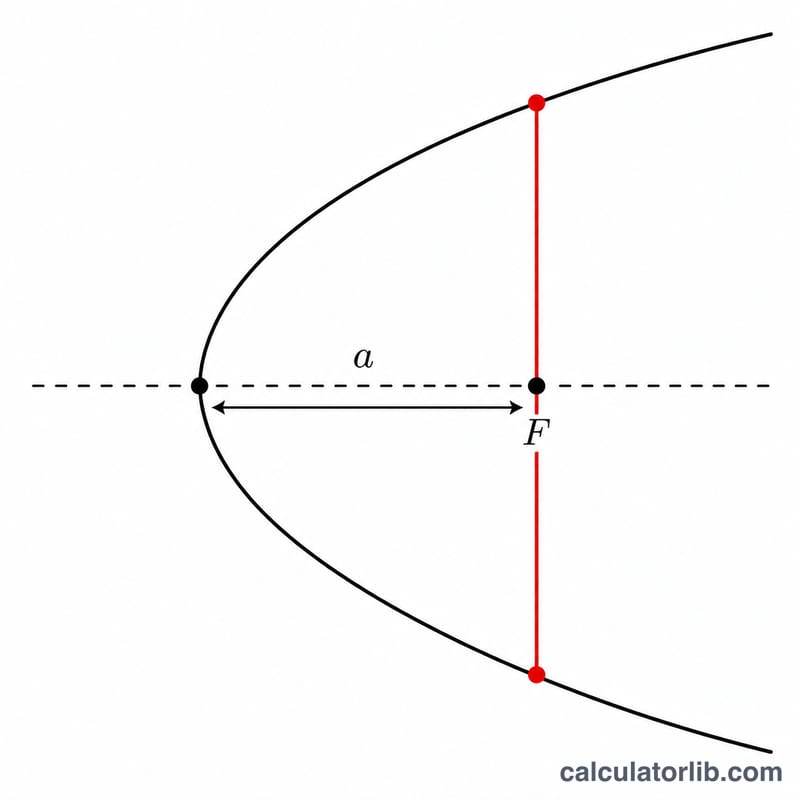
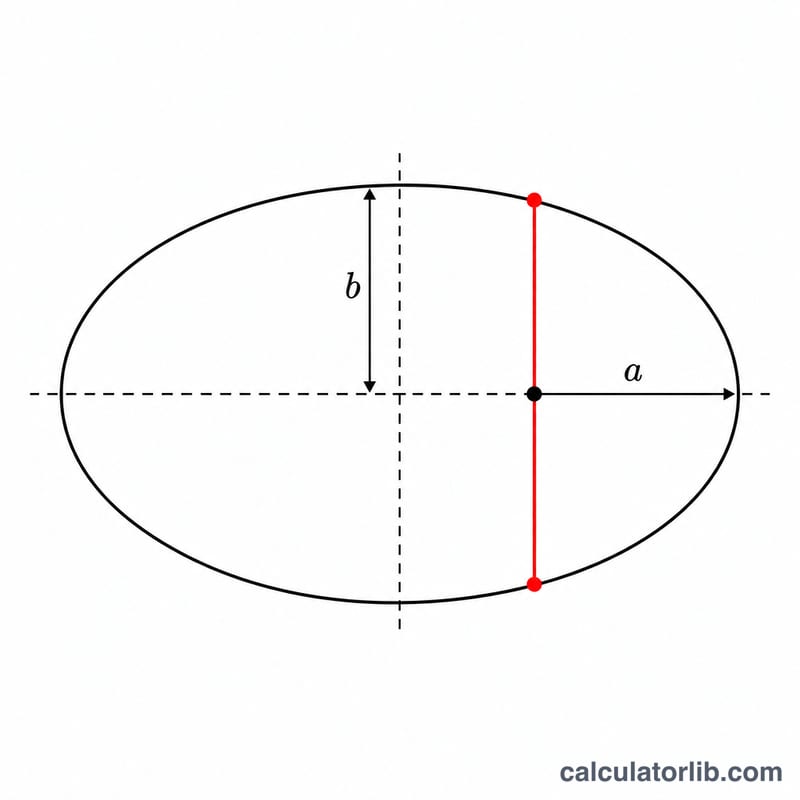
The latus rectum of a conic section is the chord that passes through a focus and is perpendicular to the major (or principal) axis. Its length characterizes how "wide" the conic opens near the focus and appears throughout the study of parabolas, ellipses, and hyperbolas. This calculator returns both the full latus rectum and the semi-latus rectum (half its length).
How to Use This Calculator
Choose the conic type. For a parabola, enter a — the distance from the vertex to the focus (the parabola is written as \(y^2 = 4ax\)). For an ellipse or hyperbola, enter the semi-major/transverse axis a and the semi-minor/conjugate axis b. Press calculate to see the length.
The Formula Explained
For a parabola the latus rectum equals \(4a\):
$$L = 4 \, \text{a}$$For an ellipse (\(x^2/a^2 + y^2/b^2 = 1\)) and a hyperbola (\(x^2/a^2 - y^2/b^2 = 1\)), the latus rectum equals \(2b^2/a\):
$$L = \dfrac{2 \, \text{b}^{2}}{\text{a}}$$The semi-latus rectum, often denoted \(\ell\), is simply half of this value and is the polar parameter used in orbital mechanics.
Worked Example
Take an ellipse with \(a = 5\) and \(b = 3\). Then
$$L = \frac{2 \cdot (3^2)}{5} = \frac{2 \cdot 9}{5} = \frac{18}{5} = 3.6 \text{ units},$$and the semi-latus rectum is \(1.8\) units. For a parabola with \(a = 2\),
$$L = 4 \cdot 2 = 8 \text{ units}.$$FAQ
Is the latus rectum the same for ellipse and hyperbola? The formula \(2b^2/a\) is the same; only the underlying equation sign differs.
What does a represent for a parabola? It is the focal distance from the vertex, as in \(y^2 = 4ax\).
What is the semi-latus rectum? Half the latus rectum; it is the standard parameter \(p\) in the polar equation of a conic.