What Is the Milliseconds to Seconds Calculator?
This tool converts a duration expressed in milliseconds (ms) into seconds (s). A millisecond is one thousandth of a second, so 1,000 milliseconds equals exactly 1 second. This conversion is common in programming, performance benchmarking, web analytics, audio/video timing, and physics, where timers and timestamps are frequently recorded in milliseconds.
How to Use It
Enter the time value in milliseconds in the input field and the calculator instantly returns the equivalent number of seconds. You can enter whole numbers or decimals — for example, 2,500 ms or 750.5 ms — and the result updates accordingly.
The Formula Explained
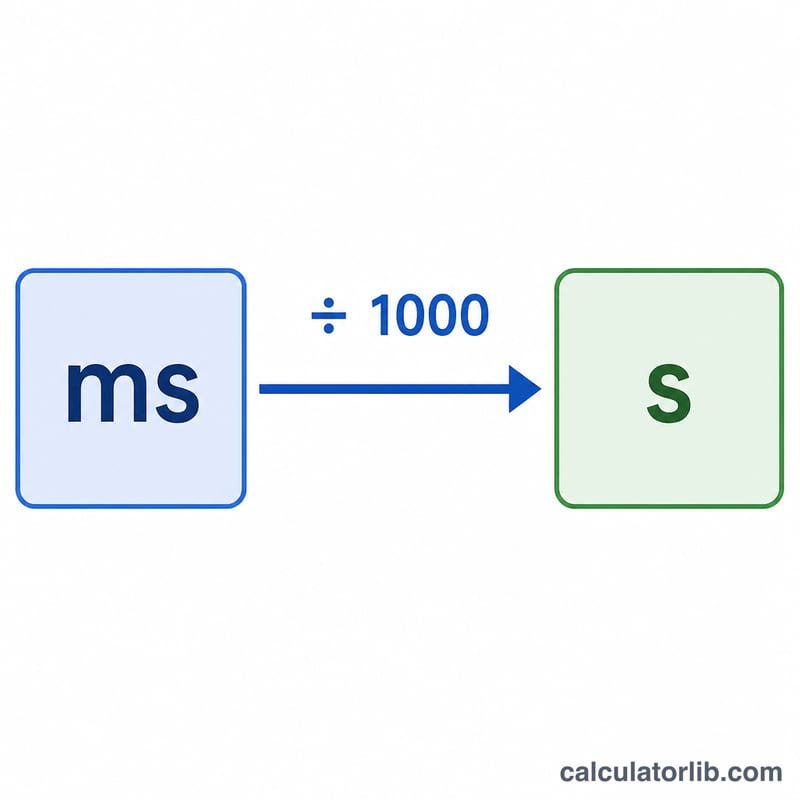
The conversion relies on a single fixed relationship between the two units:
$$\text{Seconds (s)} = \frac{\text{Milliseconds (ms)}}{1000}$$
Because there are exactly 1,000 milliseconds in one second, dividing by 1,000 scales the value down to seconds. To go the other direction, multiply seconds by 1,000.
Worked Example
Suppose a web page took 3,500 milliseconds to load. Dividing by 1,000 gives $$3500 \div 1000 = 3.5 \text{ seconds}.$$ Likewise, \(250 \text{ ms} = 250 \div 1000 = 0.25\) seconds, and \(60{,}000 \text{ ms} = 60\) seconds (one minute).
Related Time Unit Relationships
Milliseconds and seconds belong to the SI system of units, where the second (symbol s) is the base unit of time and all submultiples are defined by exact decimal prefixes: milli- (m) = 10−3, micro- (µ) = 10−6 and nano- (n) = 10−9. The conversion this calculator performs is therefore exact, not an approximation:
$$\text{Seconds (s)} = \frac{\text{Milliseconds (ms)}}{1000}$$
The multiples above the second — minute (min), hour (h) and day (d) — are not SI base units but are accepted for use with the SI, and their relationships to the second are also fixed by definition (60 s, 3 600 s and 86 400 s respectively).
| Unit (symbol) | In seconds (s) | In milliseconds (ms) | In microseconds (µs) | In nanoseconds (ns) |
|---|---|---|---|---|
| 1 nanosecond (ns) | 0.000000001 s | 0.000001 ms | 0.001 µs | 1 ns |
| 1 microsecond (µs) | 0.000001 s | 0.001 ms | 1 µs | 1,000 ns |
| 1 millisecond (ms) | 0.001 s | 1 ms | 1,000 µs | 1,000,000 ns |
| 1 second (s) | 1 s | 1,000 ms | 1,000,000 µs | 1,000,000,000 ns |
| 1 minute (min) | 60 s | 60,000 ms | 60,000,000 µs | 60,000,000,000 ns |
| 1 hour (h) | 3,600 s | 3,600,000 ms | 3,600,000,000 µs | 3,600,000,000,000 ns |
| 1 day (d) | 86,400 s | 86,400,000 ms | 86,400,000,000 µs | 86,400,000,000,000 ns |
Every value in the table is exact by definition — there is no rounding and no measurement uncertainty involved. Note the correct symbols: the millisecond is ms (lower-case m, never "MS" or "mS"), the microsecond is µs (Greek mu; "us" is a common ASCII substitute), the nanosecond is ns, and the second is s (not "sec"). Minute and hour use min and h.
Worked example
Suppose a web request is logged with a duration of 2,450 ms. Dividing by 1,000 moves the decimal point three places to the left:
$$\text{Seconds} = \frac{2450\ \text{ms}}{1000} = 2.45\ \text{s}$$
So 2,450 ms equals 2.45 seconds. Going the other way, multiply by 1,000: 0.75 s = 750 ms, and 1 min 30 s = 90 s = 90,000 ms.
One practical caution: the "day = 86,400 s" relationship holds for the SI day used in calculations, but civil clock days can differ — a leap second added to UTC makes that particular day 86,401 s long, and regions that observe daylight saving time have one 23-hour and one 25-hour calendar day each year. For unit conversion of a measured duration in milliseconds, the exact factor of 1,000 always applies.
FAQ
How many milliseconds are in a second? Exactly 1,000 milliseconds make up one second.
How do I convert seconds back to milliseconds? Multiply the number of seconds by 1,000. For example, \(4 \text{ seconds} = 4{,}000 \text{ ms}\).
Can I enter decimal milliseconds? Yes. The calculator accepts decimal values such as 1,234.56 ms and returns the precise number of seconds.