
What is a diffraction grating?
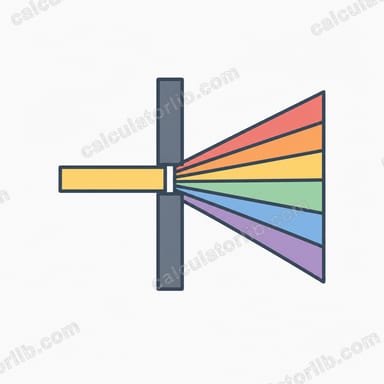
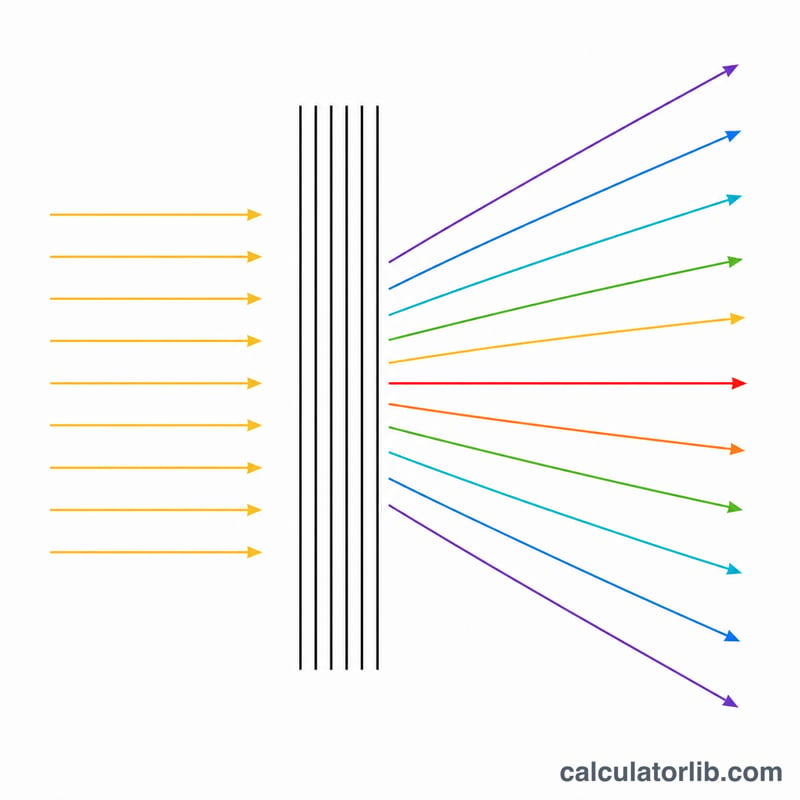
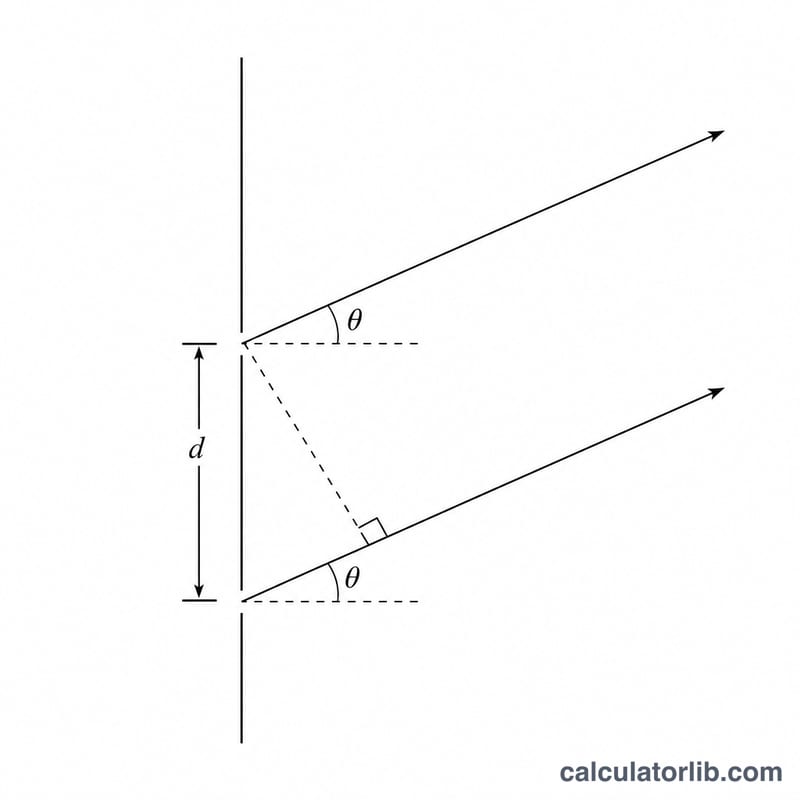
A diffraction grating is an optical component with many equally spaced parallel slits or grooves. When light passes through (or reflects off) it, the waves interfere and produce sharp bright maxima at specific angles. This calculator uses the grating equation \(d\cdot\sin\theta = m\cdot\lambda\) to find the angle θ at which a given wavelength is diffracted into a chosen order m. It works for any wavelength and grating density, so it applies universally — no country-specific rules involved.
How to use it
Enter the grating density in lines per millimetre (a common spec printed on gratings, e.g. 600 lines/mm), the wavelength of light in nanometres, and the diffraction order m (1 for the first bright fringe, 2 for the second, and so on). The calculator converts lines/mm into the slit spacing d, then computes θ. If the combination is physically impossible — when \(m\cdot\lambda/d\) exceeds 1 — it tells you no diffracted maximum exists.
The formula explained
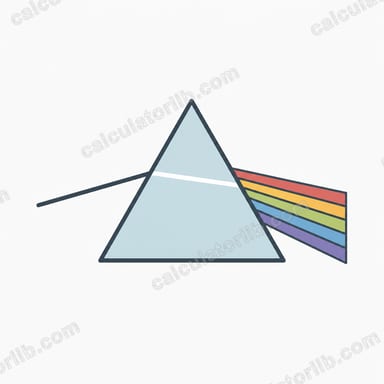
The slit spacing is \(d = 1 / (\text{lines per metre})\). The path difference between adjacent slits is \(d\cdot\sin\theta\). Constructive interference (a bright fringe) occurs when this path difference equals a whole number of wavelengths: $$d\cdot\sin\theta = m\cdot\lambda$$ Rearranging gives $$\theta = \arcsin\!\left( \frac{m\,\lambda}{d} \right)$$ Larger orders and longer wavelengths bend the light to larger angles, which is why gratings spread white light into a spectrum.
Worked example
For a 600 lines/mm grating, \(d = 1/600 \text{ mm} = 1666.67 \text{ nm}\). With green light at \(\lambda = 550\) nm in first order (\(m = 1\)): $$\sin\theta = \frac{1 \times 550}{1666.67} = 0.33$$ so \(\theta = \arcsin(0.33) \approx 19.27°\).
FAQ
What if I get "no maximum exists"? That means \(m\cdot\lambda/d > 1\), which is mathematically impossible because \(\sin\theta\) cannot exceed 1. Use a lower order or a grating with fewer lines per mm.
Why convert lines/mm to spacing? The equation needs the physical distance d between slits, which is the reciprocal of the line density.
Does this work for reflection gratings? Yes — the same equation governs both transmission and reflection gratings at normal incidence.