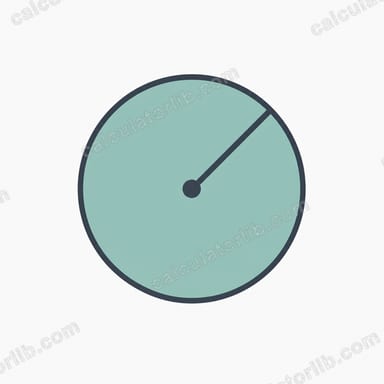

What This Calculator Does
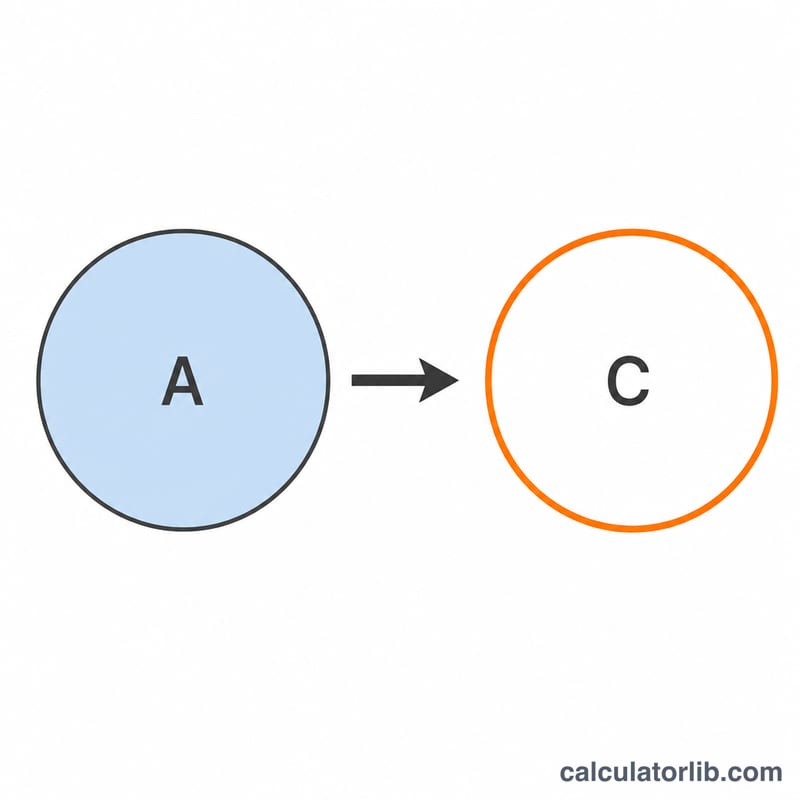
This tool computes the circumference (perimeter) of a circle when you only know its area. Normally circumference is found from the radius, but if you start with the area you can skip the manual conversion. Enter any positive area value and the calculator returns the circumference along with the matching radius and diameter.
How to Use It
Type the circle's area into the input box and submit. The area can be in any square unit (cm², m², in², ft²) — the resulting circumference will simply be in the corresponding linear unit. The calculator also displays the radius and diameter so you can verify your result.
The Formula Explained
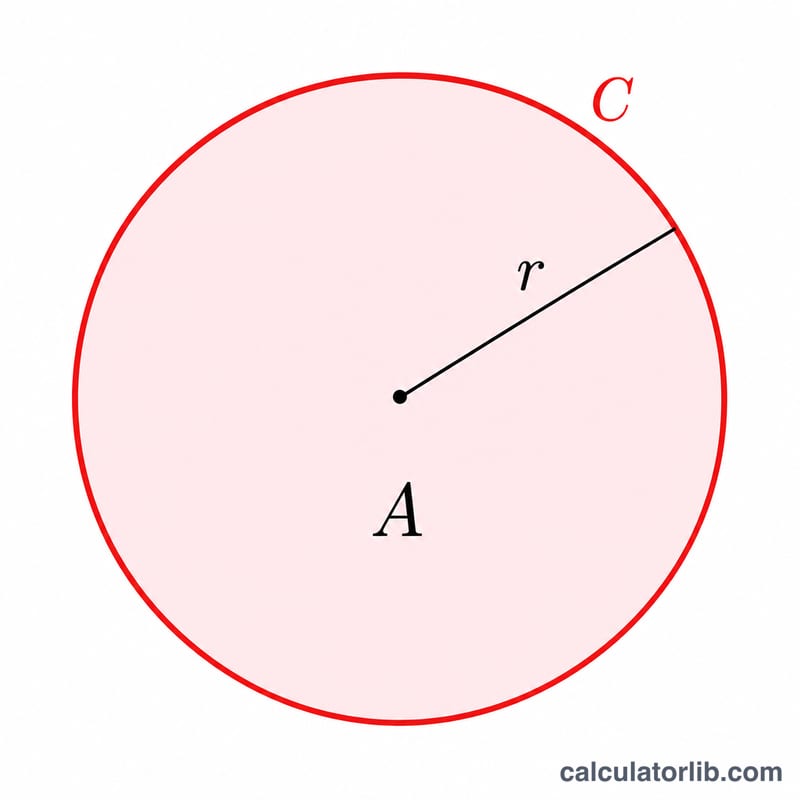
The area of a circle is \(A = \pi r^2\). Solving for the radius gives \(r = \sqrt{A/\pi}\). The circumference is \(C = 2\pi r\). Substituting the radius expression yields the compact direct formula:
$$C = 2\sqrt{\pi \cdot \text{Area }(A)}$$
This combines both steps so you never need to compute the radius separately.
Worked Example
Suppose a circle has an area of 50 square meters. First, \(\pi \times 50 = 157.0796\). The square root of that is \(12.5331\). Multiply by 2: \(C \approx 25.07\) meters. The radius is \(\sqrt{50/\pi} = \sqrt{15.9155} \approx 3.99\) m, and the diameter is about 7.98 m.
FAQ
Can I use this for any unit? Yes. The area unit must be the square of the length unit (e.g. m² gives m). The math is unit-agnostic.
Why is it called perimeter and circumference? For a circle, the perimeter is specifically called the circumference — they mean the same boundary length.
What if I enter zero or a negative number? Area must be positive. A zero or negative value returns a circumference of zero since no real circle exists.