
What This Calculator Does
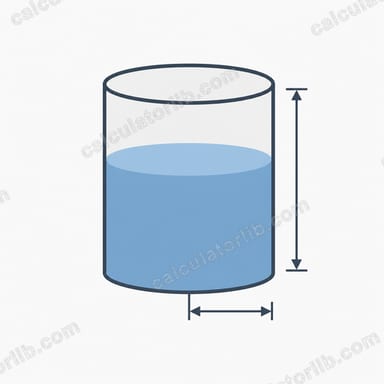
The Vertical Cylindrical Tank Volume Calculator works out how much liquid a standing (upright) cylindrical tank holds in total and how much it currently contains at a given liquid level. It's ideal for water tanks, fuel and oil drums, brewing and fermentation vessels, chemical storage, and rainwater harvesting. Results are shown in cubic metres and litres, plus the fill percentage and remaining headspace.
How to Use It
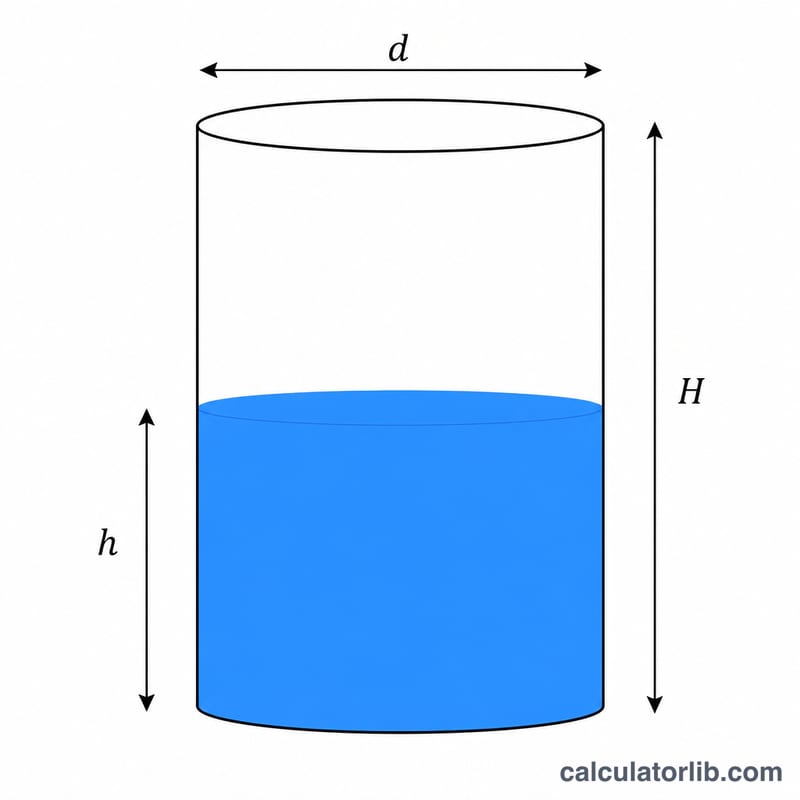
Enter three measurements in the same length unit (metres are assumed here): the tank's internal diameter, its total height, and the current liquid level measured from the bottom. Press calculate to see the filled volume, the total capacity, and how full the tank is. If you enter a level larger than the height, it is capped at the tank height; negative values are treated as empty.
The Formula Explained
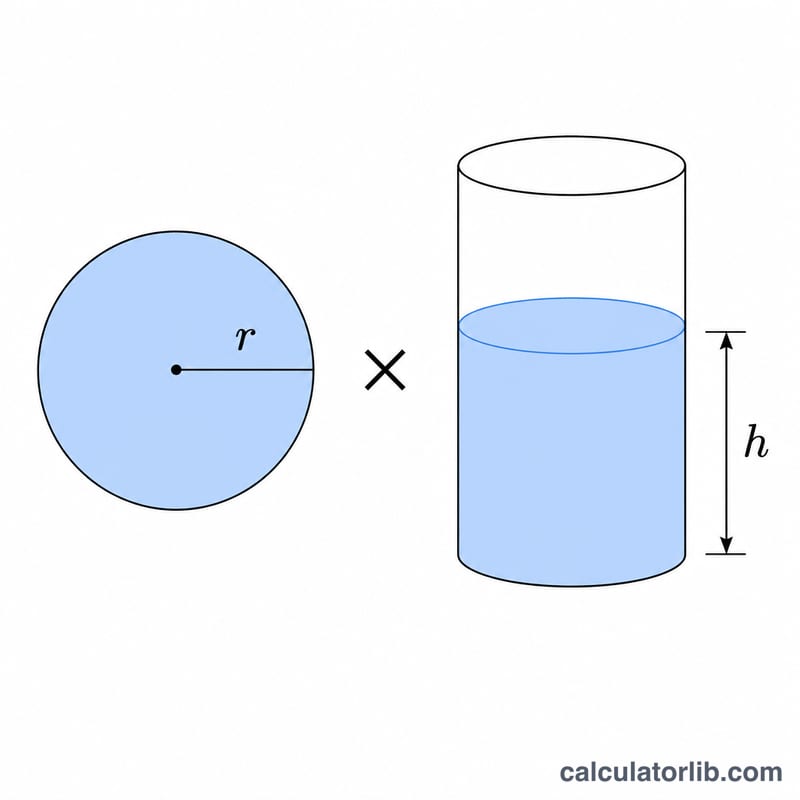
A vertical cylinder has a circular cross-section, so its volume is the area of that circle multiplied by height. The radius is half the diameter, \(r = D/2\). Total capacity is $$V = \pi \cdot r^{2} \cdot H$$, and the filled volume at liquid level \(h\) is $$V = \pi \cdot r^{2} \cdot h$$. Because the cross-section is constant, the fill percentage equals the level divided by total height: \(h/H \times 100\). One cubic metre equals 1,000 litres.
Worked Example
Suppose a tank has a diameter of 2 m, a height of 3 m, and a liquid level of 1.5 m. The radius is 1 m. Total volume $$= \pi \times 1^{2} \times 3 \approx 9.4248 \text{ m}^{3} \ (\approx 9{,}424.8 \text{ L}).$$ Filled volume $$= \pi \times 1^{2} \times 1.5 \approx 4.7124 \text{ m}^{3} \ (\approx 4{,}712.4 \text{ L}).$$ The tank is 50% full, leaving about 4.7124 m³ of headspace.
FAQ
Does this work for horizontal tanks? No. A horizontal cylinder partially filled needs a circular-segment formula. This tool assumes the cylinder stands upright so the liquid surface is a full circle.
Can I use feet or inches? Yes—just enter all three values in the same unit. The volume will then be in cubic feet (or cubic inches), and the litre conversion will not apply.
Should I use internal or external diameter? Use the internal (inside) diameter for an accurate liquid volume, since wall thickness reduces actual capacity.