
What is the Horizontal Cylindrical Tank Volume Calculator?
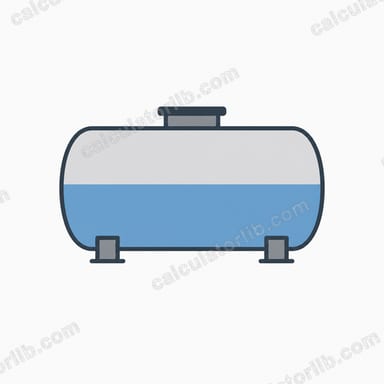
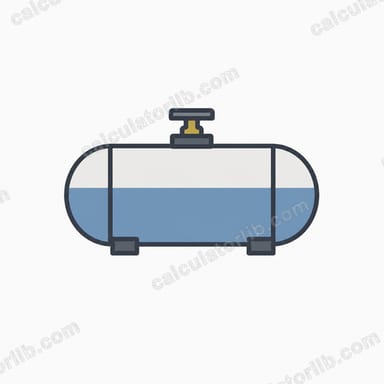
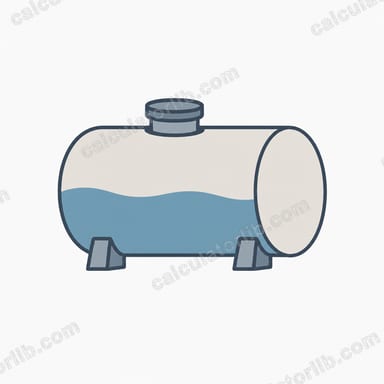
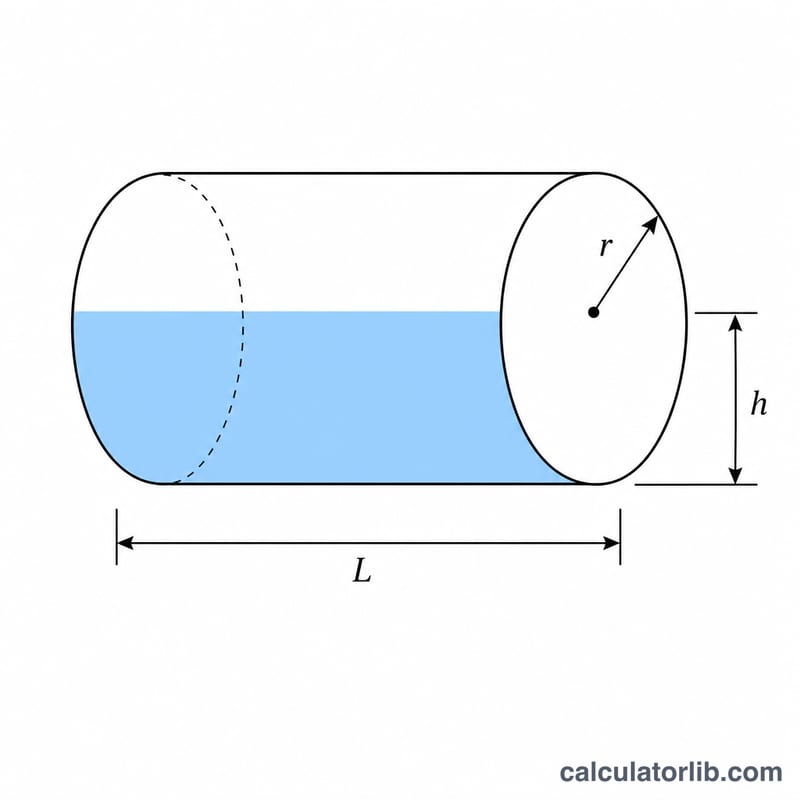
This tool calculates how much liquid is inside a horizontal cylindrical tank — the common shape of fuel tanks, water cisterns, propane tanks and chemical storage drums lying on their side. Because the tank lies horizontally, the liquid surface forms a flat chord across the circular cross-section, so the filled area is a circular segment. The volume is that segment area multiplied by the tank length.
How to use it
Enter the tank diameter, the tank length (the long horizontal dimension), and the liquid height measured vertically from the bottom of the tank. Pick a length unit. The calculator returns the partial-fill volume in cubic units, the percentage full, the full-tank capacity, and converts the result to liters and US gallons. To get the full tank capacity, set the liquid height equal to the diameter.
The formula explained
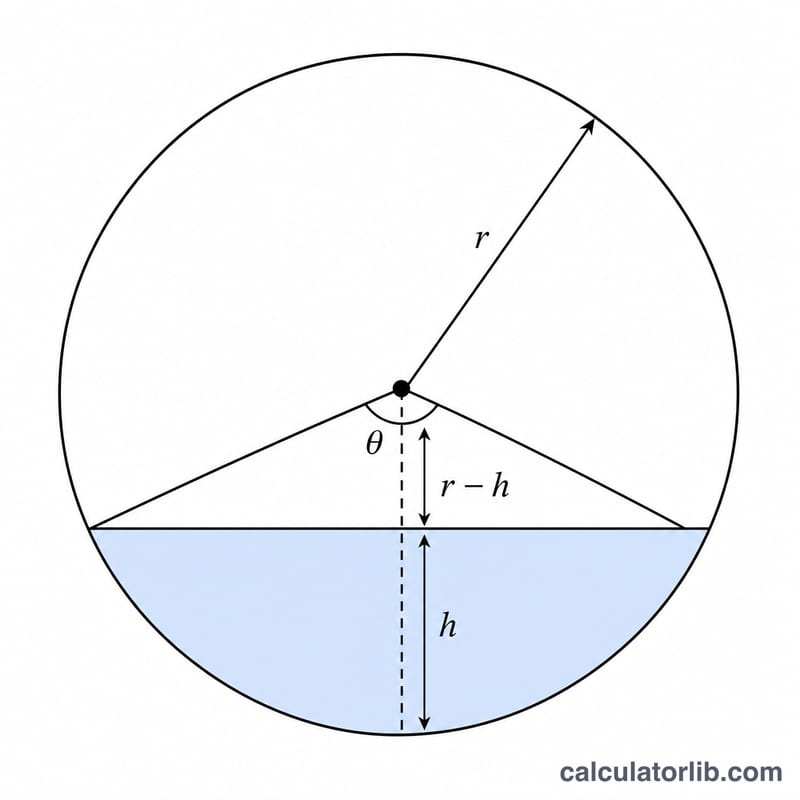
For a full tank the volume is simply \(V = \pi \cdot r^{2} \cdot L\). For a partial fill to height \(h\), the cross-sectional area of the liquid is a circular segment:
$$V = L\left[\,r^{2}\cos^{-1}\!\left(\frac{r-h}{r}\right) - (r-h)\sqrt{2rh-h^{2}}\,\right]$$where r is the radius (diameter \(\div\) 2). When \(h = r\) (half full) the inverse cosine equals \(\pi/2\) and the volume is exactly half the full tank, as expected.
Worked example
Diameter = 2 m so \(r = 1\) m, length \(L = 5\) m, liquid height \(h = 1\) m (exactly half full). Since \(h = r\), the formula gives $$V = 5\cdot\left(1^{2}\cdot\cos^{-1}(0) - 0\cdot\sqrt{(\ldots)}\right) = 5\cdot(1\cdot 1.5708) = 7.854 \text{ m}^{3}.$$ The full tank holds \(\pi \cdot 1^{2} \cdot 5 = 15.708\) m³, so we are at 50% — correct for a half-full tank. That's 7,854 liters or about 2,074 US gallons.
FAQ
What units should I use? Use any consistent length unit for diameter, length and height; the calculator converts the volume to liters and gallons automatically.
What if the height exceeds the diameter? The height is capped at the diameter, returning the full-tank volume.
Does this work for vertical tanks? No — a vertical cylinder uses \(V = \pi \cdot r^{2} \cdot h\). This tool is specifically for tanks lying on their side.