
What This Calculator Does
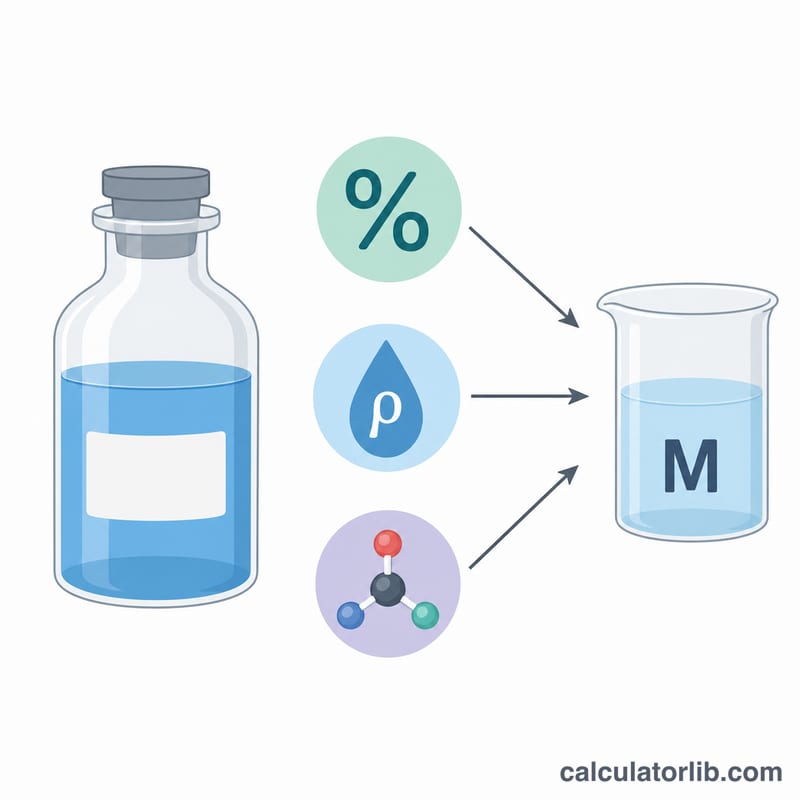
Reagent bottles of acids and bases — like concentrated hydrochloric acid or sulfuric acid — list their strength as a mass percent (% w/w) and a density on the label, not as a molarity. This calculator converts those two label values plus the compound molar mass into a usable molar concentration (mol/L), so you can plan dilutions accurately.
How to Use It
Enter three values: the mass percent printed on the bottle (for example 37 for 37% HCl), the density in grams per milliliter, and the molar mass of the solute in grams per mole. Press calculate to get the molarity in mol/L.
The Formula Explained
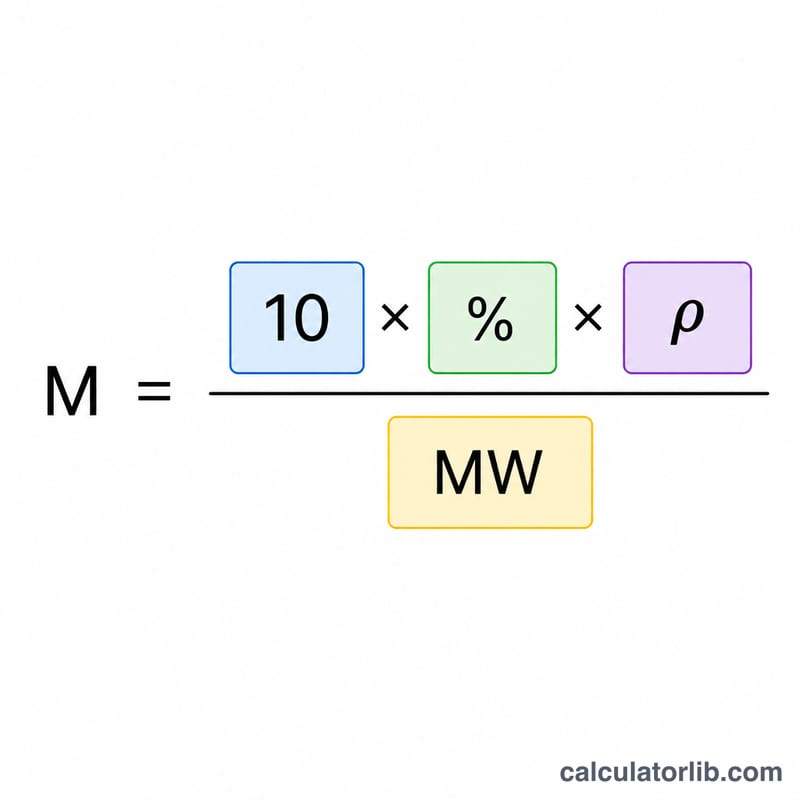
The working equation is $$M = \frac{10 \times \text{\%w/w} \times \text{density}}{\text{MW}}$$ Density in g/mL multiplied by 1000 gives the mass of one liter of solution in grams; multiplying by the mass fraction (%w/w ÷ 100) gives the grams of solute per liter; dividing by molar mass converts grams to moles. The 1000 ÷ 100 simplifies to the factor of 10, leaving the compact form above.
Worked Example
Concentrated hydrochloric acid is 37% w/w with a density of 1.19 g/mL, and HCl has a molar mass of 36.46 g/mol. $$M = \frac{10 \times 37 \times 1.19}{36.46} = \frac{440.3}{36.46} \approx 12.08 \text{ mol/L}$$ This matches the familiar ~12 M value for concentrated HCl.
FAQ
Why is there a factor of 10? It combines the 1000 mL-per-liter conversion with the division by 100 to turn a percentage into a fraction (1000 ÷ 100 = 10).
What units must I use? Density in g/mL, percent as a plain number out of 100, and molar mass in g/mol. The result comes out in mol/L.
Does this work for any solute? Yes — it works for any single-component solution where you know the mass percent, density, and molar mass, such as sulfuric acid, ammonia, or nitric acid.