
What is a Tax-Inclusive Price Breakdown?
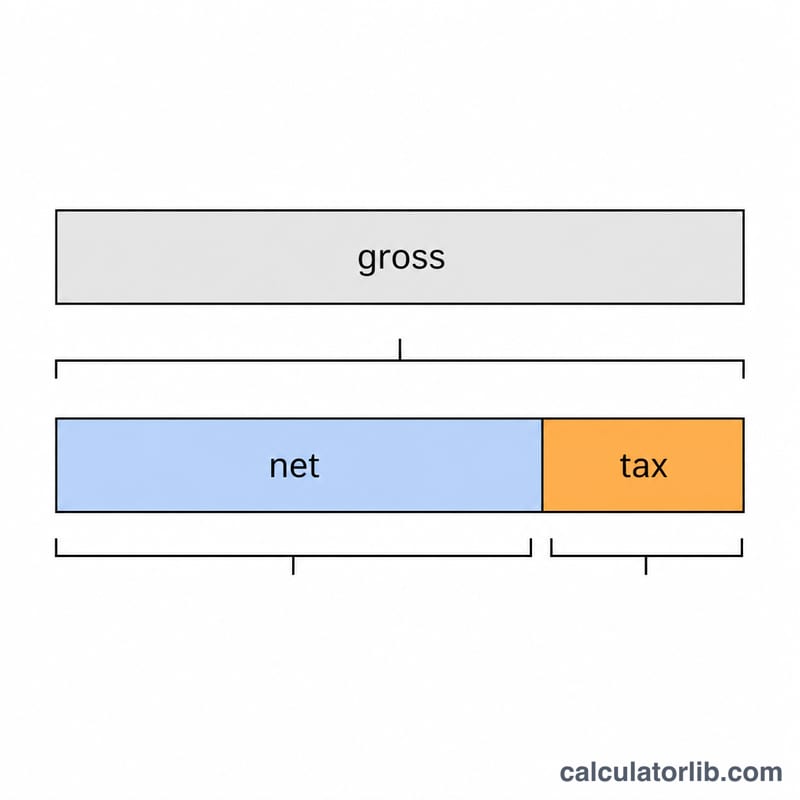
When a displayed price already includes sales tax (or VAT/GST), the figure you see at checkout is the gross price. A tax-inclusive breakdown reverses this: it separates the gross price into the net amount (the value before tax) and the tax portion. This is essential for bookkeeping, invoicing, expense reports, and reclaiming input tax.
How to Use It
Enter the gross price exactly as charged (the all-in amount) and the applicable tax rate as a percentage. The calculator instantly shows the net pre-tax price and the tax amount baked into the total. It works for any percentage-based consumption tax, such as US sales tax, EU VAT, or GST.
The Formula Explained
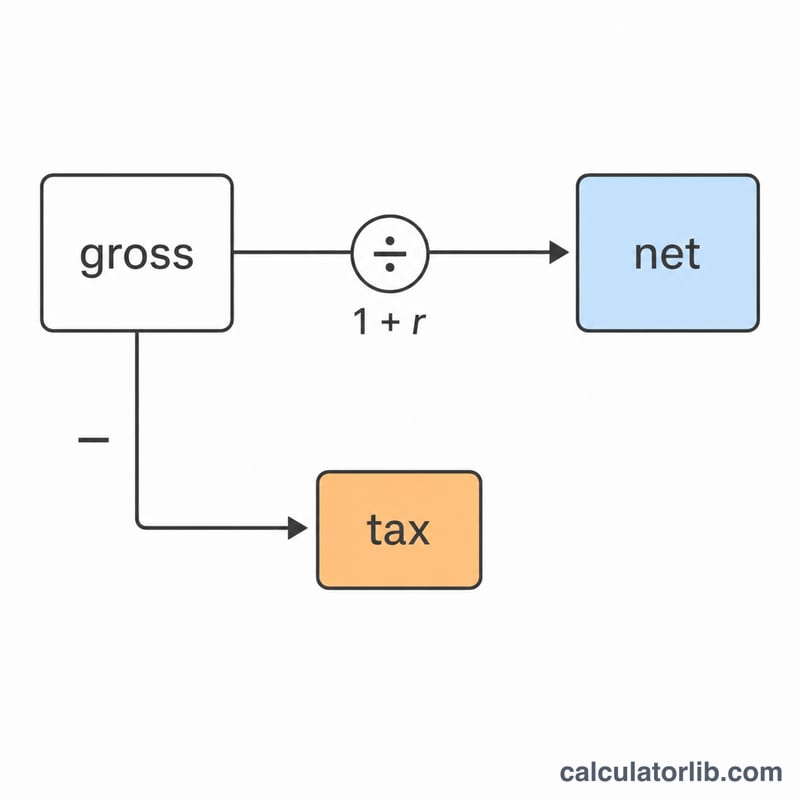
Because tax is added on top of the net price, the gross equals net multiplied by (1 + rate/100). To go backwards we divide instead of subtract:
$$\text{net} = \frac{\text{gross}}{1 + \dfrac{\text{rate}}{100}}$$ and \(\text{tax} = \text{gross} - \text{net}\). A common mistake is to simply take rate% of the gross — that overstates the tax, because the rate applies to the net, not the gross.
Worked Example
Suppose an item costs 108.00 with tax included at an 8% rate. The net price is $$108 / (1 + 0.08) = 108 / 1.08 = 100.00$$ The tax is \(108 - 100 = 8.00\). Notice that 8% of the net (100) is exactly 8, confirming the breakdown.
FAQ
Why not just take 8% of the gross? That gives 8.64, which is wrong — the tax is calculated on the net price, so you must divide the gross by 1.08 first.
Does this work for VAT and GST? Yes. The math is identical for any single-rate, percentage-based tax that is added to a net price.
What if the rate is 0%? The net equals the gross and the tax is zero — the formula handles this safely.