
What Is the Weighted Average Cost Method?
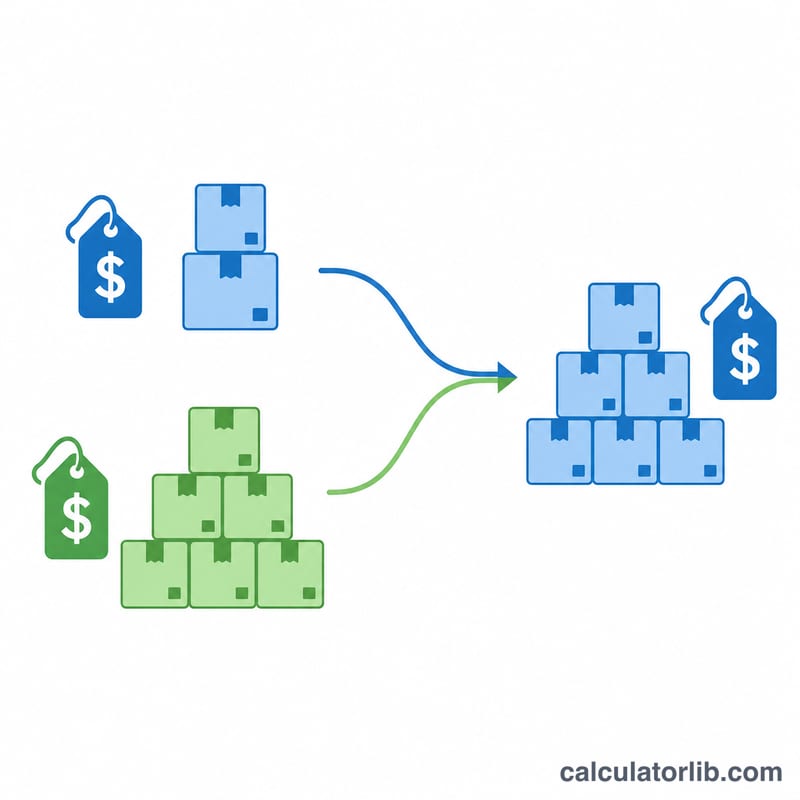
The weighted average cost (WAC) method is an inventory valuation technique that assigns a single average cost to every unit available for sale during a period. Instead of tracking each item's exact purchase price (like FIFO or LIFO), WAC blends the cost of beginning inventory with the cost of new purchases. It is widely used in accounting and is permitted under both GAAP and IFRS, especially for businesses dealing in large quantities of identical, interchangeable goods.
How to Use This Calculator
Enter the units and total cost of your beginning inventory, then enter the units and total cost of purchases made during the period. The calculator adds everything together and divides total cost by total units to give you the weighted average cost per unit. Use that figure to value ending inventory and to calculate cost of goods sold (COGS).
The Formula Explained
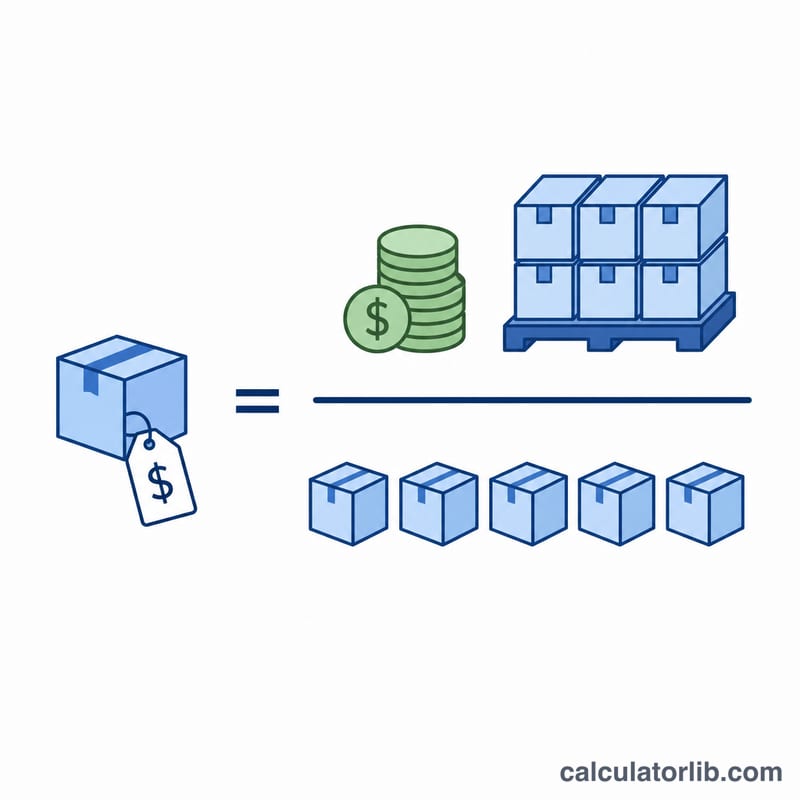
The formula is simply $$\text{WAC} = \frac{\text{Total Cost of Goods Available}}{\text{Total Units Available}}$$ "Goods available" means everything on hand: opening stock plus everything bought during the period. By dividing total dollars by total units, you smooth out price fluctuations across all units, removing the need to know which specific batch a sold item came from.
Worked Example
Suppose you start the month with 100 units that cost $500 in total, then buy 300 more units for $1,800. Total units available \(= 100 + 300 = 400\). Total cost \(= \$500 + \$1{,}800 = \$2{,}300\). $$\text{WAC} = \$2{,}300 \div 400 = \mathbf{\$5.75 \text{ per unit}}$$ If you then sell 250 units, \(\text{COGS} = 250 \times \$5.75 = \$1{,}437.50\), and ending inventory \(= 150 \times \$5.75 = \$862.50\).
FAQ
Is WAC the same as average price? Not exactly. It is weighted by quantity, so larger purchases influence the average more than small ones.
When should I use the weighted average method? It works best for homogeneous, interchangeable items such as raw materials, fuel, grains, or commodity products where tracking individual costs is impractical.
Does WAC change after each purchase? Under a perpetual system the average is recalculated after every purchase (moving average). Under a periodic system it is calculated once at period end, as this calculator does.