
What Is Exponential Growth Prediction?
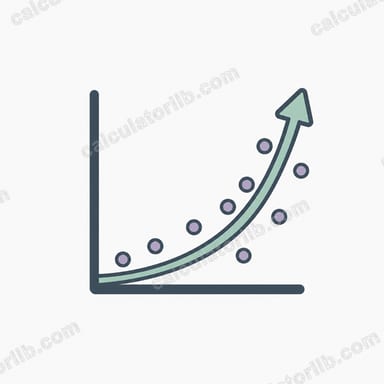
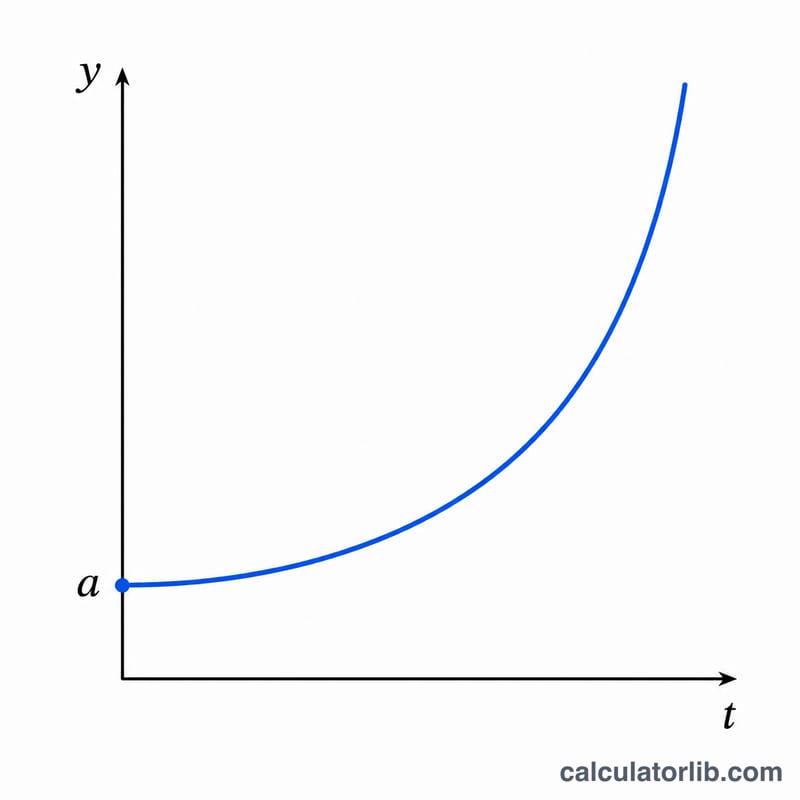
Exponential growth describes a quantity that increases by a constant percentage each period, so the absolute increase gets larger over time. This calculator applies the standard formula \(y(t) = a(1 + r)^t\) to forecast the future value of anything that compounds — investments, populations, user bases, bacteria, or sales — given a starting amount, a per-period growth rate, and the number of periods.
How to Use the Calculator
Enter three values: the initial value (a) — what you start with; the growth rate per period (%) — for example 5 for 5% growth each period; and the number of periods (t) — how many years, months, or steps to project forward. The calculator returns the predicted future value plus the total growth (future value minus initial value).
The Formula Explained
In \(y(t) = a(1 + r)^t\), the rate \(r\) is the decimal form of your percentage (5% → 0.05). The base \((1 + r)\) is the per-period multiplier, and raising it to the power \(t\) compounds the growth across all periods. If \(r\) is negative, the same formula models exponential decay.
$$y(t) = a(1 + r)^t$$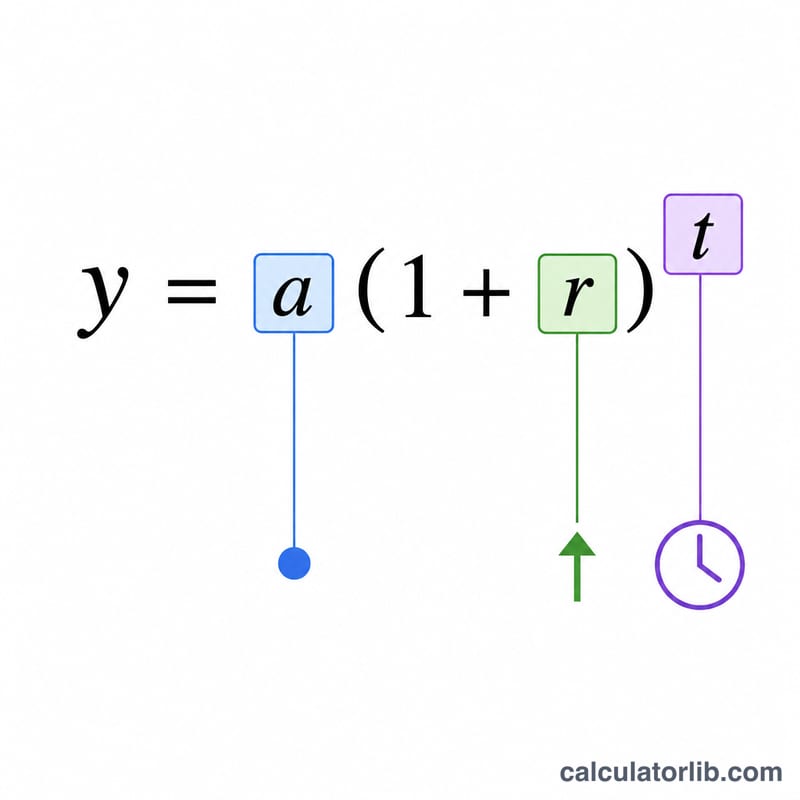
Worked Example
Suppose you invest 1,000 at 5% growth per year for 10 years. Then \(r = 0.05\) and \((1 + 0.05)^{10} \approx 1.62889\). Multiplying: $$1{,}000 \times 1.62889 \approx 1{,}628.89$$ Total growth is about 628.89.
FAQ
What if growth is negative? Enter a negative rate (e.g. -3) to model decline or decay; the formula still applies.
Can periods be fractional? Yes — you can enter values like 2.5 periods, and the calculator computes the corresponding power.
Is this the same as compound interest? Yes, when interest compounds once per period this is identical to the compound-growth formula.