
What this calculator does
Lenders quote loans in two very different ways. A flat rate charges interest on the entire original loan amount for the whole term, regardless of how much you have already repaid. A reducing-balance rate (used for most mortgages and standard EMI loans) charges interest only on the outstanding balance, which shrinks with every payment. Because of this, a flat rate of, say, 10% costs you far more than a reducing rate of 10%. This calculator shows both side by side and estimates the effective true rate hidden inside a flat-rate quote.
How to use it
Enter the loan amount (principal), the quoted flat interest rate per year, and the loan term in years. The calculator computes the total flat interest, the equivalent reducing-balance EMI at the same nominal rate, and an approximate effective rate so you can compare apples to apples.
The formula explained
Flat interest is simply \(I = P \times r \times t\). The total repayment is the principal plus that interest, split evenly across the months. For reducing balance, the monthly installment uses the standard amortization formula $$\text{EMI} = \frac{P \cdot i (1+i)^n}{(1+i)^n - 1}$$ where \(i\) is the monthly rate (annual ÷ 12) and \(n\) is the number of months. The effective rate approximates the reducing-balance rate that would cost the same as the quoted flat rate.
Worked example
Borrow 100,000 at a 10% flat rate over 5 years. Flat interest = \(100{,}000 \times 0.10 \times 5 = 50{,}000\), so you repay 150,000 (2,500 per month). The same 10% as a reducing rate gives an EMI of about 2,125, totalling only ~127,482 — over 22,000 less. The flat loan's effective rate is roughly 18%, almost double the headline number.
Key Terms Explained
- Principal
- The original amount borrowed, before any interest is added. All interest calculations start from this figure.
- Flat interest rate
- A rate applied to the full original principal for every year of the loan, regardless of repayments made. Simple to advertise but more expensive than it appears.
- Reducing-balance (diminishing) rate
- A rate applied only to the outstanding balance, which decreases as you repay. Interest charged falls over time, so the same nominal rate costs much less than a flat rate.
- EMI (Equated Monthly Installment)
- A fixed monthly payment covering both interest and principal on a reducing-balance loan, calculated so the loan is fully repaid by the end of the term.
- Nominal vs effective rate
- The nominal rate is the quoted annual figure. The effective rate reflects the true cost once compounding and the repayment structure are accounted for; the effective reducing-balance rate equivalent to a flat rate is typically nearly double it.
- Loan term
- The total length of the loan, expressed in years or months. Longer terms increase total interest, and they widen the flat-vs-reducing gap.
- Amortization
- The process of paying off a loan through scheduled installments, each split between interest and principal. Early payments are interest-heavy; later payments are principal-heavy.
Interpreting Your Result
The effective rate of a flat loan tells you what reducing-balance rate would produce the same total interest. Because a flat rate keeps charging on money you have already repaid, the equivalent reducing-balance rate is substantially higher — commonly in the range of 1.8 to 1.9 times the quoted flat rate for multi-year loans. So a "low" 10% flat rate can behave like an 18–19% reducing-balance rate.
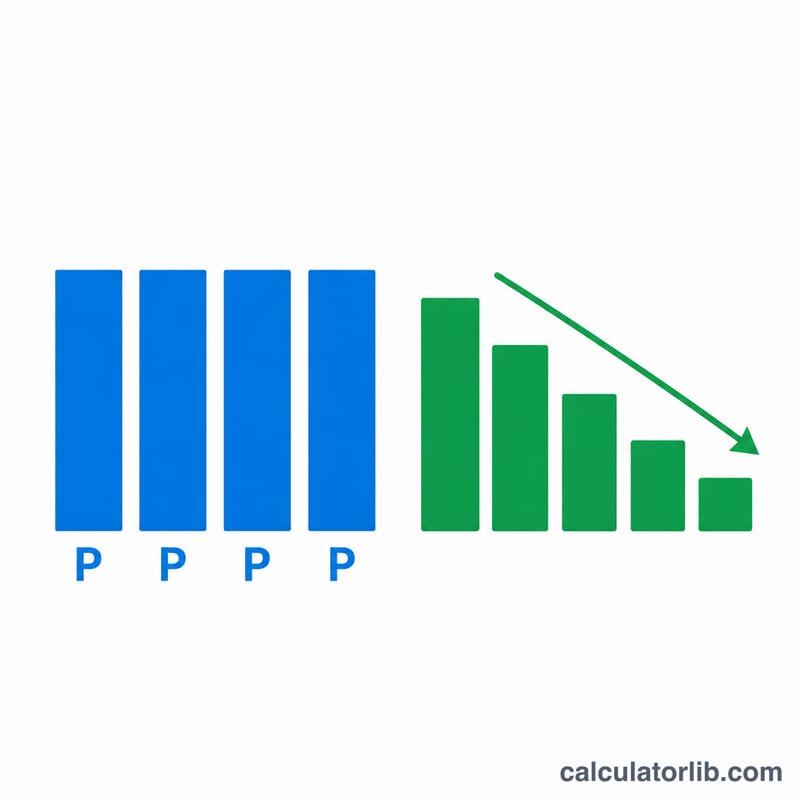
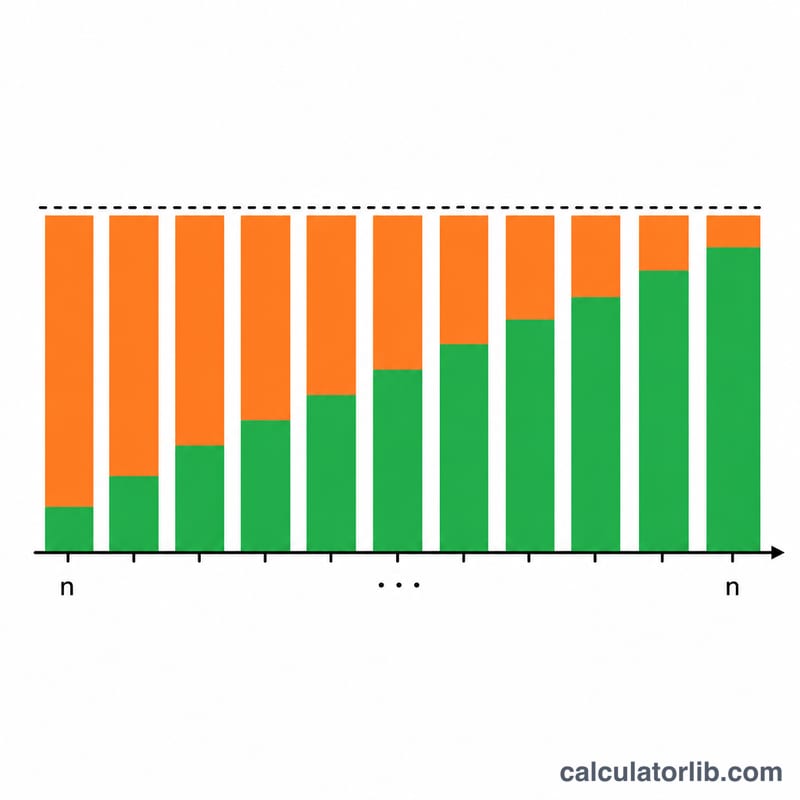
The total interest differs between the two methods for a single reason: the base the rate is applied to. Flat interest uses the constant original principal; reducing-balance interest uses the falling outstanding balance. Halfway through the term you may owe less than half the principal, yet a flat loan still charges interest as if the full amount were outstanding.
When comparing offers, convert everything to the same basis before deciding. If a lender quotes a flat rate, use the effective figure here to compare it fairly against a reducing-balance or APR quote. You can also translate a nominal rate into a true annualized rate with an effective annual rate (APY) calculator when compounding frequency matters.
The effective figure produced here is an approximation intended for comparison only. Actual costs depend on exact payment frequency, day-count conventions, fees, insurance and any rounding the lender applies, so always confirm the contractual figures. This is general educational information, not personalized financial advice — consult a qualified professional before committing to a loan.
FAQ
Why is a flat rate more expensive? You keep paying interest on money you have already repaid. With reducing balance, interest falls as the balance falls.
Is the effective rate exact? It is a close approximation intended for quick comparison; exact APR depends on fees and compounding conventions.
Which is better for me? A lower reducing-balance rate is almost always cheaper than a similar or even lower flat rate. Always convert flat quotes before comparing.