
What is the Flat vs Reducing Interest Rate Calculator?
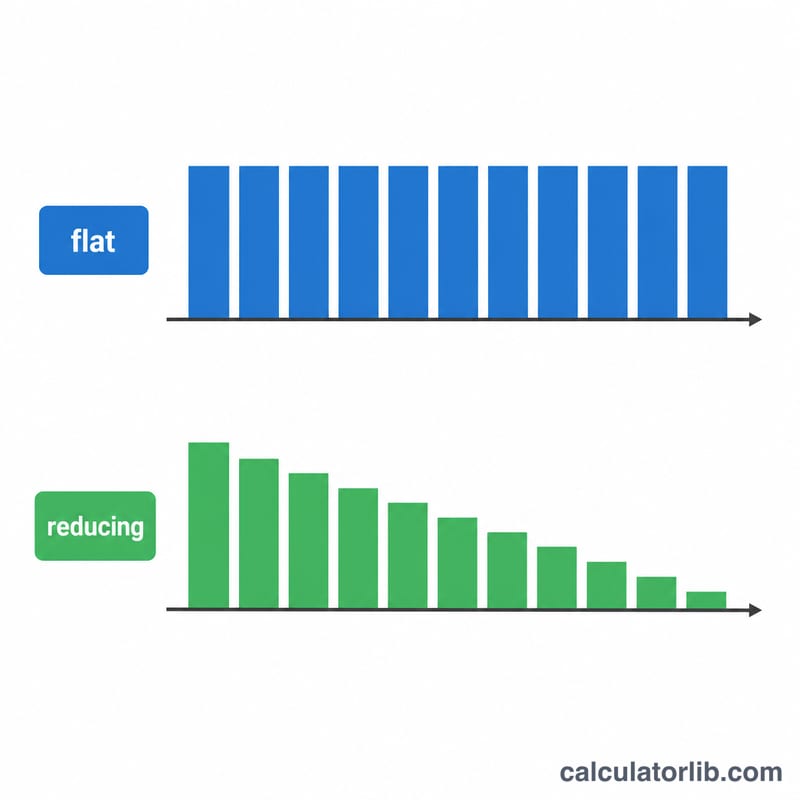
Lenders often advertise a low "flat" interest rate that sounds cheaper than it really is. With a flat rate, interest is charged on the entire original loan amount for the whole term — even though you pay the principal down every month. A reducing-balance (amortizing) rate charges interest only on the outstanding balance. This calculator converts a quoted flat rate into the equivalent effective reducing-balance rate so you can compare apples to apples.
How to use it
Enter your loan amount, the quoted flat interest rate (% per year), and the loan tenure in years. The tool computes the flat-rate EMI, then solves for the reducing-balance annual rate that would produce that exact same EMI. As a rule of thumb, a flat rate is roughly 1.7–1.9× its equivalent reducing rate for typical multi-year loans.
The formula explained
The flat EMI is simply total cost divided by the number of months: $$\text{EMI}_{\text{flat}} = \frac{P + P\cdot f\cdot Y}{n}$$, where \(P\) is principal, \(f\) the flat annual rate, \(Y\) the years, and \(n\) the number of months. The reducing EMI follows the standard amortization formula $$\text{EMI} = P\cdot \frac{r\,(1+r)^{n}}{(1+r)^{n} - 1}$$ with \(r\) the monthly rate. We use bisection to find the monthly \(r\) that makes the reducing EMI equal the flat EMI, then multiply by 12 to report the effective annual rate.
Worked example
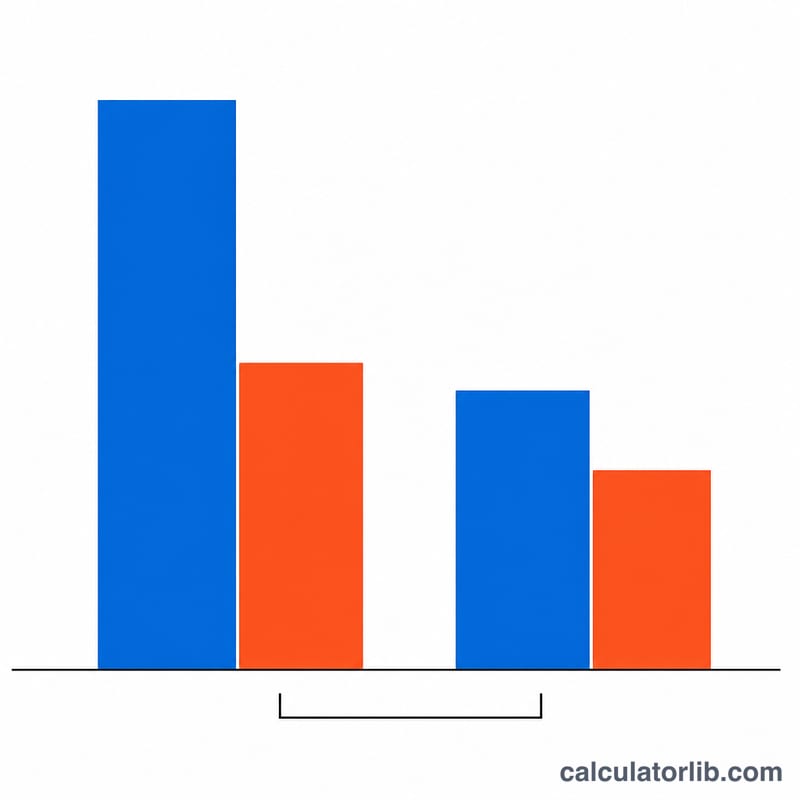
Borrow 100,000 at a 10% flat rate over 5 years (60 months). Total interest \(= 100{,}000 \times 0.10 \times 5 = 50{,}000\), so total payment \(= 150{,}000\) and EMI \(= 2{,}500\). The effective reducing-balance rate that yields a 2,500 EMI is about 17.27% per year — far higher than the 10% headline number.
FAQ
Why is the effective rate so much higher? Because flat interest ignores that your balance shrinks each month, so you keep paying interest on money you've already repaid.
Which is better for me as a borrower? A reducing-balance loan at the same nominal rate is always cheaper. Always convert flat rates before comparing offers.
Is this currency-specific? No — it works with any currency; just enter consistent numbers.