
What Is Email Bounce Rate?
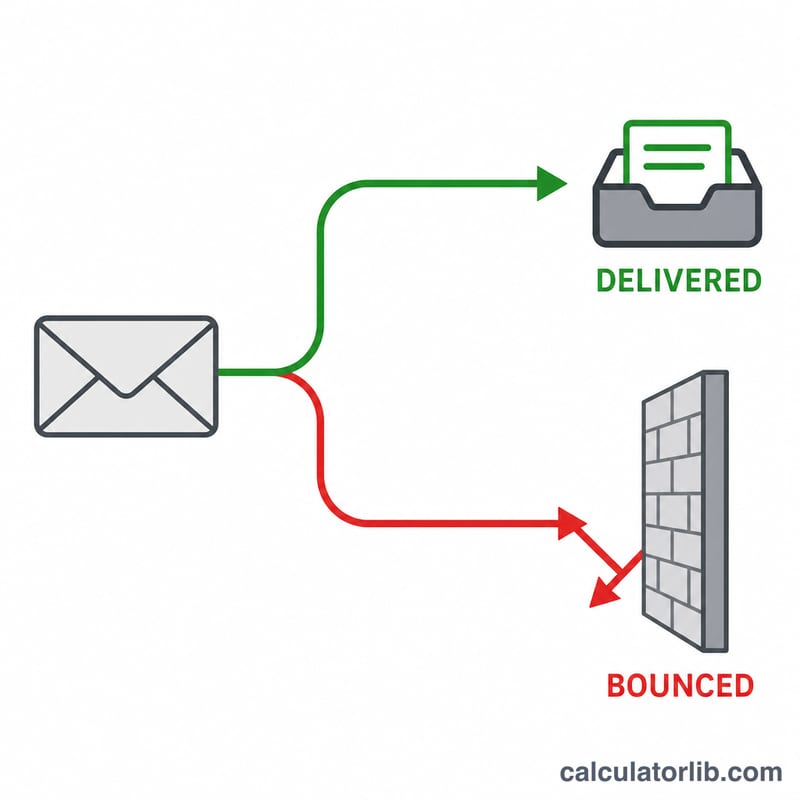
Email bounce rate is the percentage of emails you send that fail to be delivered to recipients' inboxes. When a message can't be delivered, it "bounces" back to the sender. Tracking this metric is essential for protecting your sender reputation, maintaining strong deliverability, and keeping your email lists clean. A high bounce rate signals to mailbox providers that your list may be outdated or improperly sourced.
How to Use This Calculator
Enter the number of bounced emails and the total number of emails sent in a campaign or time period. The calculator instantly returns your bounce rate as a percentage, along with your delivery rate and the count of delivered messages. You'll find these numbers in your email service provider's campaign reports.
The Formula Explained
The bounce rate is calculated as:
$$\text{Bounce Rate (\%)} = \frac{\text{Bounced Emails}}{\text{Emails Sent}} \times 100$$Dividing bounced emails by total emails sent gives the fraction that failed to deliver; multiplying by 100 converts it to a percentage. Bounces come in two types: hard bounces (permanent failures, such as invalid addresses) and soft bounces (temporary issues, like a full inbox).
Worked Example
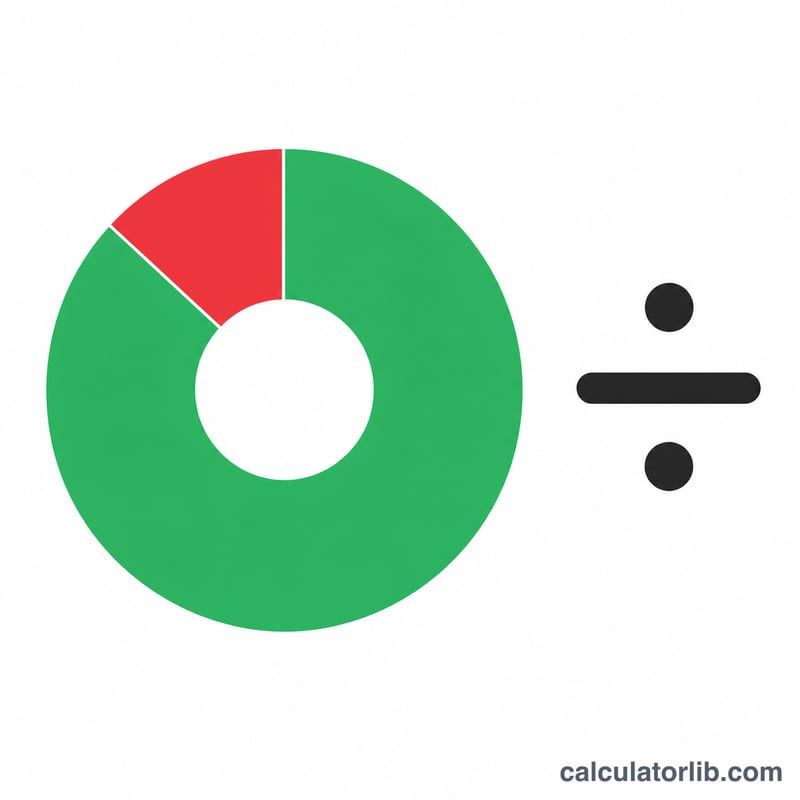
Suppose you sent 10,000 emails and 150 bounced. Your bounce rate is $$(150 \div 10{,}000) \times 100 = 1.5\%$$ That leaves 9,850 delivered emails and a delivery rate of 98.5%. A bounce rate under 2% is generally considered healthy.
FAQ
What is a good email bounce rate? Aim for under 2%. Rates above 5% suggest list-hygiene problems that can hurt deliverability.
How do I lower my bounce rate? Use double opt-in, regularly clean your list, remove invalid addresses, and avoid purchased lists.
Do soft bounces count? Most ESPs include both hard and soft bounces in the total. Repeated soft bounces are often eventually treated as hard bounces.