
What this calculator does
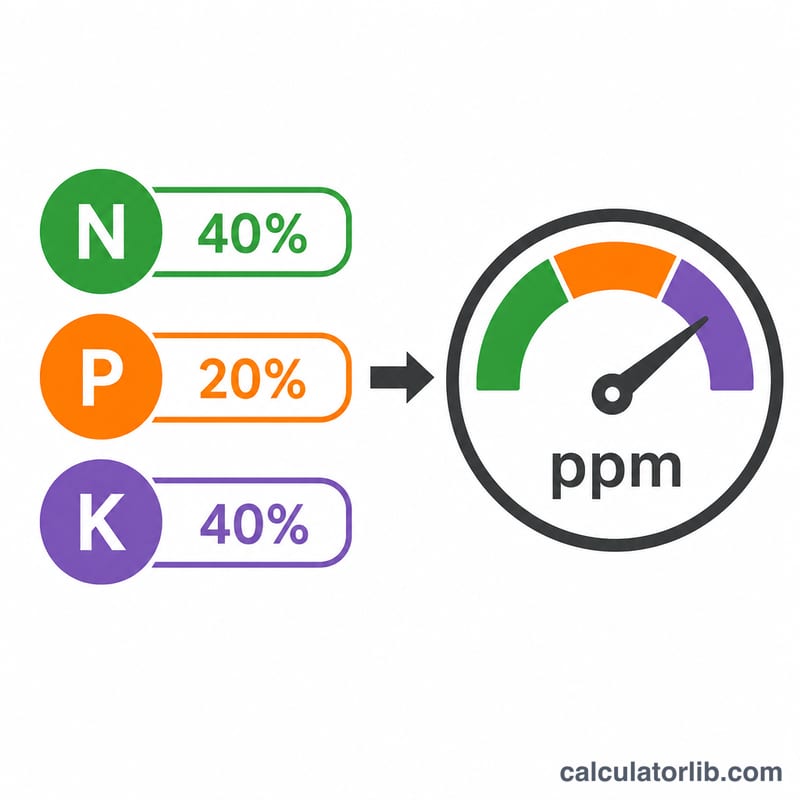
The Fertilizer PPM Calculator converts a dose of fertilizer into a nutrient concentration measured in parts per million (ppm), which for dilute water solutions is identical to milligrams per liter (mg/L). Growers using hydroponics, fertigation, or liquid feeding need ppm to match a plant target rather than just "scoops per gallon." This tool works for nitrogen (N), phosphorus (P), potassium (K), or any single nutrient listed as a percentage on the label.
How to use it
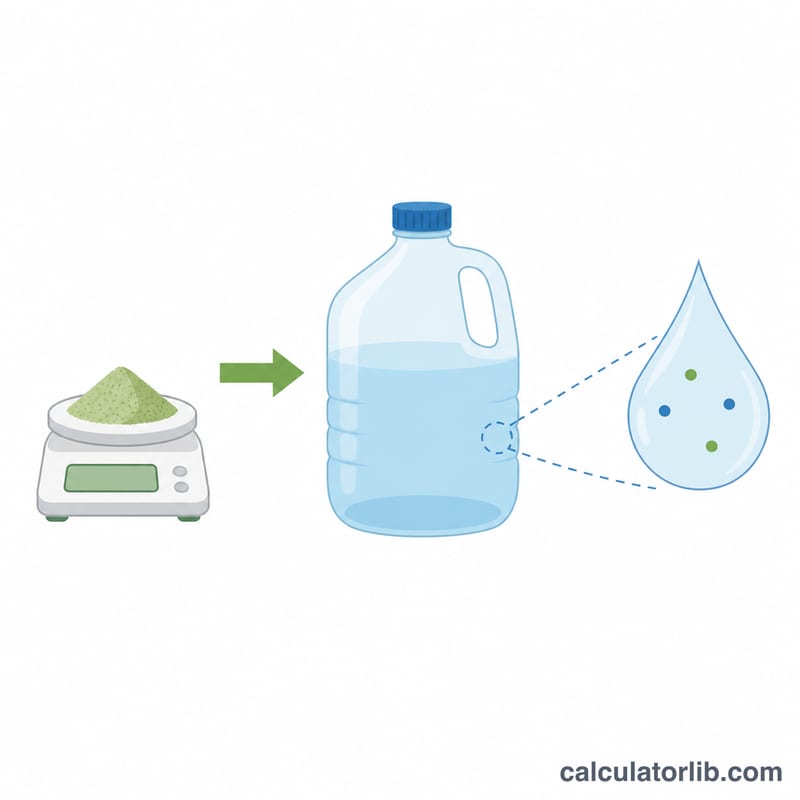
Enter three values: the grams of fertilizer you dissolved, the percentage of the nutrient you care about (taken from the N-P-K label), and the volume of water in liters. If you mix by the gallon, multiply gallons by 3.785 to get liters. The result is the ppm of that one nutrient in the finished solution, plus the pure grams of nutrient supplied.
The formula explained
One part per million in water means one milligram of substance per liter of solution. A gram is 1000 milligrams, so grams times 1000 gives milligrams. Multiplying by the nutrient fraction (percent divided by 100) keeps only the active nutrient, and dividing by liters spreads it through the water:
$$\text{ppm} = \frac{\text{grams} \times \frac{\text{percent}}{100} \times 1000}{\text{liters}}$$
Worked example
Suppose you dissolve 10 g of a 20-20-20 fertilizer in 10 L of water and want the nitrogen ppm. Nitrogen is 20%, so the pure nitrogen is \(10 \times 0.20 = 2\ \text{g} = 2000\ \text{mg}\). Dividing by 10 L gives 200 mg/L, i.e. 200 ppm of nitrogen. The same math applies to the phosphorus and potassium figures.
FAQ
Is ppm the same as mg/L? For dilute water-based nutrient solutions, yes — 1 ppm equals 1 mg/L because one liter of water weighs about one million milligrams.
The label shows P2O5 and K2O, not P and K. Guaranteed analysis lists oxides. To get elemental phosphorus multiply %P2O5 by 0.436; for elemental potassium multiply %K2O by 0.830. Enter the elemental percent if you want elemental ppm.
How do I work in gallons? Convert gallons to liters (1 US gallon = 3.785 L) before entering the volume, since the formula is metric.