
What is a PCR Master Mix Calculator?
A PCR master mix calculator works out how much of each reagent you need to prepare a batch of polymerase chain reaction (PCR) tubes. Instead of pipetting each component into every tube, you make one shared master mix and aliquot it. This tool scales every reagent by the number of reactions plus a pipetting excess so you never run short.
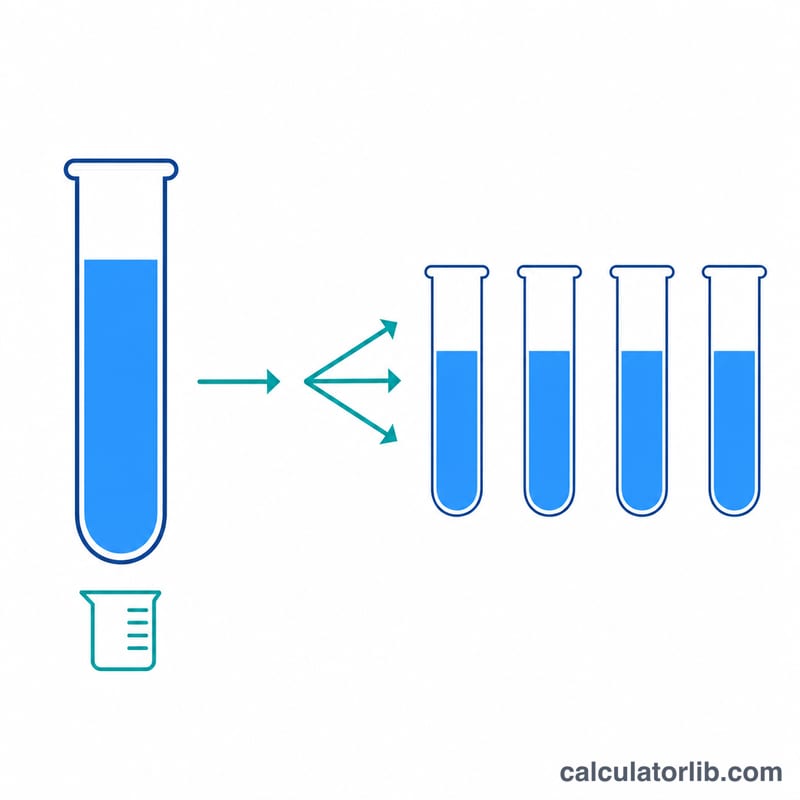
How to use it
Enter the single-reaction volume, the number of reactions, and a pipetting excess (typically 5–10%). For each reagent, enter the stock concentration and the desired final concentration in the reaction. The calculator returns the volume of each reagent, the template volume, and the balancing volume of nuclease-free water.
The formula explained
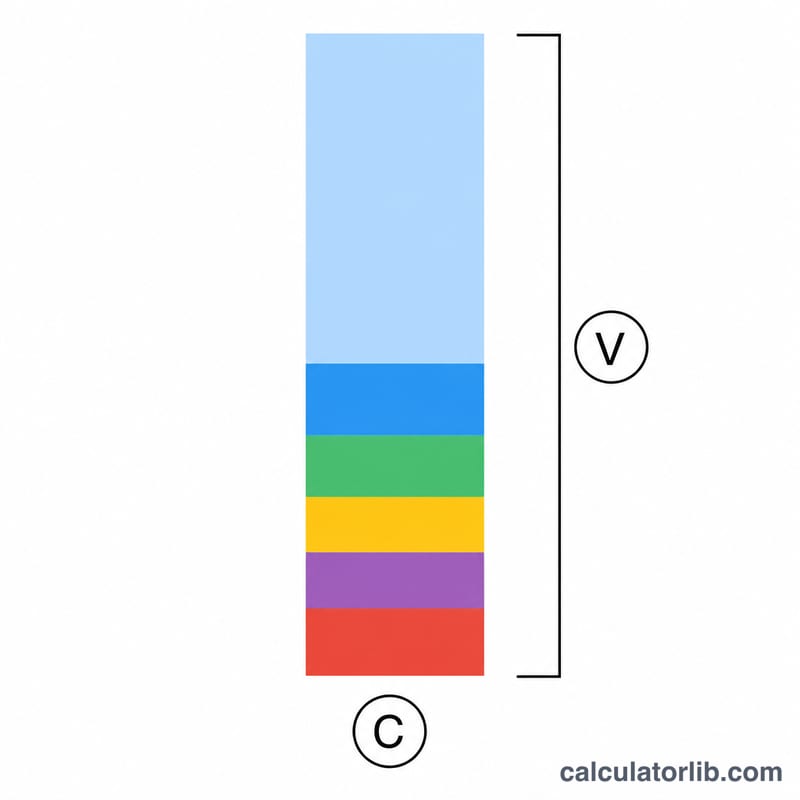
Each reagent volume comes from the dilution relationship \(C_1 V_1 = C_2 V_2\). For a master mix we multiply by the effective reaction count \(n = \text{reactions} \times (1 + \text{excess}/100)\):
$$V = \frac{C_{\text{final}} \times V_{\text{reaction}} \times n}{C_{\text{stock}}}$$Units must be consistent between stock and final for each component (X with X, mM with mM, µM with µM, U/µL with U/µL).
Worked example
For 10 reactions of 25 µL with 10% excess, \(n = 10 \times 1.10 = 11\). A 10X buffer to 1X needs
$$\frac{1 \times 25 \times 11}{10} = 27.5\ \text{µL}$$dNTPs from 10 mM to 0.2 mM need
$$\frac{0.2 \times 25 \times 11}{10} = 5.5\ \text{µL}$$The total mix volume is \(25 \times 11 = 275\ \text{µL}\), and water fills whatever is left after all reagents and template.
FAQ
Why add pipetting excess? Small volume losses on tips and tube walls add up; 5–10% extra ensures the last tube gets a full reaction.
What if water comes out negative? Your reagent volumes already exceed the reaction volume — reduce a final concentration, raise a stock, or increase the reaction volume.
Can I leave a component blank? Set its stock to 0 to exclude it; that reagent volume becomes 0 and water compensates.