

What Is DPMO?
DPMO stands for Defects Per Million Opportunities, a core metric in Six Sigma and quality management. It standardizes defect rates so that processes of different sizes and complexity can be compared on the same scale. Instead of just counting raw defects, DPMO accounts for how many chances for a defect actually existed.
How to Use This Calculator
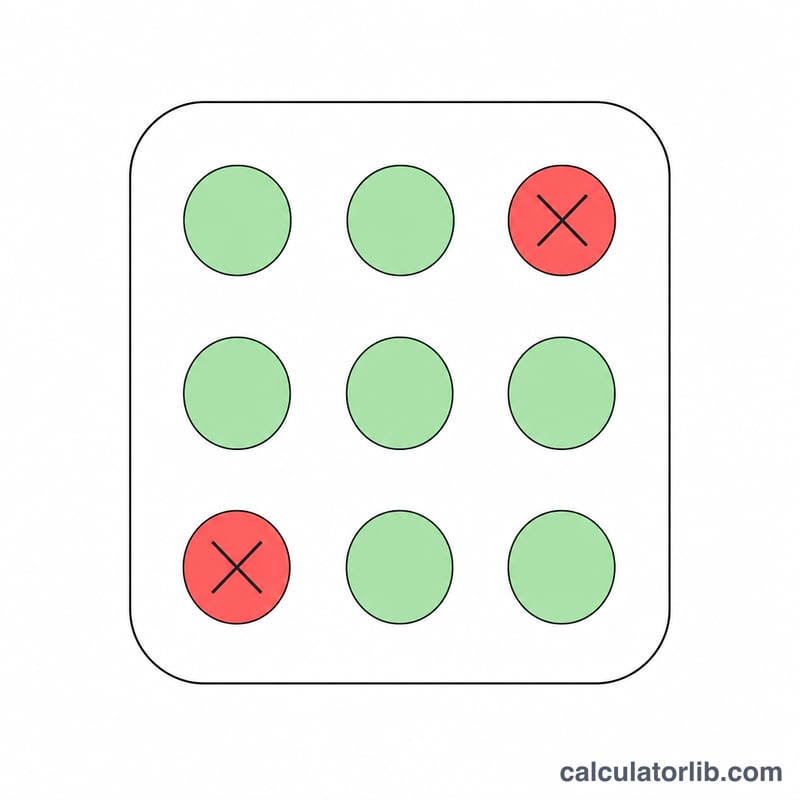
Enter three values: the total number of defects found, the number of units inspected, and the number of opportunities per unit (the distinct ways each unit could be defective). The calculator returns DPMO along with the defects-per-opportunity (DPO) ratio and the process yield.
The Formula Explained
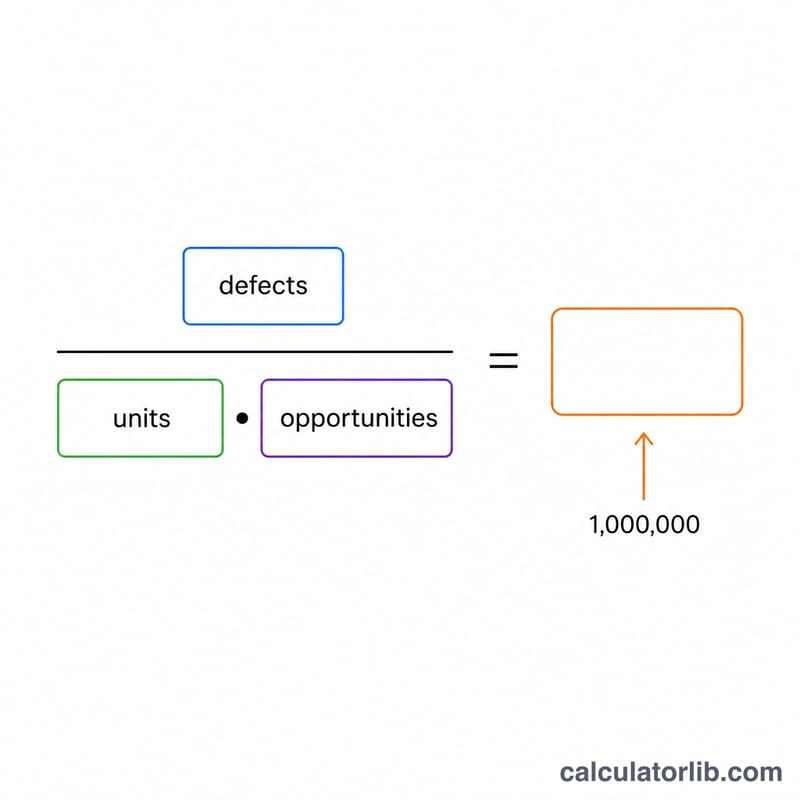
$$\text{DPMO} = \frac{\text{Defects}}{\text{Units} \times \text{Opportunities per Unit}} \times 1{,}000{,}000$$ The product of units and opportunities gives the total number of chances for a defect. Dividing defects by that total gives DPO, a fraction between 0 and 1. Multiplying by one million scales it into the familiar DPMO figure. Process yield is simply \((1 - \text{DPO}) \times 100\%\).
Worked Example
Suppose you inspect 1,000 units, each with 10 opportunities for a defect, and find 5 defects. Total opportunities = \(1{,}000 \times 10 = 10{,}000\). DPO = \(5 \div 10{,}000 = 0.0005\). $$\text{DPMO} = 0.0005 \times 1{,}000{,}000 = \mathbf{500}$$ The yield is \((1 - 0.0005) \times 100\% = 99.95\%\).
FAQ
What counts as an "opportunity"? An opportunity is any distinct point where a defect could occur on a unit — for example, the solder joints on a circuit board or fields on a form.
How does DPMO relate to sigma level? Lower DPMO means higher quality. A world-class "Six Sigma" process targets about 3.4 DPMO. You can convert DPMO to a sigma level using a standard conversion table.
What is the difference between DPMO and PPM? PPM (parts per million) counts defective units per million units, while DPMO counts defects per million opportunities and so reflects unit complexity.