
What is Cohen's d?
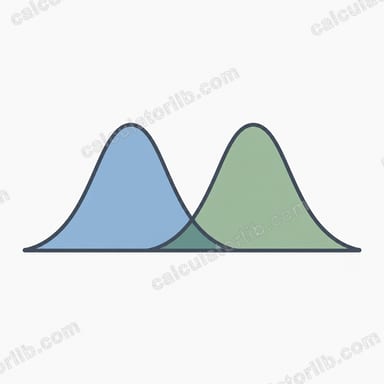
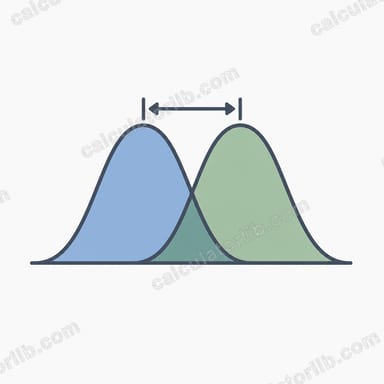
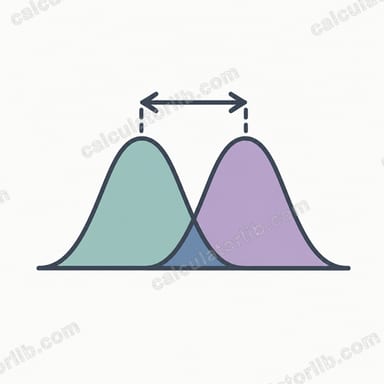
Cohen's d is a standardized measure of effect size that expresses the difference between two group means in units of pooled standard deviation. While a p-value tells you whether a difference is statistically significant, Cohen's d tells you how large that difference actually is — making it essential for interpreting practical importance in research, psychology, education, and medicine.
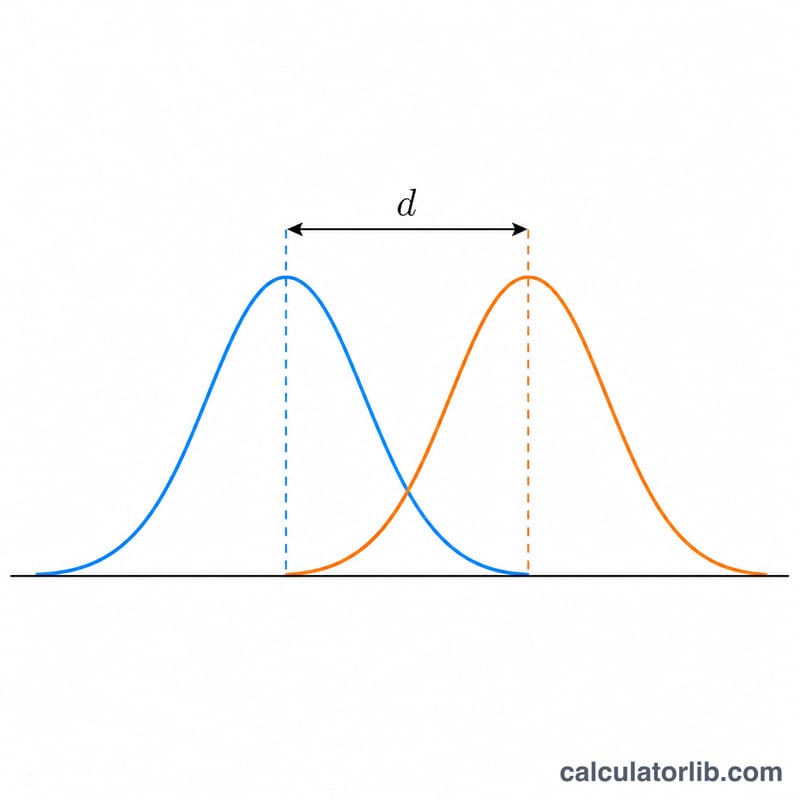
How to use this calculator
Enter the mean, standard deviation, and sample size for each of your two groups. The calculator computes the pooled standard deviation, divides the difference of means by it, and reports Cohen's d along with a conventional interpretation of its magnitude.
The formula explained
The formula for Cohen's d is:
$$d = \frac{\text{M1} - \text{M2}}{s_p}$$where
$$s_p = \sqrt{\frac{(\text{n1}-1)\,\text{s1}^{2} + (\text{n2}-1)\,\text{s2}^{2}}{\text{n1} + \text{n2} - 2}}$$The numerator is simply \(\text{M1} - \text{M2}\), the raw difference between group means. The denominator is the pooled standard deviation, which combines both groups' variances weighted by their degrees of freedom (\(n - 1\)). Dividing by this pooled spread standardizes the difference so it can be compared across studies and measurement scales.
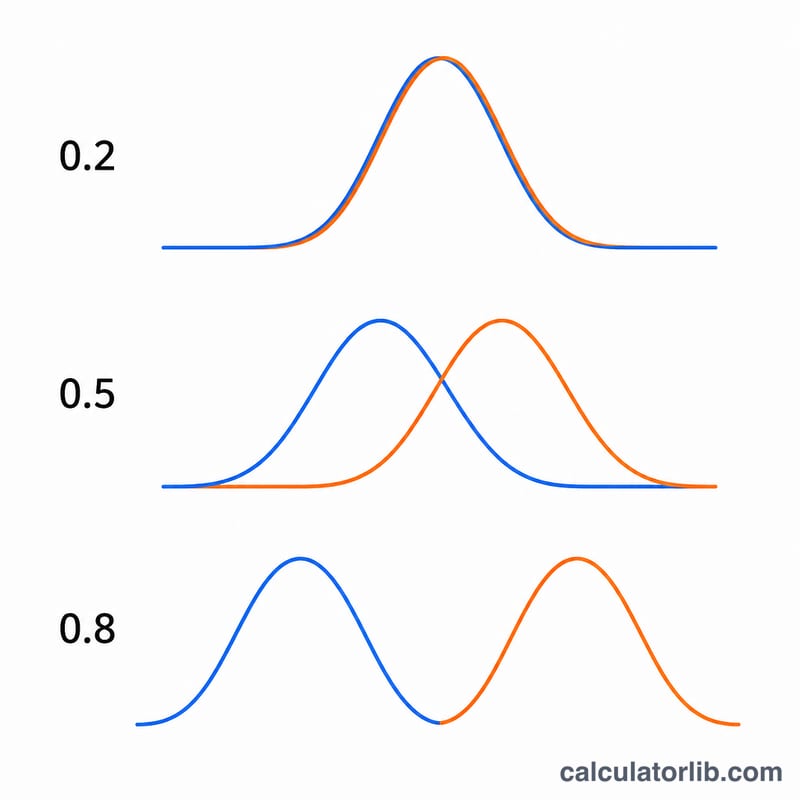
Cohen's conventional benchmarks: \(d \approx 0.2\) is a small effect, \(d \approx 0.5\) is medium, and \(d \approx 0.8\) or above is large.
Worked example
Suppose Group 1 has \(\text{M1} = 100\), \(\text{s1} = 15\), \(\text{n1} = 30\), and Group 2 has \(\text{M2} = 90\), \(\text{s2} = 12\), \(\text{n2} = 30\). The pooled variance is $$\frac{(29 \cdot 225) + (29 \cdot 144)}{58} = \frac{6525 + 4176}{58} = 184.5,$$ so the pooled SD \(\approx 13.5830\). Then $$d = \frac{100 - 90}{13.5830} \approx 0.7363$$ — a medium-to-large effect.
FAQ
Is the sign of d important? The sign just indicates which group has the higher mean. Researchers usually report the absolute value when discussing magnitude.
When should I use pooled SD? The pooled standard deviation assumes the two groups have roughly equal variances. If variances differ greatly, consider Glass's delta or Hedges' g instead.
What is Hedges' g? Hedges' g is a small-sample-corrected version of Cohen's d that multiplies d by a bias-correction factor; for large samples the two values nearly coincide.