
What Is a Raw Score?
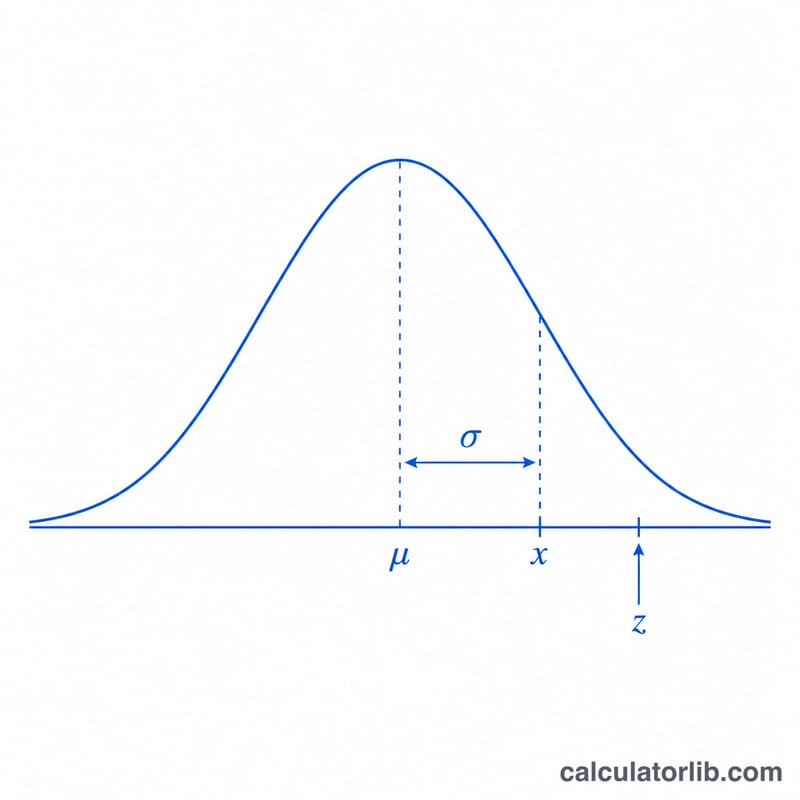
A raw score is an original, unstandardized measurement — such as a test result, height, or IQ value — before any transformation. A z-score tells you how many standard deviations a value sits above or below the mean. This Raw Score Calculator does the reverse of z-score standardization: it takes a known z-score and converts it back into the raw value using the distribution's mean and standard deviation.
How to Use the Calculator
Enter the z-score, the mean (\(\mu\)) of the distribution, and the standard deviation (\(\sigma\)). The calculator returns the raw score \(x\). A positive z-score produces a raw score above the mean, a negative z-score produces one below it, and a z-score of 0 returns exactly the mean.
The Formula Explained
The conversion uses:
$$x = \mu + z \times \sigma$$
Here \(z\) is multiplied by the standard deviation to find how far the value lies from the mean in original units, and that distance is added to the mean. It is simply the standardization formula \(z = (x - \mu) / \sigma\) rearranged to solve for \(x\).
Worked Example
Suppose IQ scores have a mean of 100 and a standard deviation of 15. A student scores a z of 1.5. Then $$x = 100 + 1.5 \times 15 = 100 + 22.5 = 122.5.$$ The student's raw IQ score is 122.5, which is 1.5 standard deviations above average.
FAQ
What does a negative z-score give? A raw score below the mean. For \(z = -2\), \(\mu = 50\), \(\sigma = 10\): \(x = 50 + (-2)(10) = 30\).
What if the z-score is 0? The raw score equals the mean exactly, since \(0 \times \sigma = 0\).
Can I use a population or sample standard deviation? Yes — use whichever \(\sigma\) matches the distribution your z-score was computed from.