
What is the PST to UTC Converter?
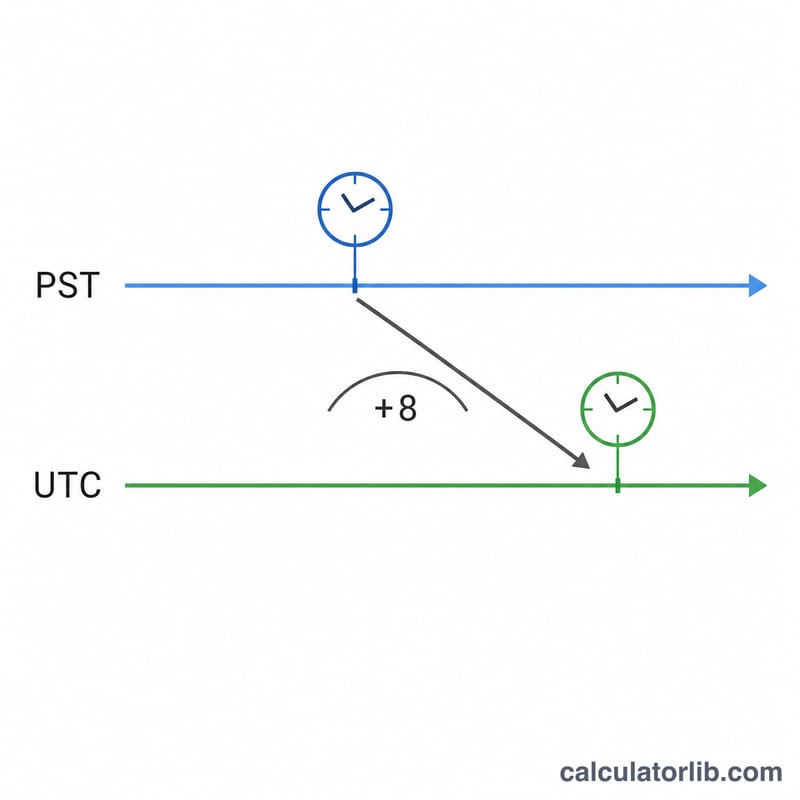
Pacific Standard Time (PST) is the standard time zone used along the west coast of the United States and Canada during winter months. It sits 8 hours behind Coordinated Universal Time (UTC), the global reference time. This converter takes any time you enter in PST and adds 8 hours to give the equivalent UTC time. Note: PST refers specifically to standard (winter) time — Pacific Daylight Time (PDT), used in summer, is only 7 hours behind UTC.
How to use it
Enter the hour (0–23, in 24-hour format) and the minutes (0–59) of your Pacific Standard Time. The calculator adds the fixed 8-hour offset and wraps around midnight automatically. If the resulting UTC time falls on the following calendar day, a day offset of +1 is shown.
The formula
The conversion is simply:
$$\text{UTC} = \left(\text{Hour (PST)} + \frac{\text{Minute}}{60} + 8\right) \bmod 24$$The modulo (remainder) operation ensures the clock wraps correctly: for example 20:00 PST + 8 hours = 28:00, which becomes 04:00 UTC the next day.
Worked example
Suppose it is 15:30 PST. Add 8 hours: \(15 + 8 = 23\), keeping the 30 minutes. The result is 23:30 UTC on the same day. Now take 20:00 PST: \(20 + 8 = 28\), which is \(28 - 24 = 4\), so 04:00 UTC with a +1 day offset.
FAQ
Is PST the same as PDT? No. PST (standard time) is UTC−8, while PDT (daylight saving, summer) is UTC−7. This tool uses the PST offset of −8.
Why does the day sometimes change? Because UTC is ahead of PST, adding 8 hours can push the time past midnight into the next calendar day.
Does UTC observe daylight saving? No. UTC never changes for daylight saving, which is why it is used as the global standard.