
What Is the EDT to PDT Converter?
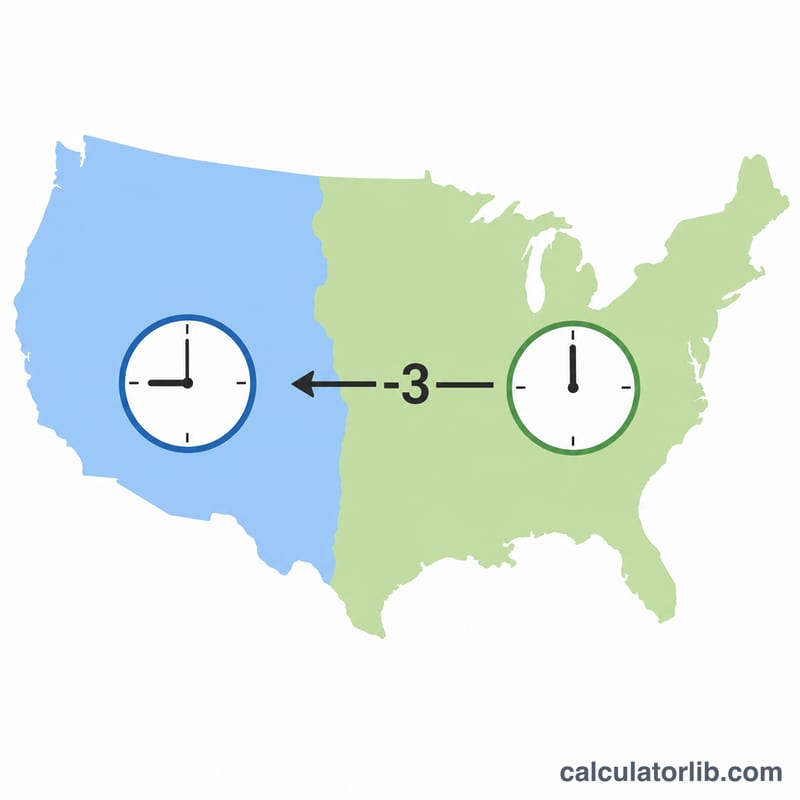
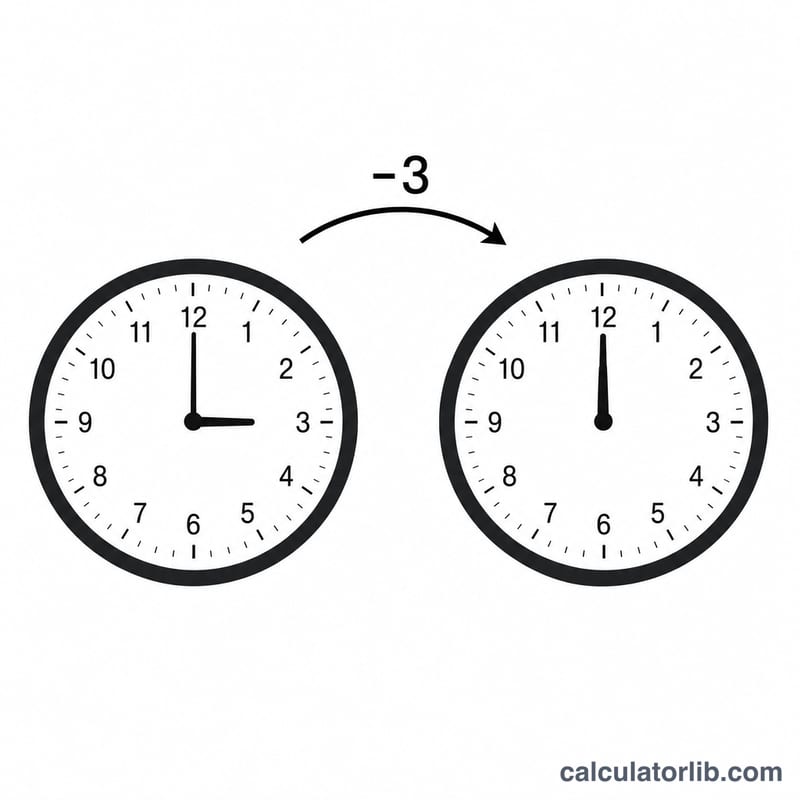
This tool converts a time given in Eastern Daylight Time (EDT) — the summer clock used on the US East Coast — into Pacific Daylight Time (PDT), the summer clock used on the US West Coast. Because both zones observe daylight saving time at the same time of year, the offset between them is a constant 3 hours: the Pacific zone is always 3 hours behind the Eastern zone.
How to Use It
Enter the EDT hour using the 24-hour clock (0–23) and the minute (0–59). The calculator subtracts 3 hours and wraps the result around midnight, so it correctly tells you when the converted time falls on the previous day. The result is shown in both 24-hour and 12-hour (AM/PM) format.
The Formula Explained
The conversion is simple modular arithmetic:
$$\text{PDT} = (\text{EDT} - 3) \bmod 24$$
Subtracting 3 can push the hour below zero. Taking the result modulo 24 (and adding 24 first to avoid negative remainders) keeps the hour in the valid 0–23 range. When the subtraction goes below zero, the time rolls back to the previous calendar day.
Worked Example
Suppose a webinar starts at 2:30 PM EDT, which is 14:30 in 24-hour time. Subtract 3 hours: \(14 - 3 = 11\). So the start time is 11:30 AM PDT. If instead a call were scheduled at 1:00 AM EDT (01:00), then \(1 - 3 = -2\), and \((-2 + 24) \bmod 24 = 22\), giving 10:00 PM PDT the previous day.
FAQ
Is the offset always 3 hours? Yes — during daylight saving time, both Eastern and Pacific shift forward by one hour, so the 3-hour gap between EDT and PDT is constant.
Does this work for standard time (EST to PST)? The 3-hour difference also holds for EST to PST, but the labels differ. Use this tool for the daylight (summer) period.
What about cities that don't observe DST? A few locations (like parts of Arizona) don't follow daylight saving, so their relationship to PDT can differ. This converter assumes standard EDT and PDT zones.