
What is the UTC to EDT Converter?
This tool converts a time given in Coordinated Universal Time (UTC) to Eastern Daylight Time (EDT), the clock used in the US Eastern time zone during daylight saving time — roughly from the second Sunday in March to the first Sunday in November. EDT covers cities such as New York, Washington D.C., Atlanta, Miami, and Toronto during summer months.
How to use it
Enter the UTC hour (0–23) and minute (0–59), then read the converted EDT clock time. If subtracting 4 hours crosses back past midnight, the result is on the previous calendar day, which the tool flags with a day offset of −1.
The formula explained
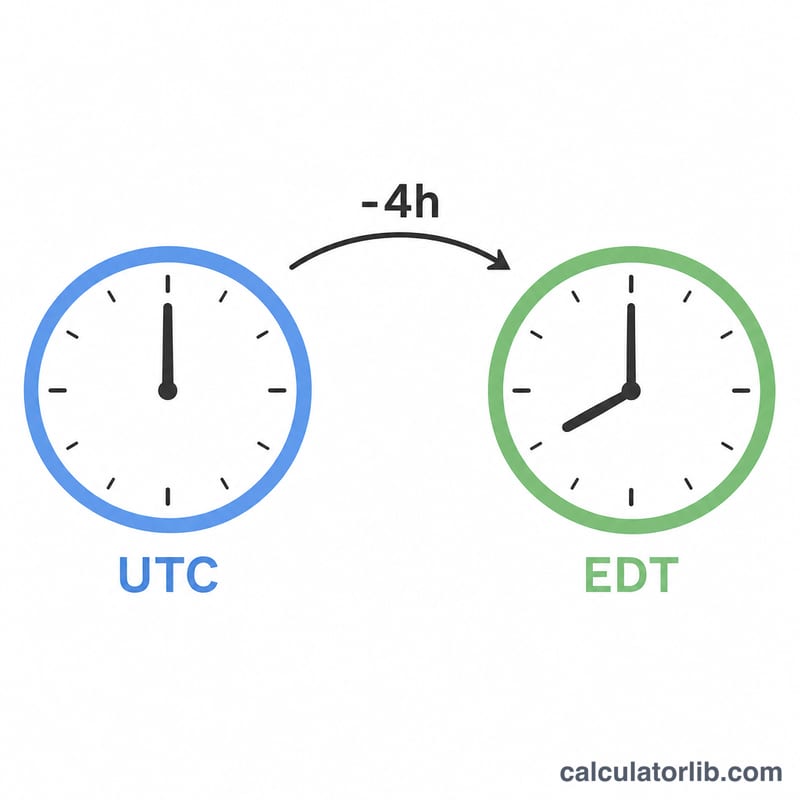
EDT is exactly 4 hours behind UTC: \(\text{EDT} = \text{UTC} - 4 \text{ hours}\). Internally the tool converts the input to total minutes after midnight, subtracts 240 minutes, and wraps the result into the 0–1439 minute range so the clock rolls over correctly.
$$\text{EDT} = \left(\left(60 \cdot \text{UTC Hour} + \text{UTC Minute} - 240 \bmod 1440\right) + 1440\right) \bmod 1440$$
$$\begin{gathered} \text{EDT}_{\min} = \Big(\big(T - 240\big) \bmod 1440 + 1440\Big) \bmod 1440 \\[1.5em] \text{where}\quad \left\{ \begin{aligned} T &= 60 \cdot \text{UTC Hour} + \text{UTC Minute} \\ \text{Hour} &= \left\lfloor \tfrac{\text{EDT}_{\min}}{60} \right\rfloor \\ \text{Min} &= \text{EDT}_{\min} \bmod 60 \end{aligned} \right. \end{gathered}$$
Worked example
Suppose an event is scheduled for 18:30 UTC. Subtracting 4 hours gives \(18{:}30 - 4{:}00 = 14{:}30\) EDT (2:30 PM). For 02:00 UTC, subtracting 4 hours gives 22:00 EDT on the previous day.
FAQ
Is EDT the same as EST? No. EST (Eastern Standard Time) is \(\text{UTC} - 5\) and applies in winter; EDT is \(\text{UTC} - 4\) and applies in summer.
When does EDT apply? During US daylight saving time, from the second Sunday of March to the first Sunday of November.
Why does the day change? Subtracting 4 hours from an early-morning UTC time can push the local time into the previous calendar day.