
What is the UTC to AEST Converter?
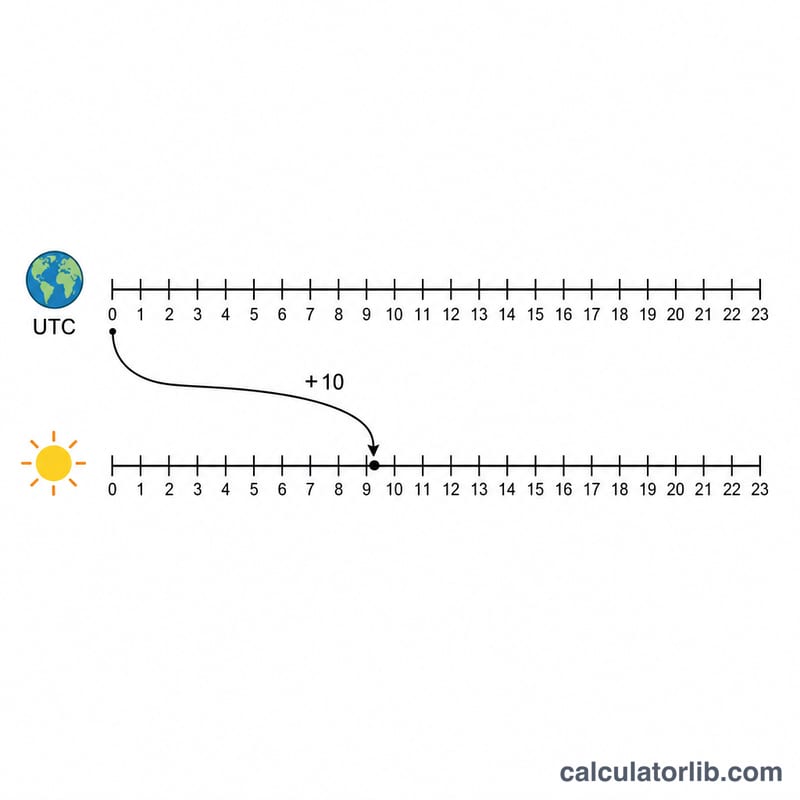
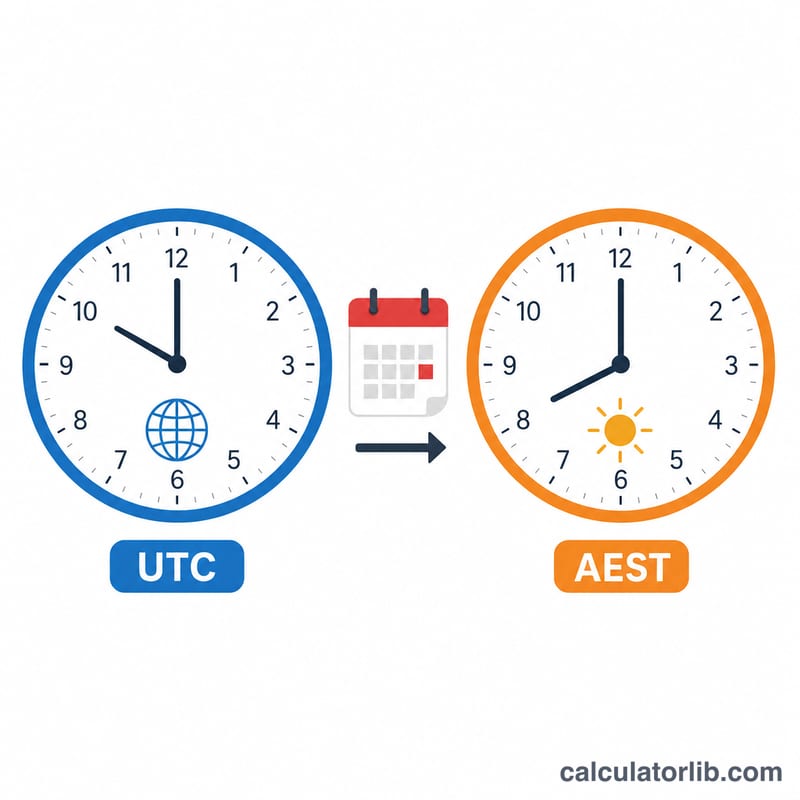
This tool converts a time given in Coordinated Universal Time (UTC) to Australian Eastern Standard Time (AEST). AEST applies to the eastern Australian states — New South Wales, Victoria, Queensland, Tasmania and the ACT — during the standard (non-daylight-saving) period. AEST is a fixed UTC+10:00 offset.
How to use it
Enter the UTC hour (0–23) and minute (0–59). The converter adds 10 hours and shows the resulting AEST time in 24-hour format. If the addition pushes the time past midnight, the result wraps around and a "Next day (+1)" note tells you the date has advanced.
The formula explained
The conversion is simply AEST = UTC + 10 hours. Internally the time is turned into total minutes from midnight, 600 minutes (10 hours) are added, and the result is taken modulo 1440 (the number of minutes in a day) so it stays within a valid clock. The number of whole days added becomes the day offset.
$$\text{AEST} = \left(\,60 \times \text{UTC Hour} + \text{UTC Minute} + 600\,\right) \bmod 1440$$
$$\begin{gathered} \text{AEST}_{\min} = \left(\,T + 600\,\right) \bmod 1440 \\[1.5em] \text{where}\quad \left\{ \begin{aligned} T &= 60 \times \text{UTC Hour} + \text{UTC Minute} \\ \text{Hour} &= \left\lfloor \tfrac{\text{AEST}_{\min}}{60} \right\rfloor \\ \text{Minute} &= \text{AEST}_{\min} \bmod 60 \\ \text{Day Offset} &= \left\lfloor \tfrac{T + 600}{1440} \right\rfloor \end{aligned} \right. \end{gathered}$$
Worked example
Suppose it is 18:30 UTC. In minutes that is \(18 \times 60 + 30 = 1110\). Adding 600 gives 1710. Since \(1710 \geq 1440\), we subtract a full day: \(1710 - 1440 = 270\) minutes, which is 04:30, with a day offset of +1. So 18:30 UTC = 04:30 AEST the next day.
FAQ
Is AEST the same as AEDT? No. During daylight saving, the eastern states use AEDT (UTC+11). This tool uses standard AEST (UTC+10).
Does all of Australia use AEST? No — Western Australia uses AWST (UTC+8) and central states use ACST (UTC+9:30). AEST covers the eastern states only.
Why does it say "next day"? Because adding 10 hours can carry the time past midnight, advancing the calendar date by one day.