
What this calculator does
This tool solves absolute value inequalities written in the standard form \(|ax + b|\) compared to \(c\), where the comparison can be <, ≤, >, or ≥. Enter the coefficient \(a\), the inside constant \(b\), the inequality type, and the right-hand value \(c\), and the calculator returns the exact solution set as an interval together with its boundary points.
How to use it
Pick values so your inequality matches \(|ax + b| \, ? \, c\). For example, \(|2x - 4| \le 6\) means \(a = 2\), \(b = -4\), type "≤", and \(c = 6\). Submit the form to see the solution interval. Square brackets [ ] indicate the endpoint is included (≤ or ≥) and parentheses ( ) indicate it is excluded (< or >).
The formula explained
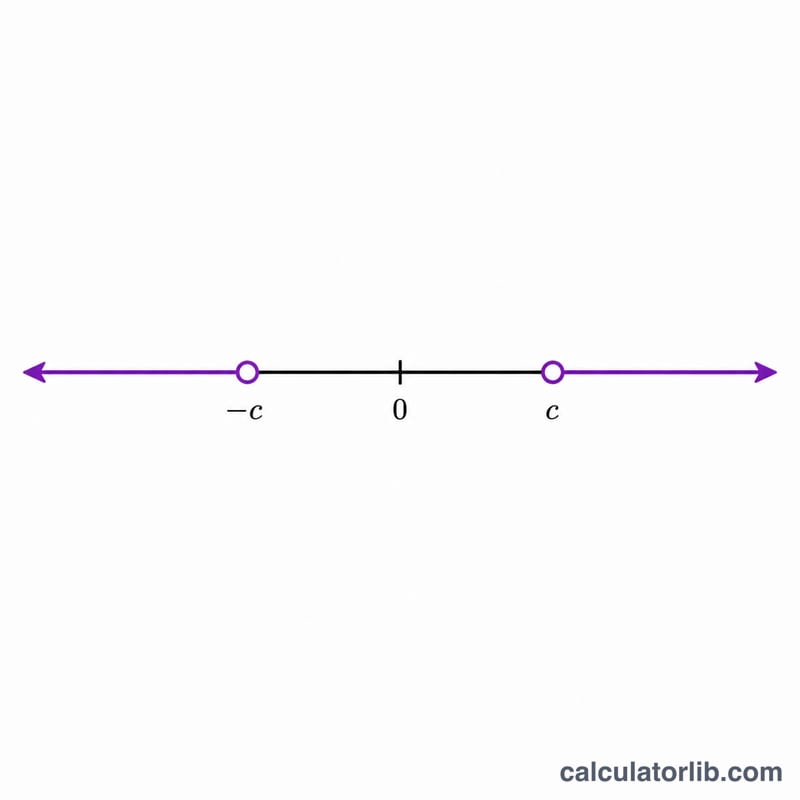
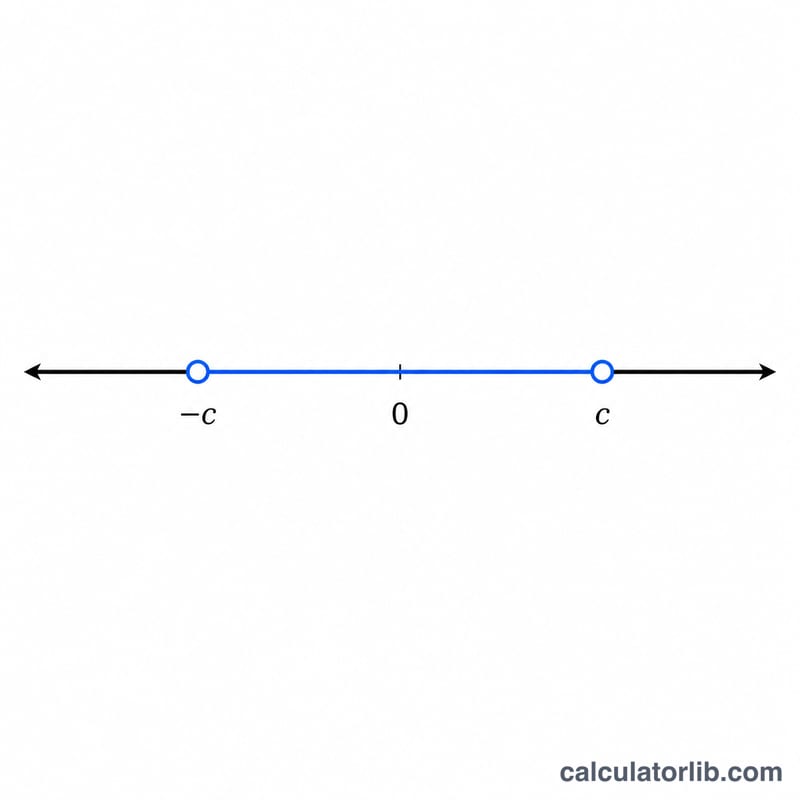
An absolute value measures distance from zero, so it is never negative. For a "less than" inequality, \(|ax+b| < c\) says the expression stays within distance \(c\) of zero, giving the compound inequality $$-c < ax+b < c$$ Solving for \(x\) produces a single bounded interval between \(\frac{-c-b}{a}\) and \(\frac{c-b}{a}\). For a "greater than" inequality, the expression must be farther than \(c\) from zero, so it splits into two rays: $$ax+b < -c \quad \text{OR} \quad ax+b > c$$ producing a union of two intervals. Special cases: if \(c\) is negative, a "less than" form has no solution while a "greater than" form is satisfied by all real numbers.
Worked example
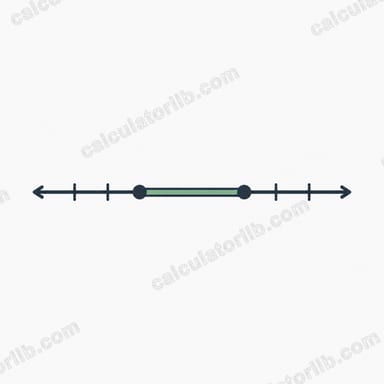
Solve \(|2x - 4| \le 6\). Here \(a = 2\), \(b = -4\), \(c = 6\). Rewrite: $$-6 \le 2x - 4 \le 6$$ Add 4: $$-2 \le 2x \le 10$$ Divide by 2: $$-1 \le x \le 5$$ The solution set is the closed interval \([-1, 5]\).
Key Terms & Symbols
- Absolute value \(|u|\)
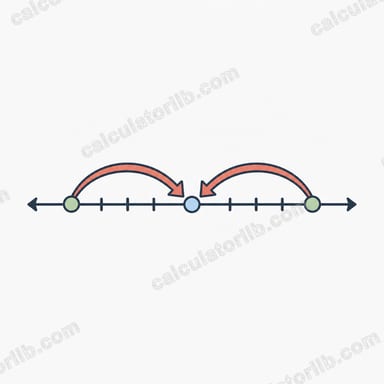
- The distance of a number from zero on the number line, always non‑negative. For example \(|-3| = 3\) and \(|5| = 5\). Because it is a distance, \(|u| \ge 0\) for every value of \(u\).
- Boundary point
- A value of \(x\) where the absolute value expression exactly equals \(c\) — the dividing point between solution and non‑solution. They are found by solving the related equation \(|ax+b| = c\).
- Open interval
- An interval that does not include its endpoints, used for strict inequalities (\(<, >\)). Written with parentheses, e.g. \((-1, 5)\).
- Closed interval
- An interval that does include its endpoints, used for inclusive inequalities (\(\le, \ge\)). Written with brackets, e.g. \([-1, 5]\).
- Brackets \([\;]\) vs parentheses \((\;)\)
- A square bracket means the endpoint is part of the solution (\(\le\) or \(\ge\)); a parenthesis means the endpoint is excluded (\(<\) or \(>\)). Infinity always uses a parenthesis.
- Union \(\cup\)
- Combines two separate sets into one solution. A "greater than" absolute value inequality produces a union of two rays, e.g. \((-\infty,-1)\cup(5,\infty)\).
- Conjunction ("and") vs disjunction ("or")
- A conjunction requires both conditions to hold at once and yields a single bounded interval (the "\(<\)" case). A disjunction requires only one condition and yields a union of two rays (the "\(>\)" case).
- Coefficients \(a\), \(b\), \(c\)
- In \(|ax+b| \;\square\; c\): \(a\) is the coefficient multiplying \(x\) inside the bars, \(b\) is the constant added inside the bars, and \(c\) is the value on the right‑hand side that the absolute value is compared against.
FAQ
What if a is negative? The calculator handles it automatically by ordering the two boundary values from smallest to largest, so the interval is always reported correctly.
Why does \(|ax+b| < 0\) have no solution? Absolute value is never negative, so it can never be less than a negative number (or less than 0).
What does the ∪ symbol mean? It is the union symbol, indicating the answer consists of two separate intervals combined, as happens with greater-than inequalities.