What Is the Age of Majority Date Calculator?
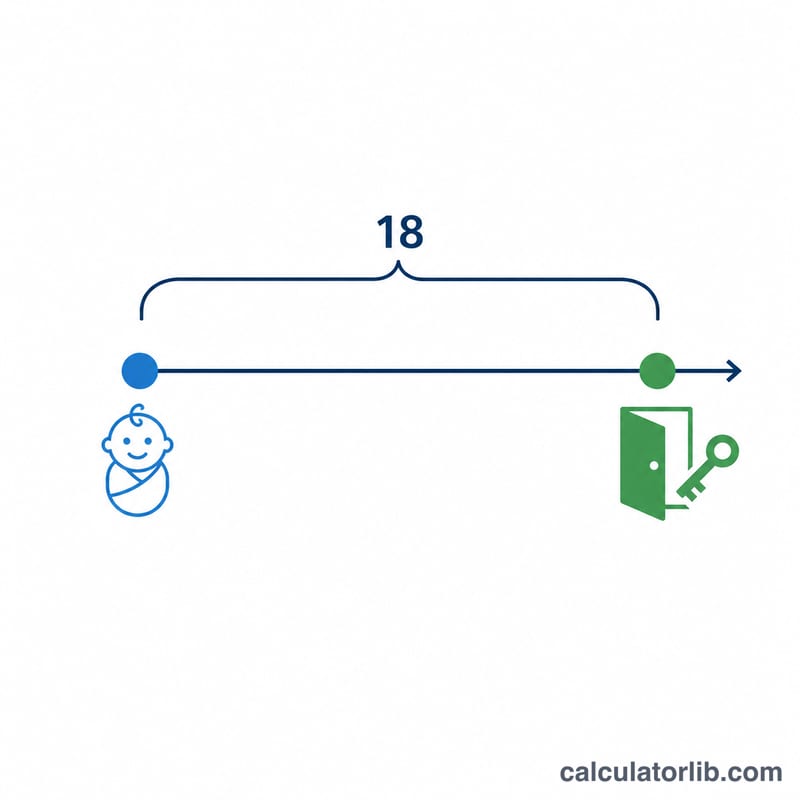
The age of majority is the moment a person is legally recognized as an adult, gaining rights such as signing contracts, voting, or consenting to medical care without a guardian. In most places this is 18, though some jurisdictions or specific rights (like purchasing alcohol in the United States) use 21. This calculator adds the chosen number of years to a birthdate and returns the exact calendar date a person reaches that milestone, plus how many days remain from today.
How to Use It
Enter the birth year, month, and day, then choose whether the age of majority is 18 or 21 years. The tool returns the majority date as Year-Month-Day and the number of days remaining until that date (negative if it has already passed).
The Formula Explained
The calculation is simply:
$$\text{majority date} = \text{birthdate} + \text{majority years}$$
We keep the same month and day and advance the year by 18 or 21. For a birthdate of 29 February, this calculator gives 28 February in non-leap years (the last day of the month).
Worked Example
Someone born on June 15, 2007, who reaches majority at 18:
$$2007 + 18 = 2025$$
so the majority date is 2025-06-15. They become a legal adult on their 18th birthday in 2025.

Interpreting Your Majority Date
The date this tool returns is the calendar anniversary of your birth, advanced by the number of years you selected: \(\text{Majority Date} = \text{Birth Date} + 18\ \text{years}\) (or \(+\,21\ \text{years}\)). In most common-law jurisdictions today, a person is treated as attaining that age at the first moment of the birthday itself — the "birthday rule". In England and Wales this was put beyond doubt by the Family Law Reform Act 1969, which provides that a person attains a particular age at the start of the relevant anniversary; before that statute, the older common-law rule held that age was attained on the day before the anniversary. A similar day-before convention still exists in Japanese age-reckoning law, where age is counted as increasing at the end of the day preceding the birthday. If a filing deadline, eligibility cut-off or contract turns on a single day, check which rule your jurisdiction applies.
Worked example
For a birthdate of 14 May 2009 with the 18-year threshold: \(2009\text{-}05\text{-}14 + 18\ \text{years} = \) 14 May 2027. Choosing 21 instead gives 14 May 2030. The month and day never change; only the year advances. The one edge case is a 29 February birthdate, since the target year may have no 29 February — jurisdictions differ on whether such a person is treated as coming of age on 28 February or 1 March, so confirm locally.
What "days remaining" means
- Positive — the majority date is still in the future; you have not yet reached that threshold. The number is how many days are left.
- Zero — the majority date is today.
- Negative — the date has already passed, and the absolute value is the number of days since you reached it. A value of \(-365\) means the threshold was crossed roughly one year ago.
Legal adulthood is not one single switch
Reaching the age of majority generally means you can enter binding contracts, sue and be sued in your own name, hold property outright and act without a parent or guardian's consent. It does not unlock every age-restricted activity at once. Separate statutory ages commonly apply to purchasing alcohol, buying tobacco or nicotine products, possessing firearms, gambling, renting a car, adopting, standing for elected office and serving on a jury — and these vary widely by country and, in federal systems, by state or province. In the United States the age of majority is 18 in most states but 19 in Alabama and Nebraska and 21 in Mississippi, while the federal minimum purchase age for alcohol and for tobacco/nicotine products is 21. Many countries have moved the general threshold to 18 in recent decades — Japan lowered its age of majority from 20 to 18 effective 1 April 2022, while keeping 20 as the minimum age for drinking and smoking.
Limits of this result
This is a calendar computation, not a determination of your legal status anywhere. The tool does not know which jurisdiction's law applies to you, and it does not account for guardianship orders, emancipation, or rules that tie a right to a school year or a registration record rather than to a birthdate. Two further practical points: the relevant date is normally the one recorded on your official birth registration or civil-registry entry, which can differ from the local wall-clock date of birth when a birth occurs near midnight or abroad; and because the date advances with the local time zone, "today" — and therefore the days-remaining figure — depends on where the calculation is made. For anything with legal or financial consequences, verify against the governing statute or ask a qualified adviser in the relevant jurisdiction; the above is general information, not legal advice.
FAQ
Is the age of majority always 18? No. It is 18 in most countries and US states, but some regions use 19 or 21, and certain rights (such as alcohol purchase in the US) require 21.
What does "days remaining" mean? It is the number of days from today until the majority date. A negative number means the date has already passed.
Does this account for leap years? Yes. The calculation uses a calendar, so leap days are handled correctly when computing the future date and day count.
Conventions and edge cases
Each case below was run through this calculator; the result column is what it actually returns.
| Case | Input | Result | Note |
|---|---|---|---|
| 29 February + 18 years | 2008-02-29 + 18 years | 2026-02-28 | Clamped to the last day of the shorter month. |
Checked on 2026-11-08
Age of majority by country
The calculator works with any age you choose. For the countries below, the age comes from the law cited in each row; where the law changed, the country presets in the form apply the old age until the change date.
| Country | Age of majority | Source |
|---|---|---|
| France | 18 (21 until 1974-07-07) | Law No. 74-631 of 5 July 1974 (Légifrance) |
| Japan | 18 (20 until 2022-04-01) | Ministry of Justice of Japan, Civil Code amendment Q&A (in Japanese) |
| South Korea | 19 (20 until 2013-07-01) | Civil Act amendment, Act No. 10429 (in Korean) |
| Taiwan | 18 (20 until 2023-01-01) | Enforcement Act of the Civil Code, art. 3-1 (in Chinese) |
| Turkey | 18 | Turkish Civil Code No. 4721, art. 11 (in Turkish) |
| Russia | 18 | Civil Code of the Russian Federation, art. 21 (in Russian) |