
What Is Bonus Depreciation?
This calculator applies to the United States. Bonus depreciation is a federal tax incentive that lets a business deduct a large percentage of the cost of qualifying property in the year it is placed in service, rather than spreading the deduction over the asset's full recovery period. It was expanded under the Tax Cuts and Jobs Act and is being phased down: 100% (2017–2022), 80% (2023), 60% (2024), 40% (2025) and 20% (2026), subject to legislative change. Always confirm the current-year rate and eligibility with a tax professional.
How to Use the Calculator
Enter the total cost of the qualifying asset and the applicable bonus depreciation rate (as a percentage). The tool returns the first-year bonus deduction and the remaining depreciable basis that would then be recovered under normal MACRS rules.
The Formula Explained
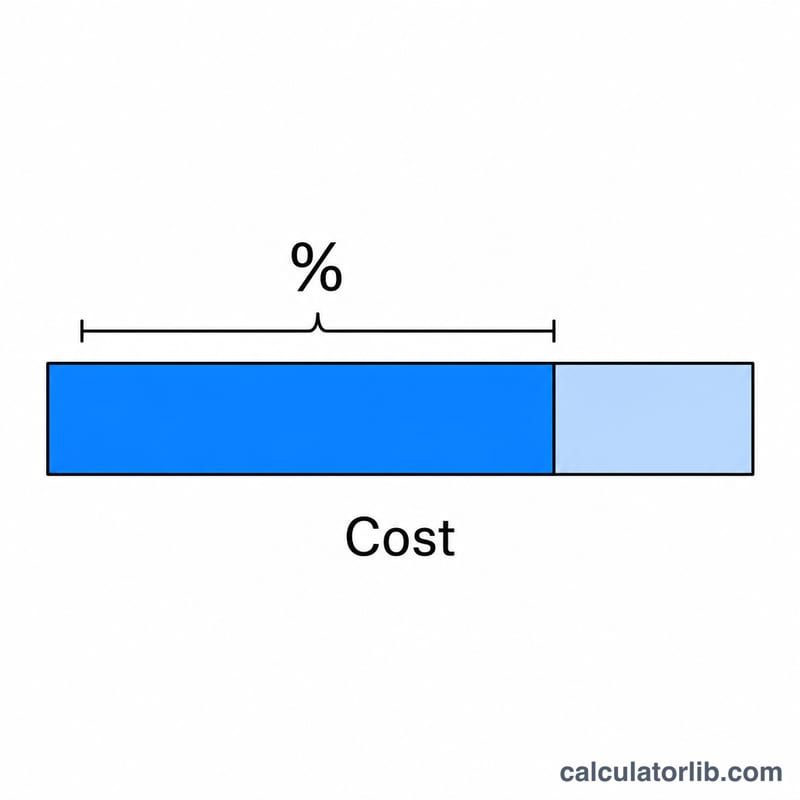
The deduction is simply the asset cost multiplied by the bonus rate: $$\text{Bonus Deduction} = \text{Asset Cost} \times \frac{\text{Rate (\%)}}{100}$$. Whatever is not deducted in year one is the remaining basis: $$\text{Remaining Basis} = \text{Asset Cost} \times \left(1 - \frac{\text{Rate (\%)}}{100}\right)$$. This remaining amount is depreciated over the property's recovery period.
Worked Example
Suppose you buy equipment for $100,000 in a year with a 60% bonus rate. The first-year bonus deduction is $$\$100{,}000 \times 0.60 = \$60{,}000$$. The remaining depreciable basis is $$\$100{,}000 \times (1 - 0.60) = \$40{,}000$$, which you depreciate normally over subsequent years.
Interpreting Your Result
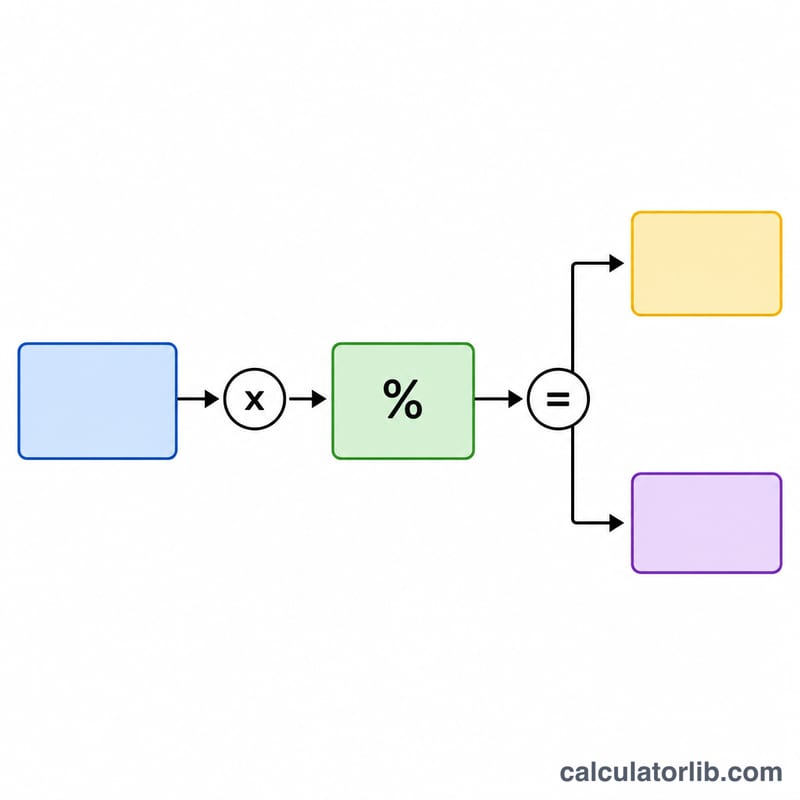
The bonus deduction shown is the amount you can subtract from current-year taxable income for the qualifying asset, accelerating the write-off into the year the property is placed in service rather than spreading it evenly across the asset's life. A larger first-year deduction lowers this year's taxable income (and potentially shifts more income into later years when the asset would otherwise have generated depreciation).
Remaining basis continues under MACRS. Bonus depreciation does not eliminate the rest of the asset's cost — it only front-loads part of it. The remaining basis (cost minus the bonus deduction) is depreciated normally under the Modified Accelerated Cost Recovery System over the property's recovery period (e.g., 5 or 7 years for most equipment). So your total deduction over the asset's life is unchanged; bonus depreciation changes only the timing.
Interaction with Section 179. Section 179 expensing and bonus depreciation are separate provisions that can be combined. The usual ordering is: first apply any Section 179 election (subject to its dollar limit and the taxable-income limitation, since Section 179 cannot create a loss), then apply bonus depreciation to the remaining basis, and finally apply regular MACRS to whatever is left. Because bonus depreciation has no taxable-income cap and can create a net operating loss, businesses often combine the two to plan the size of the current-year deduction.
Actual tax savings depend on your marginal rate. A deduction reduces taxable income, not tax dollar-for-dollar. The cash benefit roughly equals the deduction multiplied by your applicable marginal tax rate. For instance, a $60,000 bonus deduction for a business taxed at a 21% federal corporate rate produces roughly $12,600 in federal tax reduction; pass-through owners would instead use their individual marginal rate, and state taxes (where states conform to bonus rules) may add further savings.
This is general educational information about how bonus depreciation is calculated and used — it is not personal tax advice. Eligibility, applicable rates, state conformity, and the interaction with Section 179 and other rules depend on your specific facts. Consult a qualified tax professional or the relevant IRS guidance before claiming a deduction.
FAQ
What property qualifies? Generally tangible property with a MACRS recovery period of 20 years or less, certain software, and qualified improvement property. Rules vary, so verify eligibility.
Is bonus depreciation the same as Section 179? No. Section 179 has annual dollar limits and income limits; bonus depreciation has no income limit and can create a loss. They can be combined.
Can I opt out? Yes—bonus depreciation is automatic but you may elect out by asset class. This estimator does not constitute tax advice.