What Is the Horse Feed Calculator?
This calculator estimates how much hay (forage) and grain a horse should eat each day based on its body weight. The widely used rule of thumb is that a horse needs around 2% of its body weight in dry forage per day. A 1,000 lb horse therefore needs roughly 20 lb of hay daily. Forage should be the foundation of every horse's diet, with grain or concentrate added only when extra energy is required.
How to Use It
Enter your horse's body weight in pounds. Adjust the forage percentage (most horses do well between 1.5% and 2.5%) and add a grain/concentrate percentage if your horse is in hard work or needs more calories. The calculator returns daily forage, grain, and total feed in pounds.
The Formula Explained
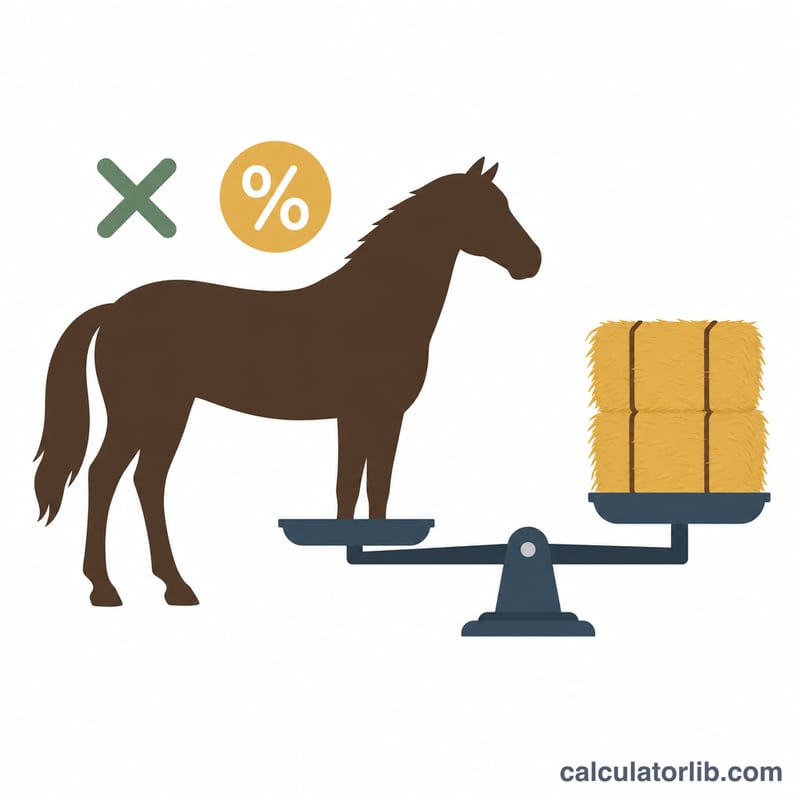
Forage (lb) = Body Weight (lb) × (Forage % ÷ 100). Grain is calculated the same way with its own percentage. Total feed is simply forage plus grain. Always weigh hay rather than feeding by flake count, since flake weight varies widely.
$$\text{Forage} = \text{Body Weight (lb)} \times \frac{\text{Forage \%}}{100}$$
$$\text{Total Feed} = \text{Forage} + \text{Grain}$$
Worked Example
For an 1,100 lb horse at 2% forage and 0.5% grain: forage = \(1{,}100 \times 0.02 = 22\) lb; grain = \(1{,}100 \times 0.005 = 5.5\) lb; total = 27.5 lb of feed per day.
$$\text{Total} = 22 + 5.5 = 27.5 \text{ lb}$$
Typical Forage and Grain Ranges by Horse Type
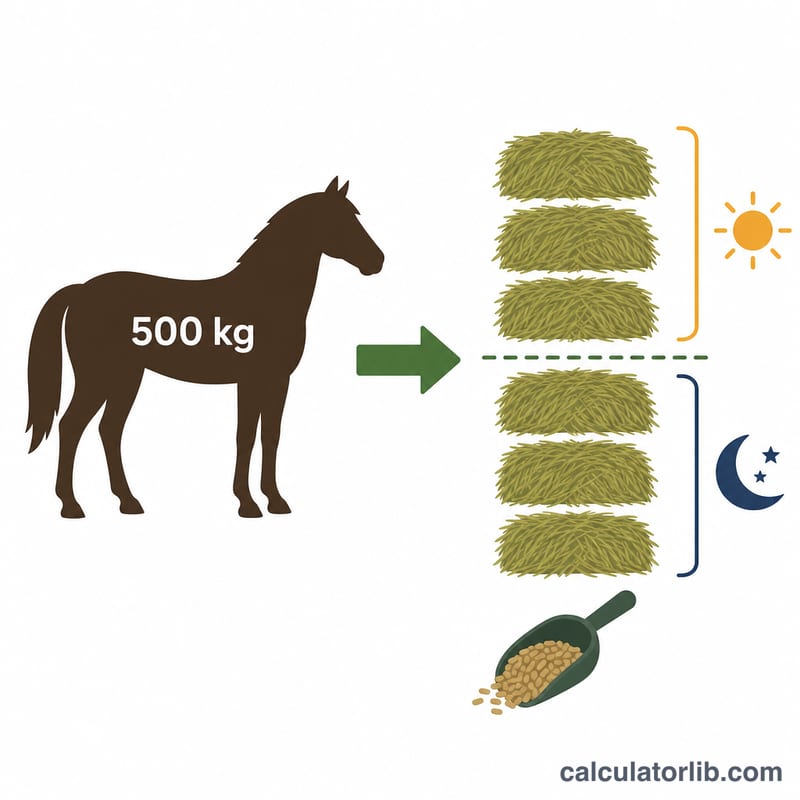
The table shows approximate daily intake as a percentage of body weight. These are general ranges based on common equine nutrition guidance (such as the NRC Nutrient Requirements of Horses), not exact prescriptions. Individual horses vary with metabolism, age, climate and feed quality.
| Horse category | Forage (% body weight) | Grain/concentrate (% body weight) | Total feed (% body weight) |
|---|---|---|---|
| Maintenance / easy keeper | 1.5-2.0% | 0-0.5% | 1.5-2.0% |
| Light work | 1.5-2.0% | 0-0.5% | 1.5-2.5% |
| Moderate work | 1.5-2.0% | 0.5-1.0% | 2.0-2.5% |
| Heavy work | 1.5-2.0% | 1.0-1.5% | 2.5-3.0% |
| Growing horse | 1.5-2.0% | 0.5-1.5% | 2.0-3.0% |
| Late pregnancy | 1.5-2.0% | 0.5-1.0% | 1.75-2.5% |
| Lactating mare | 2.0-2.5% | 0.5-1.5% | 2.5-3.0% |
| Senior | 1.5-2.5% | 0-1.0% | 1.75-2.5% |
- Overall forage range: about 1.5-2.5% of body weight per day, with total feed about 1.5-3.0%.
- Minimum forage: most equine nutrition guidelines advise at least about 1-1.5% of body weight in forage daily to support gut health, even for horses on a weight-loss plan.
- Single grain meal limit: keep any one grain meal under about 0.5% of body weight, which is about 5 lb for a 1,000 lb horse, to reduce the risk of digestive upset.
Daily total = body weight × (forage % + grain %) ÷ 100. For example, a 1,000 lb horse at 2% forage and 0.5% grain gets 25 lb of total feed per day.
Feed Amounts by Horse Weight
Daily amounts in pounds, calculated as body weight × percentage ÷ 100. Grain is fixed at 0.5% of body weight per day. Total = forage + grain.
| Body weight | Forage at 1.5% | Forage at 2% | Forage at 2.5% | Grain at 0.5% | Total (1.5% + grain) | Total (2% + grain) | Total (2.5% + grain) |
|---|---|---|---|---|---|---|---|
| 500 lb (pony) | 7.5 | 10 | 12.5 | 2.5 | 10 | 12.5 | 15 |
| 800 lb | 12 | 16 | 20 | 4 | 16 | 20 | 24 |
| 1,000 lb | 15 | 20 | 25 | 5 | 20 | 25 | 30 |
| 1,200 lb | 18 | 24 | 30 | 6 | 24 | 30 | 36 |
| 1,500 lb (draft) | 22.5 | 30 | 37.5 | 7.5 | 30 | 37.5 | 45 |
Worked example (1,200 lb horse, 2% forage, 0.5% grain): \(1200 \times \frac{2 + 0.5}{100} = 1200 \times 0.025 = 30\) lb per day, made up of 24 lb forage and 6 lb grain.
All values are in pounds per day. Grain amounts at or above about 5 lb per day should be split across several meals (see below).
Interpreting Your Result
The result is an estimate of daily feed as a percentage of body weight, and it is best read as an as-fed starting point. Hay is typically about 85-90% dry matter, so 20 lb of as-fed hay supplies roughly 17-18 lb of dry matter. Nutritional guidelines often express the 2% rule in dry matter, so a horse needing 20 lb of dry matter may need about 22-24 lb of hay as fed. Hay quality, moisture, pasture access and the energy density of your grain all change what the horse actually receives.
Forage first
Forage (hay, pasture) should make up most of the ration, and at least 50% of the total feed by weight. In the 1,000 lb example at 2% forage and 0.5% grain, forage is 20 of 25 lb, or 80% of the total. If your grain percentage would push forage below half of the total, reconsider the plan or talk to an equine nutritionist.
Check body condition and adjust
- Use the Henneke body condition score (1-9 scale). A score of 4-6 is generally considered ideal.
- Below about 4: the horse may need more forage, better-quality hay or more calories. Increase gradually.
- Above about 6: reduce grain first, consider lower-energy hay, and keep forage above the minimum of roughly 1-1.5% of body weight.
- Reassess every few weeks with a weight tape or scale and a hands-on body condition check, and change amounts slowly over 7-10 days.
Feeding practices
- Split grain into small meals, keeping each meal under about 0.5% of body weight (about 5 lb for a 1,000 lb horse).
- Spread hay across the day where possible, since horses are designed to eat small amounts almost continuously.
- Make feed changes gradually and always provide fresh water.
This is general guidance, not veterinary advice. Horses with metabolic conditions (such as insulin resistance or laminitis), dental problems, or special life stages should have a plan from a veterinarian or equine nutritionist.
FAQ
Is 2% always right? It's a starting point. Easy keepers may need 1.5%, while hard keepers or working horses may need more. Monitor body condition.
Should I weigh hay? Yes. Flakes vary in weight, so a kitchen or luggage scale gives much more accurate feeding.
Does this replace a vet? No. Use it as a guide and consult a vet or equine nutritionist for special needs, growth, pregnancy, or illness.