What this calculator does
This tool gives the exact probability of being dealt a specific poker hand in a single 5-card deal from a standard, well-shuffled 52-card deck (no jokers, no wild cards). It works for every ranked category, from the rare royal flush down to a plain high card, and reports the result as a percentage, a decimal probability, and easy-to-read "1 in N" odds.
How to use it
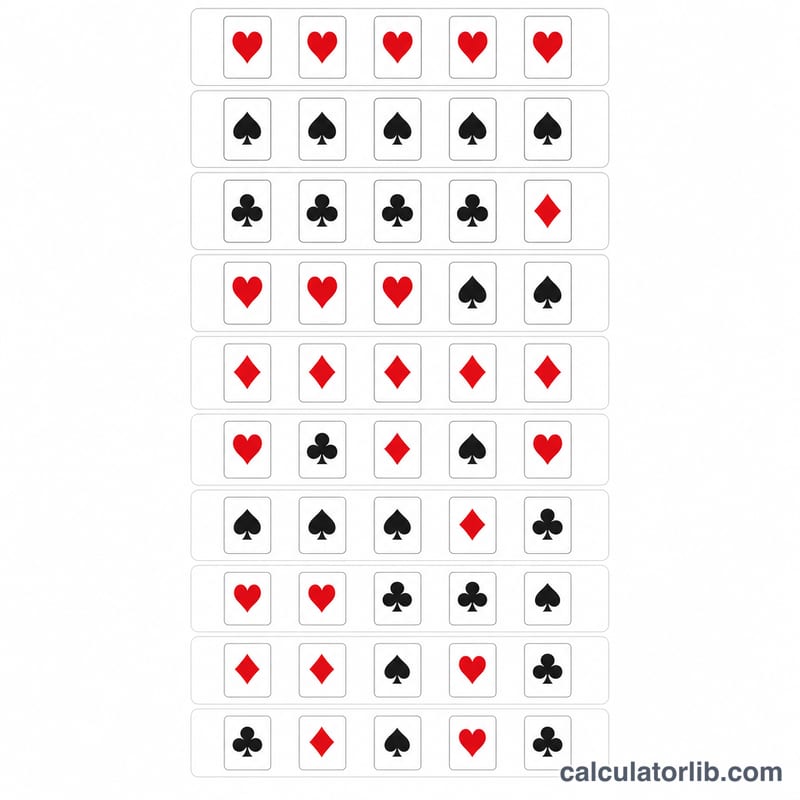
Pick a hand type from the dropdown and read the results. Categories such as "Flush" and "Straight" are counted inclusively (a flush count includes straight flushes), which matches the standard combinatorial tables most textbooks use. Select "Straight flush (incl. royal)" to see all 40 straight flushes, or "Royal flush" alone for just the 4 top-end versions.
The formula explained
The probability of any hand is simply the number of card combinations that produce it divided by the total number of possible 5-card hands. There are \(\binom{52}{5} = 2{,}598{,}960\) distinct 5-card hands. For example, four of a kind can be formed in 624 ways: 13 choices of rank for the quad, times \(\binom{48}{1}=48\) choices for the fifth card. So $$P = \frac{624}{2{,}598{,}960} \approx 0.024\%.$$
Worked example
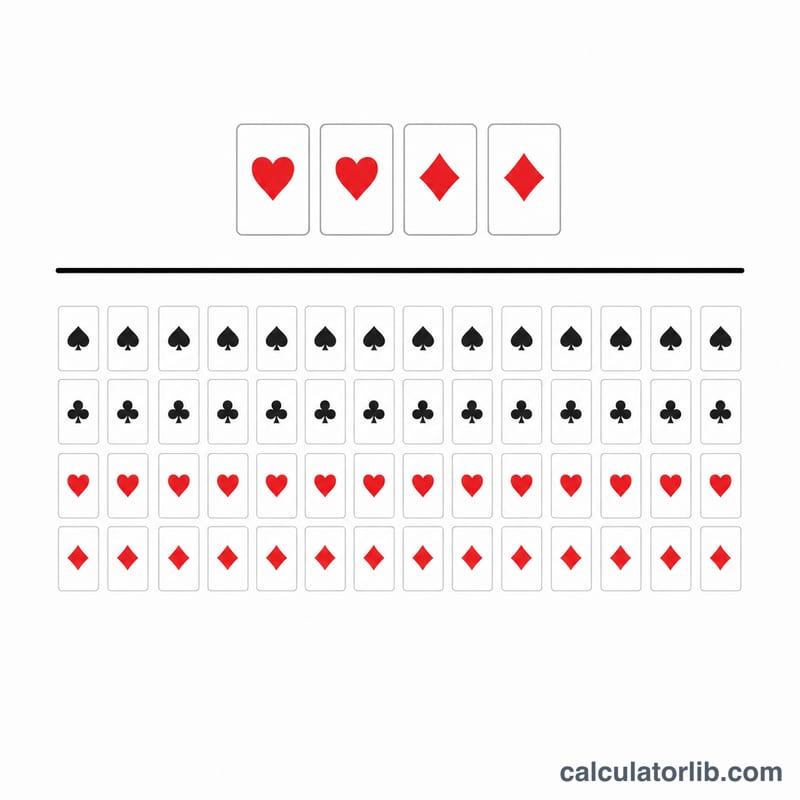
Full house: choose the rank for the triple (13 ways), pick 3 of its 4 suits \(\binom{4}{3}=4\), choose a different rank for the pair (12 ways), and pick 2 of its 4 suits \(\binom{4}{2}=6\). That gives $$13\times4\times12\times6 = 3{,}744 \text{ ways}.$$ Dividing by 2,598,960 gives about 0.1441%, or roughly 1 in 694 hands.
5-Card Poker Hand Probability Table
These figures apply to a single 5-card hand dealt from a shuffled standard 52-card deck (no wild cards, no jokers). The total number of possible hands is \(\binom{52}{5} = 2{,}598{,}960\), and each hand has probability \(P = \frac{ {\text{hand ways}}}{2{,}598{,}960}\).
| Rank | Hand | Combinations | Probability | Approx. odds (1 in N) |
|---|---|---|---|---|
| 1 | Royal flush | 4 | 0.000154% | 1 in 649,740 |
| 2 | Straight flush (excl. royal) | 36 | 0.001385% | 1 in 72,193 |
| 3 | Four of a kind | 624 | 0.02401% | 1 in 4,165 |
| 4 | Full house | 3,744 | 0.14406% | 1 in 694 |
| 5 | Flush (excl. straight flush) | 5,108 | 0.19654% | 1 in 509 |
| 6 | Straight (excl. straight flush) | 10,200 | 0.39246% | 1 in 255 |
| 7 | Three of a kind | 54,912 | 2.1128% | 1 in 47.3 |
| 8 | Two pair | 123,552 | 4.7539% | 1 in 21.0 |
| 9 | One pair | 1,098,240 | 42.2569% | 1 in 2.37 |
| 10 | High card | 1,302,540 | 50.1177% | 1 in 2.0 |
The ten counts add up to exactly 2,598,960, so the probabilities sum to 100%.
Exclusive vs. inclusive counts
This table uses exclusive counts: each hand is placed in only its highest category. Flush (5,108) therefore excludes all straight flushes and royal flushes, and straight (10,200) excludes them too. The inclusive counts, which count a hand in every category it qualifies for, are larger:
- Straight flush including royal: 36 + 4 = 40
- Flush including straight flushes: 5,108 + 36 + 4 = 5,148 (that is, \(4 \times \binom{13}{5}\))
- Straight including straight flushes: 10,200 + 36 + 4 = 10,240 (that is, \(10 \times 4^5\))
If you compare figures from different sources, check which convention they use. The exclusive counts are the ones that give a total of 2,598,960.
Poker Hand Terms and Definitions
- Rank
- The value of a card: 2 through 10, J, Q, K, A. There are 13 ranks in a standard deck.
- Suit
- One of four groups of 13 cards: spades, hearts, diamonds, clubs.
- Combination (n choose k)
- The number of ways to pick k items from n when order does not matter: \(\binom{n}{k} = \frac{n!}{k!\,(n-k)!}\). For 5-card hands, \(\binom{52}{5} = 2{,}598{,}960\).
- Kicker
- A side card that is not part of the made hand's main combination. Kickers break ties between hands of the same category, for example a pair of kings with an ace kicker beats a pair of kings with a queen kicker.
- Straight
- Five cards of consecutive ranks, in mixed suits. Ace can be high (10-J-Q-K-A) or low (A-2-3-4-5, the "wheel"), but wraparound hands such as Q-K-A-2-3 are not straights. There are 10 possible rank sequences.
- Flush
- Five cards of the same suit that are not all consecutive in rank.
- Four of a kind (quads)
- Four cards of the same rank plus one other card.
- Full house
- Three cards of one rank plus two cards of another rank.
- Three of a kind (trips)
- Three cards of the same rank plus two cards of two different other ranks (not a pair).
- Two pair
- Two cards of one rank, two cards of a second rank, and one card of a third rank.
- Exclusive vs. inclusive counting
- Exclusive counting assigns each hand only to its best category. Inclusive counting counts a hand in every category it satisfies, so a straight flush would also be counted as both a straight and a flush.
- Royal flush
- The highest straight flush: 10-J-Q-K-A all in the same suit. There are exactly 4 of them, one per suit.
FAQ
Are the flush and straight counts overlapping? The "Flush" figure (5,108) and "Straight" figure (10,200) include straight flushes. Subtract the 40 straight flushes if you want the exclusive count.
Does this account for community cards in Texas Hold'em? No. It models a single 5-card deal, like five-card draw, not the multi-stage drawing of Hold'em or Omaha.
Why does high card show 1,302,540 ways? That is the number of 5-card hands with no pair, no straight and no flush — the largest single category.