
What Is Relative Change?
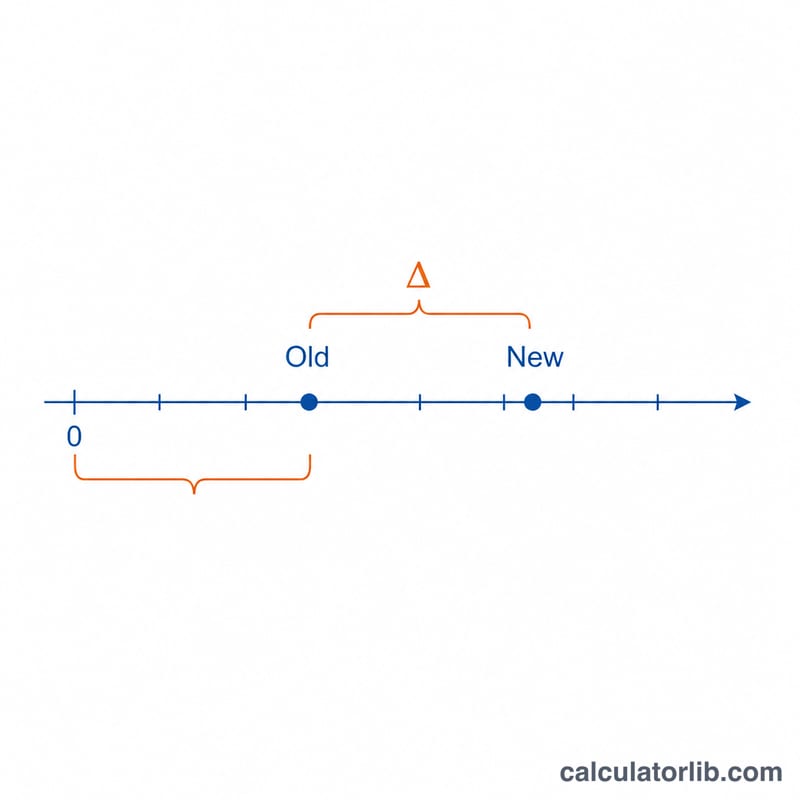
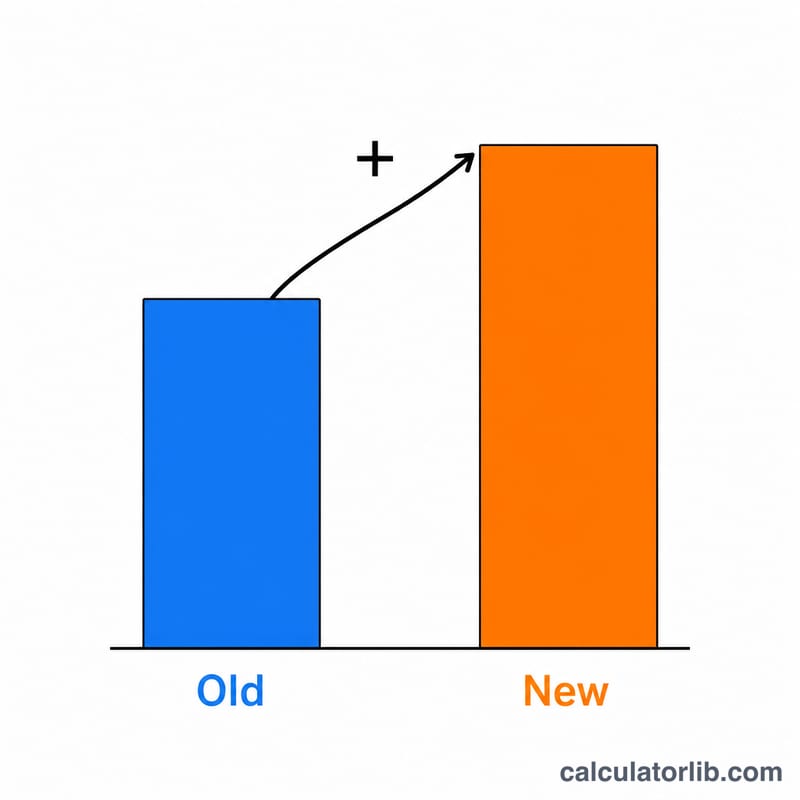
Relative change measures how much a quantity has grown or shrunk compared to its starting point, expressed as a percentage. Unlike absolute change, which only tells you the raw difference, relative change puts that difference in context by dividing it by the magnitude of the original value. This makes it easy to compare changes across quantities of very different sizes.
How to Use This Calculator
Enter the Old Value (your starting or reference figure) and the New Value (the figure you are comparing to). The calculator returns the relative change as a percentage. A positive result means an increase, while a negative result means a decrease.
The Formula Explained
The relative change is calculated as:
$$\text{Relative Change} = \frac{\text{New Value} - \text{Old Value}}{\left|\text{Old Value}\right|} \times 100\%$$
The absolute value bars around the old value ensure the sign of the percentage reflects the direction of the actual change, even when the old value is negative. Note that relative change is undefined when the old value is zero, because you cannot divide by zero.
Worked Example
Suppose a stock price rose from $200 to $250. The absolute change is \(250 - 200 = 50\). The relative change is $$\frac{50}{\left|200\right|} \times 100 = 25\%$$ So the price increased by 25%.
FAQ
Is relative change the same as percentage change? Yes, relative change expressed in percent is the percentage change between two values.
What if the old value is zero? Relative change is undefined when the old value is zero because the calculation requires dividing by it; this calculator returns 0 in that case.
Why use the absolute value of the old value? Using \(\left|\text{Old}\right|\) keeps the sign of the result tied to the true direction of change, which matters when the starting value is negative.