
What Is the Road Base Calculator?
Road base (also called crushed aggregate base, CAB, or sub-base) is the compacted layer of crushed stone and fines that supports driveways, roads, patios and building pads. This calculator estimates both the volume and the weight of road base you need so you can order the right amount and avoid costly second deliveries.
How to Use It
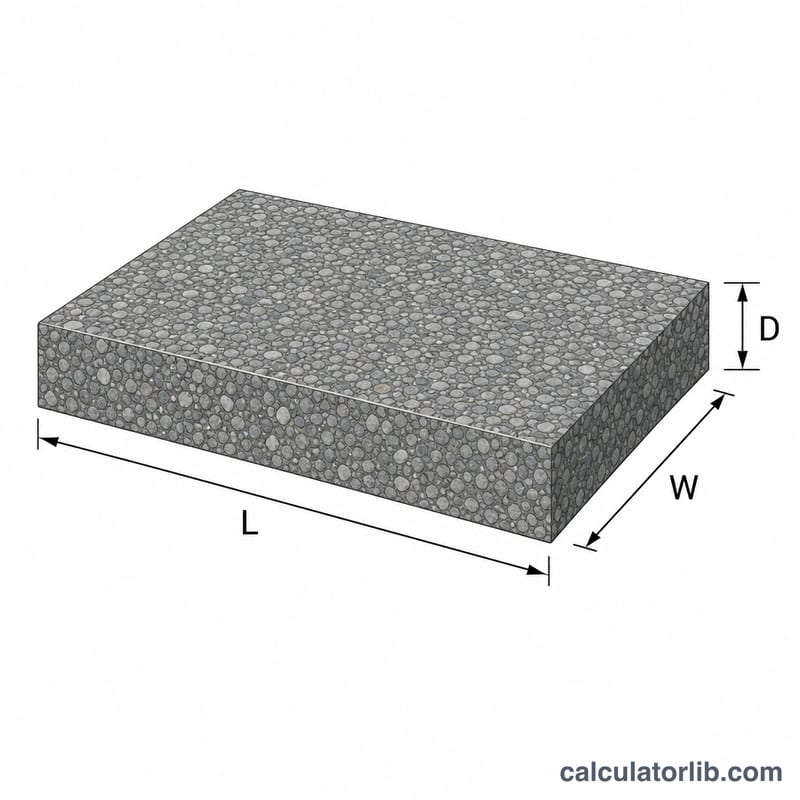
Enter the length and width of the area in feet, and the depth of the base layer in inches. Then set the density — compacted road base typically weighs about 1.5 tons per cubic yard, though crushed limestone or gravel can range from 1.3 to 1.7. The tool returns the required base in tons, cubic yards and cubic feet.
The Formula Explained
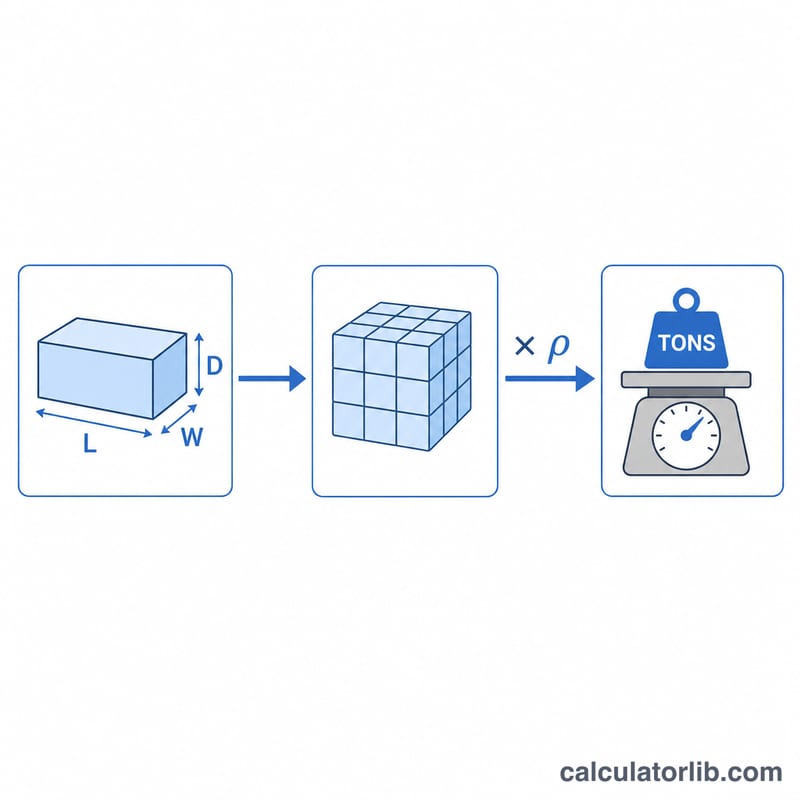
First the depth is converted from inches to feet by dividing by 12. The volume in cubic feet is length \(\times\) width \(\times\) depth. Dividing by 27 converts cubic feet to cubic yards (since \(1\ \text{yd}^3 = 27\ \text{ft}^3\)). Finally, multiplying the cubic-yard volume by the density gives the weight in tons:
$$\text{Tons} = \frac{L \times W \times (D/12)}{27} \times \rho$$
Worked Example
For a driveway 20 ft long, 10 ft wide, with a 6-inch base and a density of 1.5 tons/yd³: depth = \(6/12 = 0.5\) ft, volume = \(20 \times 10 \times 0.5 = 100\) ft³ = \(100/27 \approx 3.70\) yd³. Weight = \(3.70 \times 1.5 \approx 5.56\) tons.
FAQ
How thick should road base be? A common driveway base is 4–6 inches compacted; heavier loads may need 8 inches or more.
What density should I use? Compacted crushed road base averages ~1.5 tons/yd³. Use a supplier-specific figure when available.
Should I order extra? Yes — add roughly 5–10% for compaction loss and uneven subgrade.