

What Is the Add Days Calculator?
The Add Days Calculator lets you take any starting date and add a chosen number of calendar days to find the exact future date. You can also subtract days by entering a negative number, making it equally useful for looking back in time. The tool handles month lengths, year boundaries, and leap years automatically, so you never have to count on your fingers or a wall calendar.
How to Use It
Enter your start date by selecting the year, month, and day. Then type the number of days you want to add in the "Days to Add" field. Use a positive number to move forward (for example, 30) or a negative number to move backward (for example, -14). The calculator instantly returns the resulting date, its weekday, and an ISO-formatted version (YYYY-MM-DD) that is handy for spreadsheets and forms.
The Formula Explained
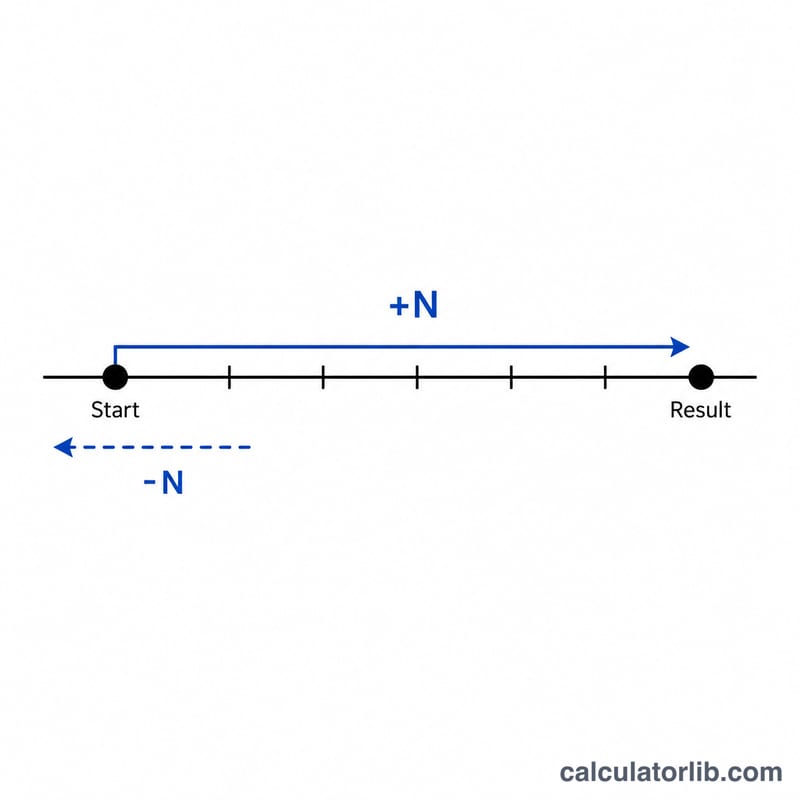
The math is simple in concept: $$\text{Result Date} = \text{Start Date} + N \text{ days}$$ Behind the scenes, the start date is converted to a calendar value, \(N\) days are added, and the calendar rolls the month and year forward as needed. February's 28 or 29 days, 30-day months, and 31-day months are all taken into account.
Worked Example
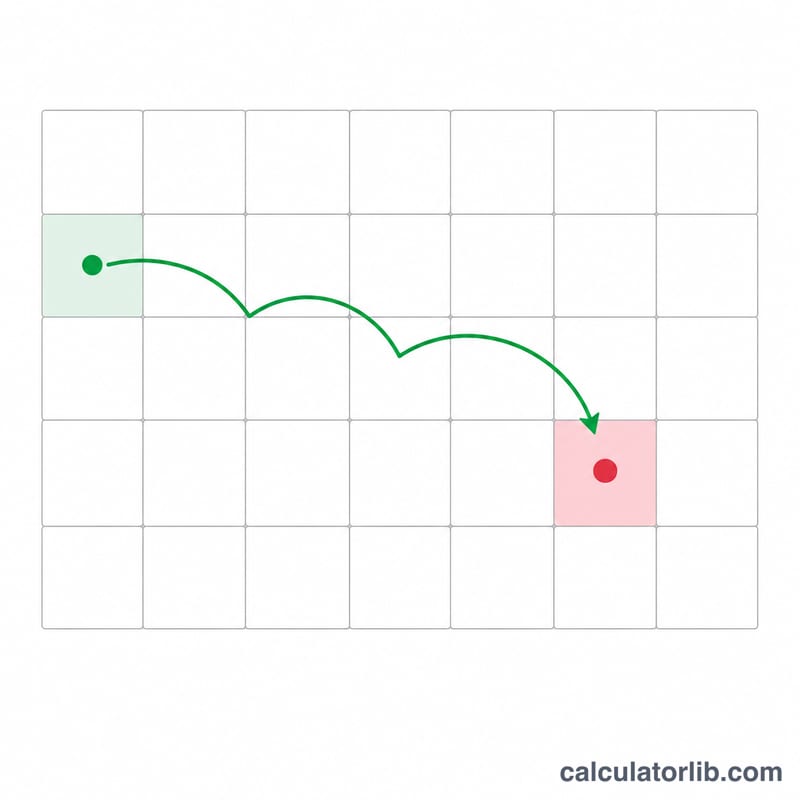
Suppose you start on January 1, 2024, and add 30 days. January has 31 days, so adding 30 days lands you on January 31, 2024. Add one more day (31 total) and you would roll into February 1, 2024. Because 2024 is a leap year, the calculator correctly counts February as having 29 days for any longer spans.
Quick Day-Count Reference
Use this table to translate common periods into an exact number of days you can type into the Days to Add field. Note that calendar months vary in length (28–31 days), so "30 days" is only an approximation of "one month."
| Period | Days | Notes |
|---|---|---|
| 1 week | 7 | Lands on the same weekday |
| 2 weeks (fortnight) | 14 | Same weekday as start |
| 4 weeks | 28 | Equals February in a common year |
| 30 days | 30 | Approximates 1 month; only April, June, Sept, Nov have exactly 30 days |
| 60 days | 60 | About 2 months |
| 90 days | 90 | About 3 months / one quarter |
| 180 days | 180 | About half a year |
| 1 year (common) | 365 | Result lands on the same date one year later |
| 1 year (leap) | 366 | When the span includes Feb 29 |
Month-length variation: January, March, May, July, August, October and December have 31 days; April, June, September and November have 30 days; February has 28 days (29 in a leap year). Because of this, adding a fixed number of days such as 30 or 90 will not always land on the "same day of a later month" — for true month-based math, add calendar months rather than days.
Leap-year rule: a year is a leap year if it is divisible by 4, except century years, which must be divisible by 400 (so 2000 was a leap year but 1900 was not). Whenever the added span crosses a February 29, the day count for one calendar year becomes 366.
FAQ
Can I subtract days? Yes — enter a negative number such as -10 to move that many days into the past.
Does it handle leap years? Absolutely. The calculator uses a true calendar engine, so February 29 in leap years is fully respected.
Is the start day counted? No. Adding 1 day to January 1 gives January 2, so the start date itself is day zero.