
What Is the Age in Hours Calculator?
This calculator tells you exactly how many hours you have been alive. Instead of measuring age in years, it converts the full elapsed time since your birth into hours — along with the equivalent days and minutes. It is a fun, precise way to look at your age and works for any date in history right up to today.
How to Use It
Enter your date of birth. By default the calculator measures up to today's date, but you can set a custom "as of" date to find your age in hours at any point — a past birthday, a future milestone, or any anniversary. The result updates immediately, showing hours, days, and minutes.
The Formula Explained
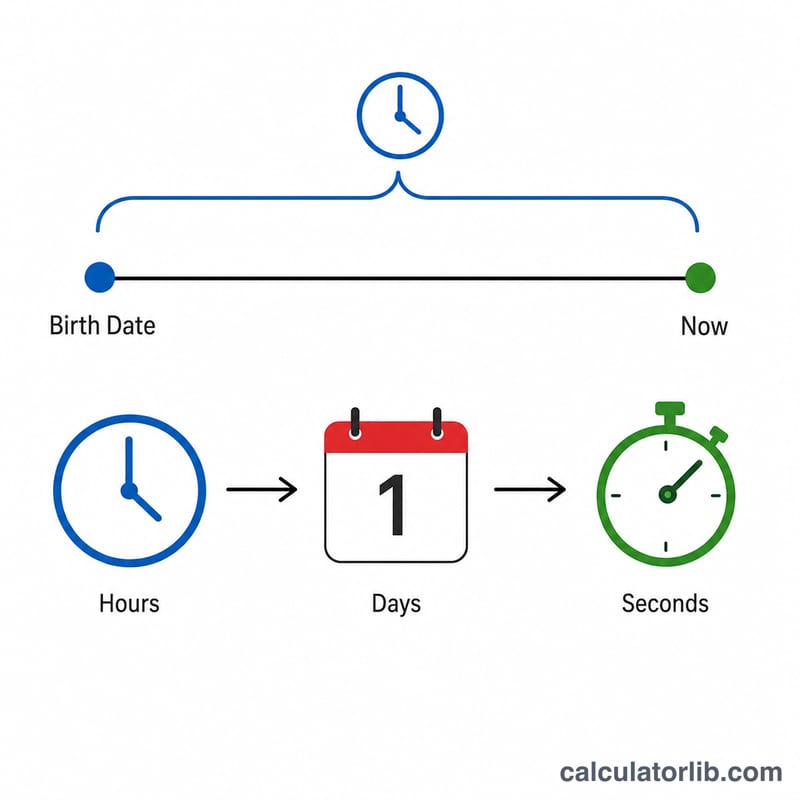
The calculation is straightforward. First, the time difference between the two dates is measured in seconds. Then it is divided by 3,600 (the number of seconds in one hour) and rounded down to a whole number:
$$\text{hours} = \left\lfloor \frac{\text{today} - \text{birth date}}{3600\ \text{s}} \right\rfloor$$
Dates are treated at midnight, so the result reflects whole calendar days converted to hours.
Worked Example
Suppose you were born on January 1, 2000 and you want your age in hours on January 1, 2001. That is a span of 366 days (2000 was a leap year). Multiply $$366\ \text{days} \times 24\ \text{hours} = 8{,}784\ \text{hours}.$$ In days the answer is 366, and in minutes it is \(366 \times 1440 = 527{,}040\) minutes.
Time Unit Conversion Reference
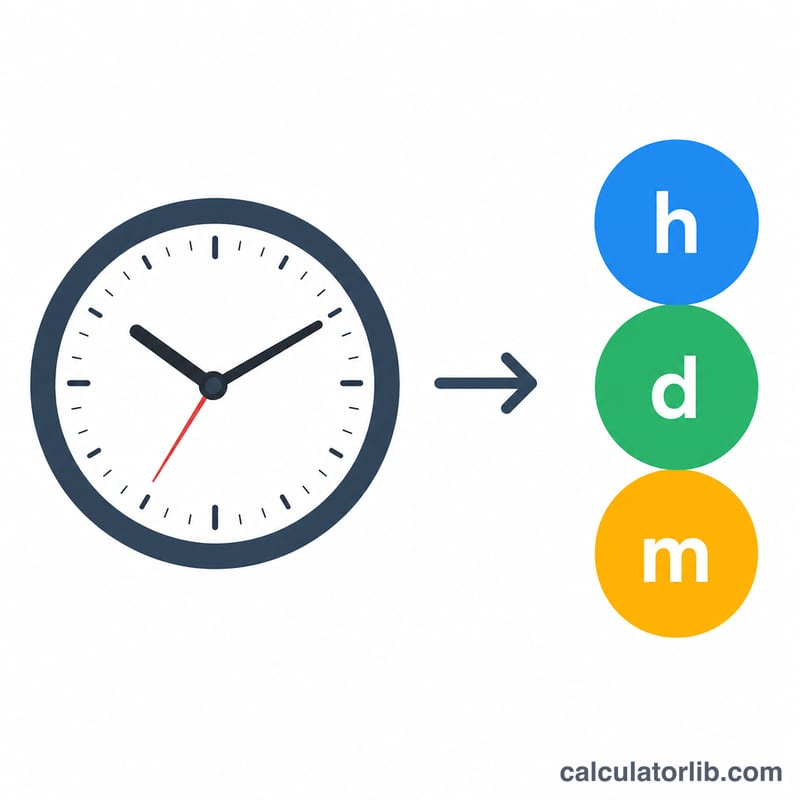
Age-in-hours calculations rest on a small set of fixed conversion factors. Because every minute is exactly 60 seconds and every hour is exactly 60 minutes, time below the level of a day is perfectly regular. At the day level and above, the only complication is the leap year, which adds one extra day (24 hours) roughly every four years. The table below lists the exact factors used to convert between common units of time.
| 1 unit | Seconds | Minutes | Hours | Days |
|---|---|---|---|---|
| 1 minute | 60 | 1 | 0.016667 | 0.000694 |
| 1 hour | 3,600 | 60 | 1 | 0.041667 |
| 1 day | 86,400 | 1,440 | 24 | 1 |
| 1 week | 604,800 | 10,080 | 168 | 7 |
| 1 common year (365 d) | 31,536,000 | 525,600 | 8,760 | 365 |
| 1 leap year (366 d) | 31,622,400 | 527,040 | 8,784 | 366 |
| 1 average year (365.25 d) | 31,557,600 | 525,960 | 8,766 | 365.25 |
The key relationships to remember are: \(1 \text{ day} = 24 \text{ h} = 1{,}440 \text{ min} = 86{,}400 \text{ s}\). A common (365-day) year therefore contains \(365 \times 24 = 8{,}760\) hours, while a leap year contains 8,784 hours. Averaged over the 4-year leap cycle, a year is about \(365.25 \times 24 = 8{,}766\) hours. So a person's age in hours grows by roughly 8,766 hours each year, or about 24 hours every day.
FAQ
Does it account for leap years? Yes. Because it uses the actual elapsed time between the two calendar dates, leap days are automatically included.
Why hours and not exact hours-minutes-seconds? Birth times are rarely entered precisely, so dates are measured from midnight for a clean, consistent result.
Can I use a future date? Yes — set the "as of" date in the future to see how many hours old you will be on that day.