

What Is the Average Collection Period?
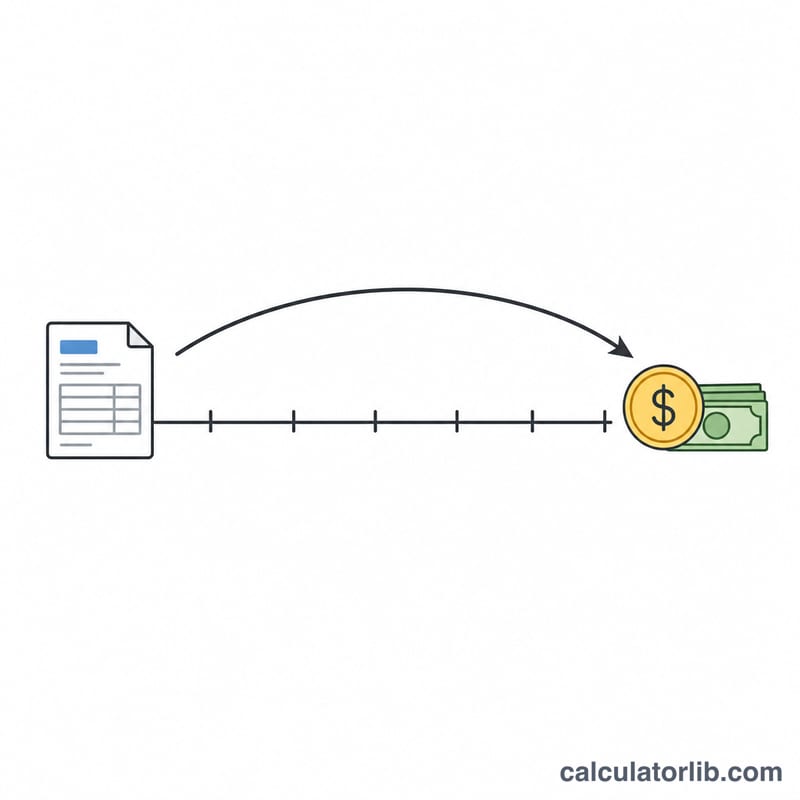
The average collection period (also called Days Sales Outstanding, or DSO) measures the average number of days a company takes to collect cash from its credit customers. A lower number means receivables are converted to cash quickly, which strengthens liquidity; a higher number can signal lenient credit terms or collection problems.
How to Use This Calculator
Enter your average accounts receivable (typically the average of beginning and ending balances), your net credit sales for the period, and the number of days in that period (365 for a year, 90 for a quarter, etc.). The calculator returns the average collection period in days plus the receivables turnover ratio.
The Formula Explained
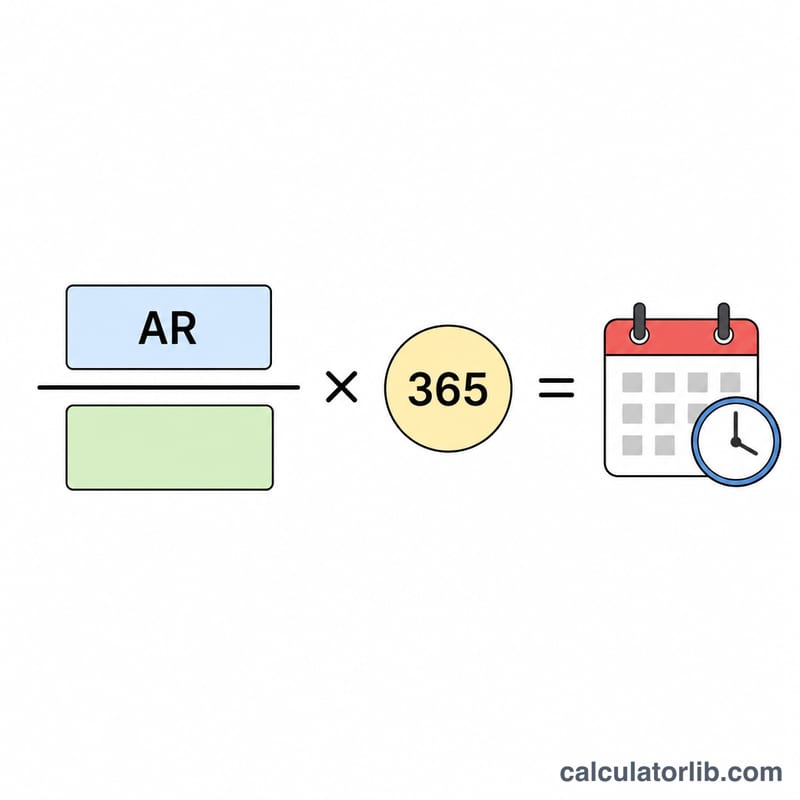
The core equation is:
$$\text{Average Collection Period} = \frac{\text{Accounts Receivable}}{\text{Net Credit Sales}} \times \text{Days}$$
It divides the money tied up in receivables by sales to get the fraction of the period worth of sales outstanding, then scales it to days. The receivables turnover ratio is simply \(\text{Net Credit Sales} \div \text{Accounts Receivable}\), and the collection period equals \(\text{Days} \div \text{Turnover}\).
Worked Example
Suppose a business has average accounts receivable of $50,000 and net credit sales of $500,000 over a 365-day year. The average collection period $$= \left(\frac{50{,}000}{500{,}000}\right) \times 365 = 0.1 \times 365 = \textbf{36.5 days}$$ The receivables turnover is \(500{,}000 \div 50{,}000 = 10\) times per year.
Typical Average Collection Periods by Industry
The "normal" collection period depends heavily on the credit terms customers are granted and on industry payment culture. Sectors that sell mostly for cash or card have very low DSO, while project-based and B2B sectors that extend long terms run much higher. The ranges below are broad, commonly cited approximations and will vary by company, region, and contract terms.
| Industry / Sector | Typical Collection Period | Notes |
|---|---|---|
| Retail & food service | 0–15 days | Mostly cash, card, and same-day settlement; little trade credit. |
| Utilities & telecom | 20–40 days | Monthly billing cycles; broadly net-30 style terms. |
| Manufacturing | 30–60 days | Trade credit to distributors and wholesalers; net-30 to net-60. |
| Wholesale / distribution | 30–55 days | Volume credit sales with negotiated terms. |
| B2B / professional services | 30–75 days | Invoice-based; terms range net-30 to net-60+. |
| Healthcare providers | 40–70 days | Insurer and payer reimbursement cycles lengthen collection. |
| Construction & engineering | 60–90+ days | Milestone billing, retainage, and long net terms inflate DSO. |
Use these only as orientation. The most reliable benchmark is your own stated credit terms and your DSO trend over consecutive periods.
Definitions & Glossary
- Average collection period (DSO)
- The average number of days between making a credit sale and collecting the cash. Also called days sales outstanding, it equals average accounts receivable divided by net credit sales, multiplied by the number of days in the period.
- Accounts receivable (AR)
- Money owed to a business by customers for goods or services delivered on credit but not yet paid for. It appears as a current asset on the balance sheet.
- Average accounts receivable
- The mean receivables balance over a period, usually the beginning balance plus the ending balance divided by two: \((\text{Beginning AR} + \text{Ending AR}) / 2\). Using an average smooths out seasonal or month-end fluctuations.
- Net credit sales
- Sales made on credit during the period, minus returns, allowances, and discounts. Cash sales are excluded because they are never part of receivables.
- Receivables turnover ratio
- The number of times a company collects its average receivables during a period, calculated as net credit sales divided by average accounts receivable. It is the inverse, in turns, of the collection period.
- Credit terms (net-30, net-60, etc.)
- The payment deadline a seller grants a buyer. "Net-30" means full payment is due within 30 days of the invoice date; "net-60" within 60 days. Terms such as "2/10 net-30" add an early-payment discount (2% if paid within 10 days, otherwise full amount in 30).
FAQ
Is a lower collection period always better? Generally yes, but an extremely low number may mean overly strict credit terms that drive away customers.
What is a good average collection period? It depends on your industry and stated credit terms. If you offer net-30 terms, a collection period near or below 30 days is healthy.
Should I use total sales or only credit sales? Use net credit sales when available, since cash sales are collected immediately and would understate the true collection time.