
What is the Fahrenheit to Rankine converter?
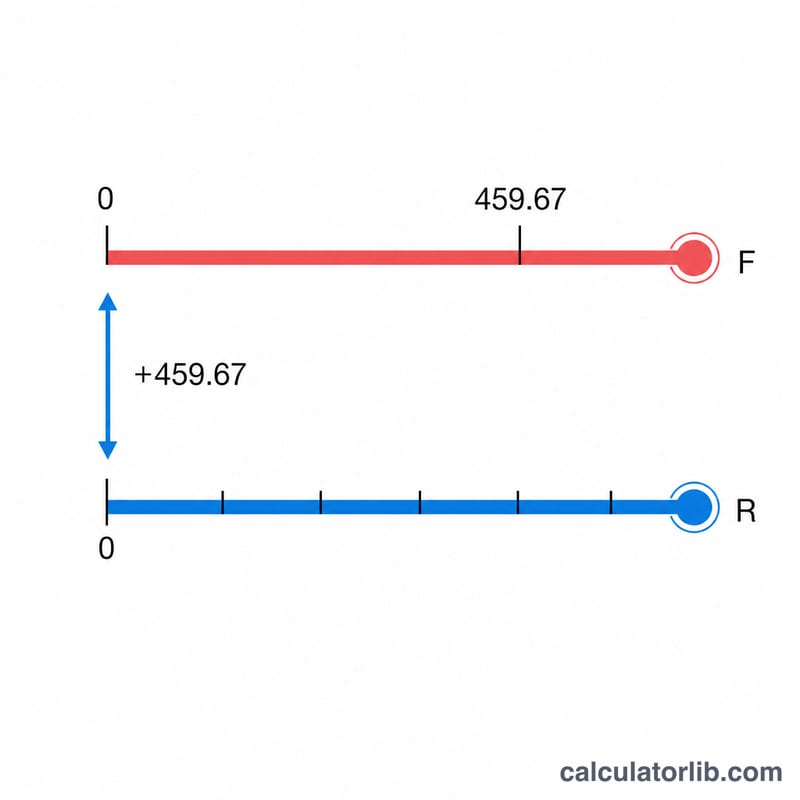
This tool converts a temperature from the Fahrenheit scale (°F) to the Rankine scale (°R). Rankine is an absolute thermodynamic temperature scale used mainly in engineering and thermodynamics in the United States. It starts at absolute zero (0 °R) but uses the same degree size as Fahrenheit, so converting between the two requires only a simple constant offset.
How to use it
Type the temperature in Fahrenheit into the input box. Negative and decimal values are accepted, so you can enter readings like −40 or 98.6. Press calculate to see the equivalent value in Rankine along with the substitution steps used to get there.
The formula explained
The conversion is:
$$\text{°R} = \text{°F} + 459.67$$
The constant 459.67 is the offset between the two zero points: absolute zero is −459.67 °F, which equals 0 °R. Because a one-degree change is the same magnitude on both scales, no multiplication is needed—you simply add the offset. To go the other way, subtract: \(\text{°F} = \text{°R} - 459.67\).
Worked example
Convert the freezing point of water, 32 °F:
$$\text{°R} = 32 + 459.67 = 491.67\ \text{°R}$$
As a check, the boiling point of water (212 °F) gives \(212 + 459.67 = 671.67\ \text{°R}\), and absolute zero (−459.67 °F) gives exactly 0 °R.
FAQ
Can Rankine be negative? No. Rankine is an absolute scale, so 0 °R is the lowest possible value. A Fahrenheit input below −459.67 °F would imply a temperature below absolute zero, which is physically impossible.
Is the degree size the same as Fahrenheit? Yes. A change of 1 °F equals a change of 1 °R; only the zero point differs.
What is −40 °F in Rankine? \(-40 + 459.67 = 419.67\ \text{°R}\).