

What is the Roman Numerals Converter?
This tool converts any whole number between 1 and 3999 into its classic Roman numeral representation. Roman numerals use seven letters — I, V, X, L, C, D and M — combined according to fixed rules to form every value in this range. The system has no symbol for zero, and standard notation tops out at 3999 (MMMCMXCIX), which is why this converter is bounded to that range.
How to use it
Enter a whole number from 1 to 3999 and the calculator returns the equivalent Roman numeral. It is handy for clock faces, book chapters, movie sequel titles, copyright years, and monument inscriptions.
The formula explained
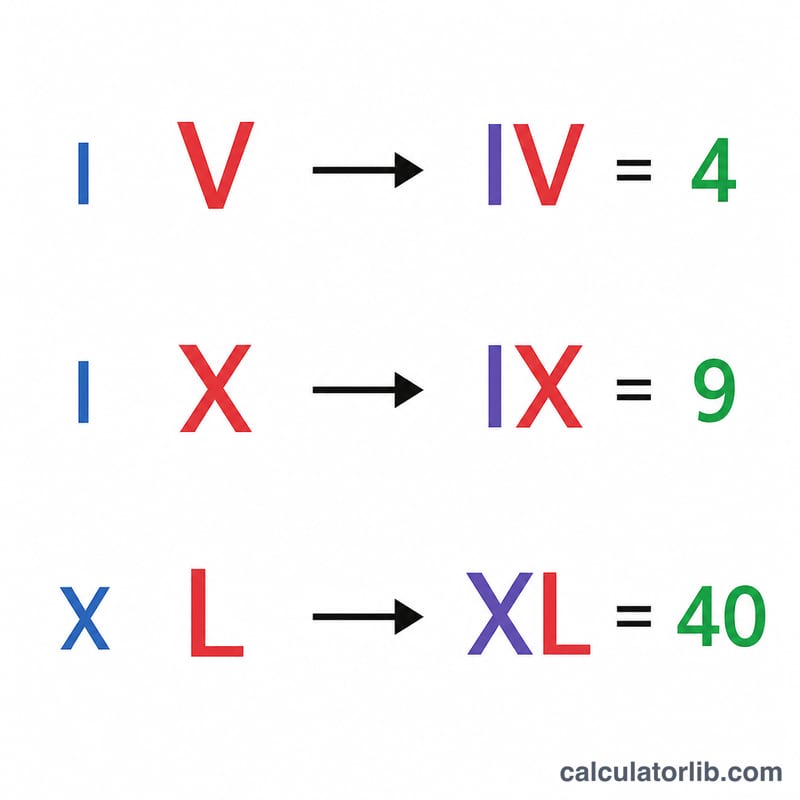
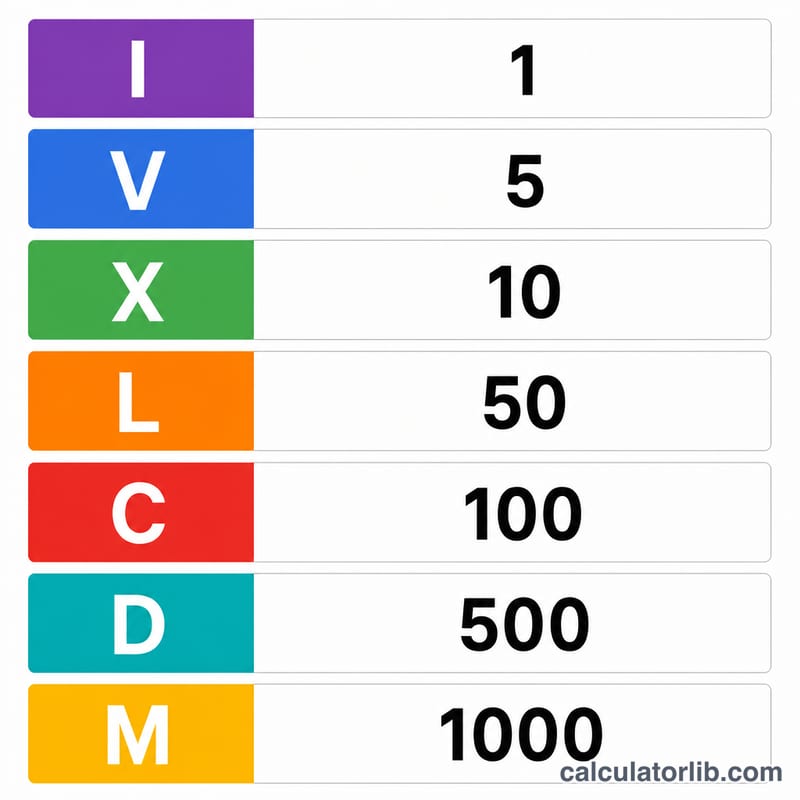
Each base symbol maps to a value: $$I{=}1,\ V{=}5,\ X{=}10,\ L{=}50,\ C{=}100,\ D{=}500,\ M{=}1000$$ The algorithm works greedily: it repeatedly subtracts the largest possible value (including the subtractive pairs \(IV{=}4\), \(IX{=}9\), \(XL{=}40\), \(XC{=}90\), \(CD{=}400\), \(CM{=}900\)) and appends the matching symbol until nothing remains. The subtractive rule means a smaller symbol placed before a larger one is subtracted — so 4 is IV (\(5-1\)) rather than IIII.
Worked example
Convert 2024. Take 1000 (M), leaving 1024. Take another 1000 (M), leaving 24. 24 has no thousands, hundreds, or fifties; take 10 (X) → 14, take 10 (X) → 4, then 4 maps to the subtractive pair IV. The result is MMXXIV.
$$2024 = M + M + X + X + IV = \text{MMXXIV}$$FAQ
Why can't I enter 0 or a negative number? Roman numerals have no symbol for zero and were not designed for negatives, so the converter starts at 1.
What is the largest value? \(3999 = \text{MMMCMXCIX}\). Larger numbers require overline (vinculum) notation, which this standard converter does not use.
Why is 4 written IV and not IIII? Standard modern notation uses the subtractive form IV. The repeated IIII form appears on some clock faces but is not the canonical spelling.