

What is credit creation?
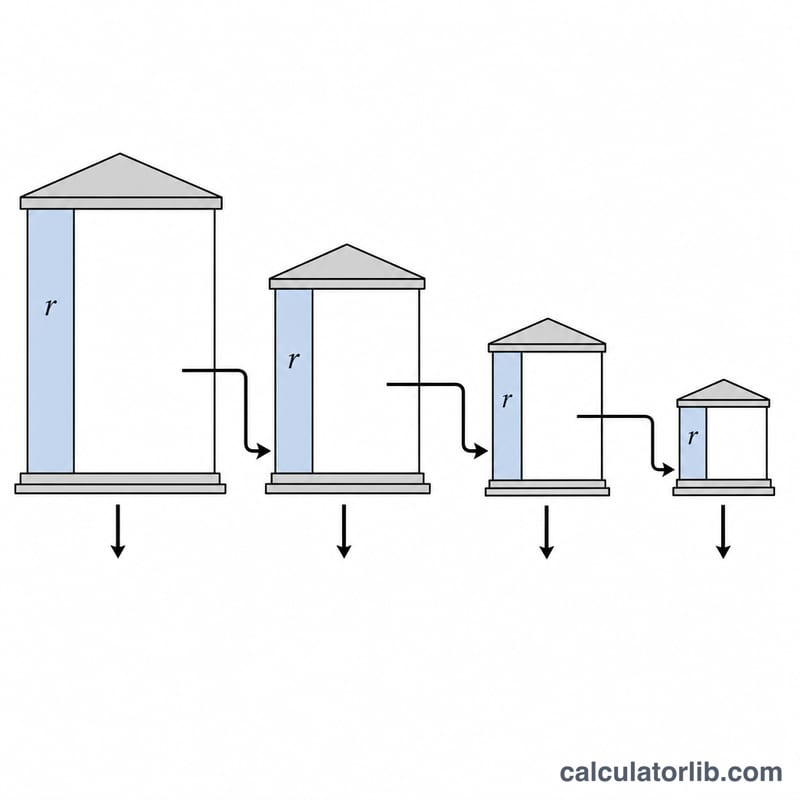
Credit creation (also called the money multiplier process) describes how a fractional-reserve banking system turns a single initial deposit into a much larger total stock of deposits. When a bank receives a deposit, it is required to hold a fixed fraction — the required reserve ratio — as reserves and may lend out the rest. That loan is spent and re-deposited at another bank, which again keeps the reserve fraction and lends the remainder. Repeated indefinitely, this chain creates new deposit money far exceeding the original deposit. The mathematics is universal to any fractional-reserve system, though the reserve requirement itself is set by each country's central bank.
How to use this calculator
Enter the initial (primary) deposit and the required reserve ratio as a percentage. The calculator returns the total deposits created across the whole banking system, the amount of newly created credit (money above the original deposit), the money multiplier, and the total loans extended. The reserve ratio must be greater than 0% (a 0% ratio would let credit grow without limit) and no more than 100%.
The formula explained
Let \(D\) be the initial deposit and \(r\) the reserve ratio expressed as a fraction (reserve % / 100). The deposits form a geometric series: \(D\), \(D(1-r)\), \(D(1-r)^2\), ... With common ratio \((1-r)\) less than 1, the series converges to \(D / r\). The money multiplier is \(1 / r\), and the credit created on top of the original deposit is \(D(1-r)/r\).
$$\text{Total Deposits} = \frac{\text{Initial Deposit}}{r}$$ $$\text{where}\quad \left\{ \begin{aligned} r &= \dfrac{\text{Reserve Ratio (\%)}}{100} \\ \text{Money Multiplier} &= \dfrac{1}{r} \\ \text{Credit Created} &= \text{Total Deposits} - \text{Initial Deposit} \end{aligned} \right.$$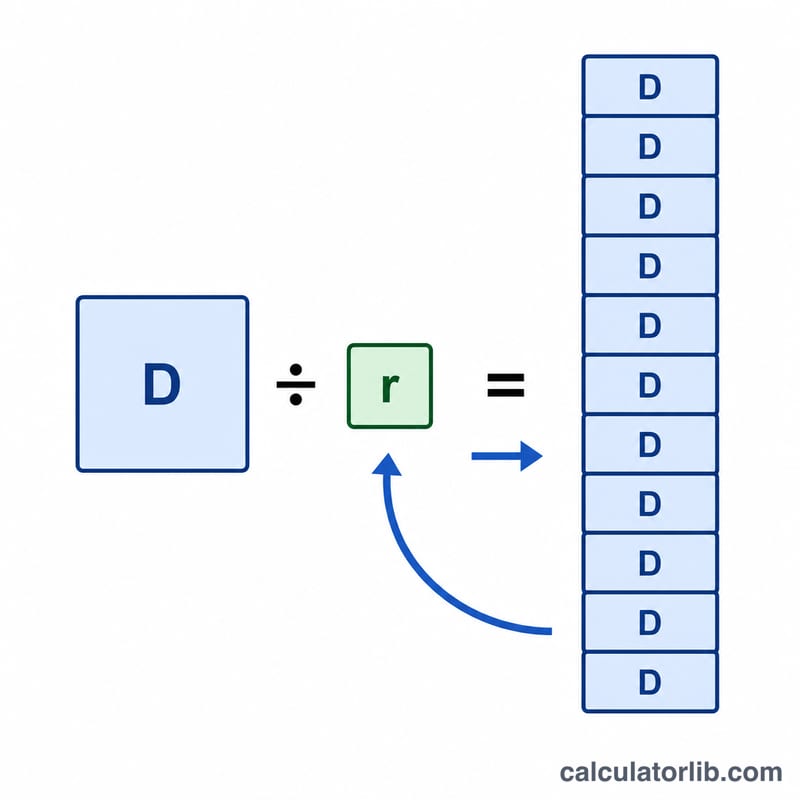
Worked example
With an initial deposit of 1,000,000 and a reserve ratio of 10%, \(r = 0.10\). The money multiplier is \(1 / 0.10 = 10\). Total deposits created \(= 1{,}000{,}000 / 0.10 = 10{,}000{,}000\). Credit created \(= 10{,}000{,}000 - 1{,}000{,}000 = 9{,}000{,}000\), which also equals the total loans extended.
FAQ
Why does a higher reserve ratio create less money? A larger reserve fraction means banks lend out less of each deposit, shrinking each round of the chain and lowering the multiplier \((1/r)\).
What happens at a 100% reserve ratio? \(r = 1\), the multiplier is 1, total deposits equal the initial deposit, and no new credit is created because banks cannot lend.
Is this a real-world prediction? It is the textbook theoretical maximum. Actual credit creation is smaller because of excess reserves, cash leakage, and loan demand, but the model captures the core mechanism.