
What Is the Futures Contract Calculator?
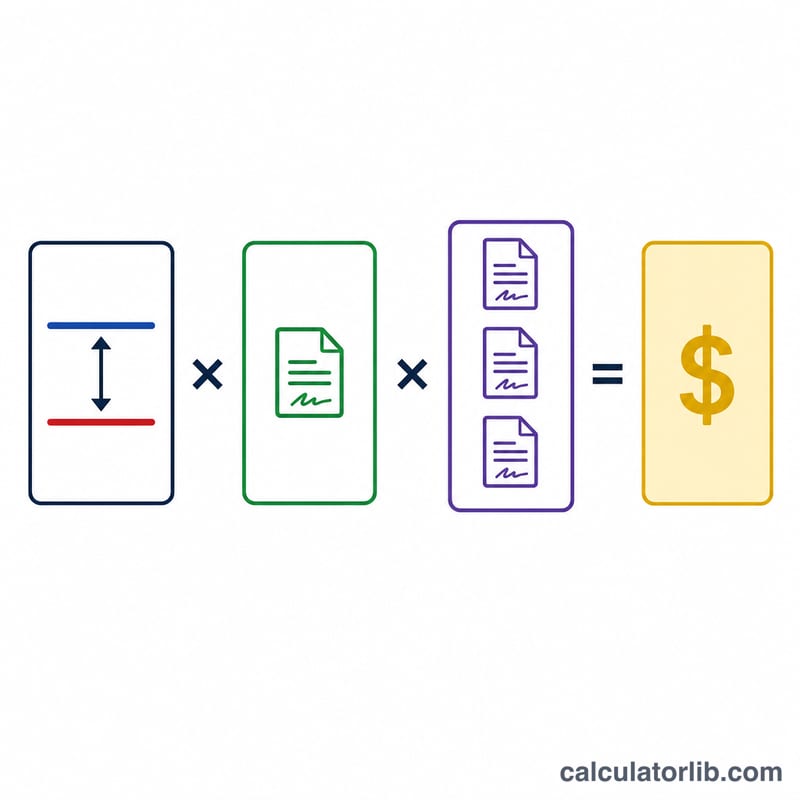
This calculator estimates the profit or loss (P&L) on a futures trade. A futures contract obligates the holder to buy or sell an underlying asset at a set price, and each contract represents a fixed number of units of that asset (the contract size or multiplier). Your gain or loss is simply the price move multiplied by the contract size and the number of contracts you hold. This is a universal calculation that works for any futures market — commodities, indices, currencies or interest rates — as long as you know the contract multiplier.
How to Use It
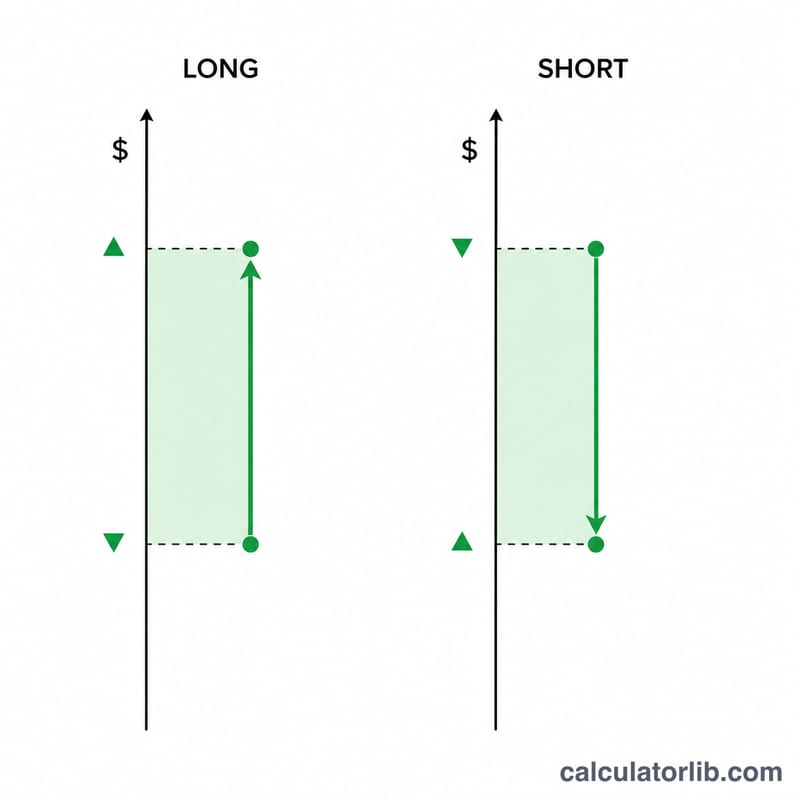
Choose whether your position is Long (you bought, profiting when price rises) or Short (you sold, profiting when price falls). Enter the entry price, the exit price, the contract size (units per contract, e.g. 50 for the E-mini S&P 500), and how many contracts you traded. The calculator returns total P&L, P&L per contract, the notional value at entry, and the return on that notional.
The Formula Explained
The core equation is
$$\text{P\&L} = \left( \text{Exit} - \text{Entry} \right) \times \text{ContractSize} \times \text{Contracts}$$for a long position. For a short position the difference is flipped to \(\left( \text{Entry} - \text{Exit} \right)\) because you profit when the price falls. Notional value is \(\text{Entry} \times \text{ContractSize} \times \text{Contracts}\), and the return on notional is \(\text{PnL} \div \text{Notional} \times 100\).
Worked Example
Suppose you go long 2 contracts with a contract size of 50, entering at 100 and exiting at 110. The price move is 10. P&L per contract = \(10 \times 50 = 500\). Total P&L = \(500 \times 2 = 1{,}000\). Notional at entry = \(100 \times 50 \times 2 = 10{,}000\), so the return on notional is 10%.
FAQ
What is contract size? It is the number of underlying units one contract controls (also called the multiplier). For example, gold futures are 100 troy ounces per contract.
Does this include fees or margin? No. The result is gross P&L before commissions, exchange fees and financing. Subtract those separately.
Why is my short P&L positive when price fell? Short sellers profit when the price drops, so the calculator reverses the price difference for short positions.