
What this calculator does
This tool estimates the length of an open belt that wraps around two pulleys (or sheaves) of different diameters. Knowing the belt length is essential when selecting a V-belt, timing belt, or flat belt, or when designing a drive layout where the center distance and pulley sizes are fixed.
How to use it
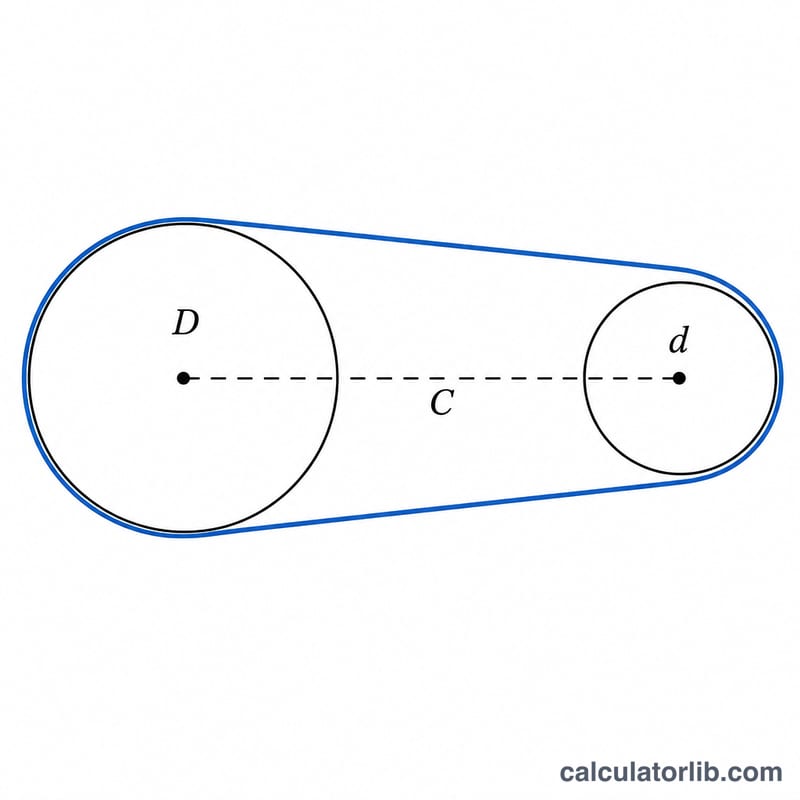
Enter the diameter of the large pulley (D), the diameter of the small pulley (d), and the center distance (C) — the straight-line distance between the two shaft centers. Use any single consistent unit (mm, cm, or inches); the result comes out in that same unit. Click calculate to get the approximate belt length.
The formula explained
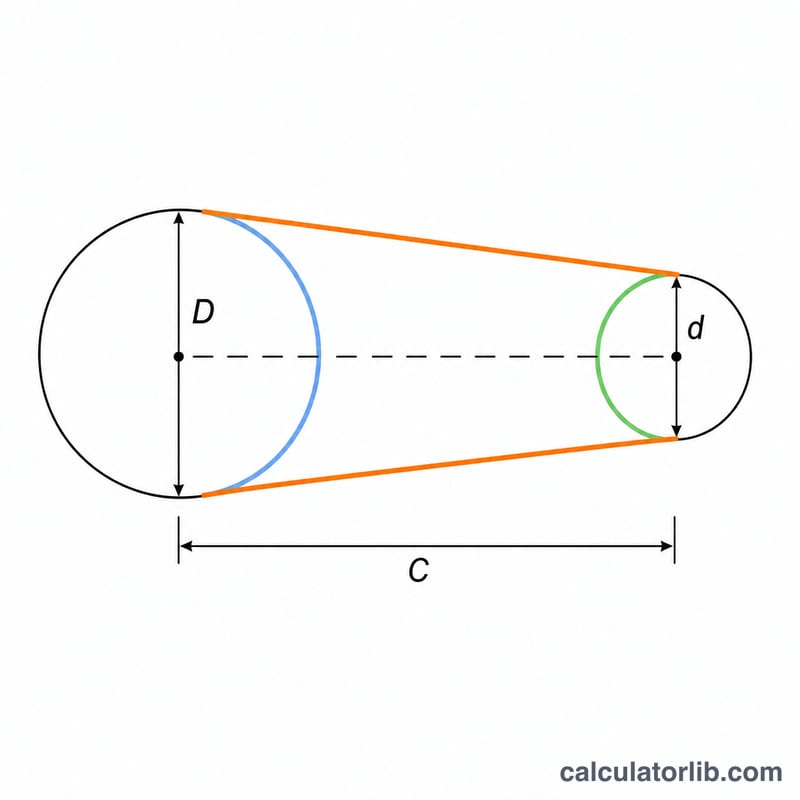
The belt length is the sum of three parts: the two straight spans between pulleys (2C), the arc wrapped around the pulleys approximated as half of each circumference (π(D+d)/2), and a small correction term for the difference in pulley sizes ((D−d)²/4C). This closed-form approximation is highly accurate for practical drives where C is larger than the pulley radii.
$$L = 2\,\text{C} + \frac{\pi}{2}\left(\text{D} + \text{d}\right) + \frac{\left(\text{D} - \text{d}\right)^{2}}{4\,\text{C}}$$
Worked example
For \(D = 200\), \(d = 100\), and \(C = 500\): the straight span is \(2 \times 500 = 1000\); the wrap term is \(\pi \times (200+100)/2 = \pi \times 150 \approx 471.24\); the correction is \((200-100)^2 / (4 \times 500) = 10000 / 2000 = 5\). Adding these gives $$L \approx 1000 + 471.24 + 5 = 1476.24 \text{ units}.$$
Practical Recommendations
- Round up to the nearest standard belt size. The formula gives a theoretical length; commercial belts come in fixed catalog lengths. Always select the next available standard size at or above your calculated value rather than rounding down.
- Leave room for tensioning and adjustment travel. Mount at least one pulley (or an idler) on adjustable slots so the center distance can be shortened slightly for installation and lengthened to take up wear and stretch. A common rule of thumb is to allow roughly 2–4% of belt length in adjustment range.
- Account for belt seating in V-grooves. A V-belt rides on its sides, not the groove bottom, so the effective wrap diameter is the pulley pitch diameter, not the outside diameter. Using outside diameters can overstate the length; use pitch (datum) diameters from the sheave specification where available.
- Match the cross-section to the sheave. Belt and groove cross-sections (A, B, 3V, 5V, etc.) must agree, and the calculated length must be expressed in the same datum system the manufacturer uses (effective, pitch, or outside length).
- Verify against manufacturer belt charts before ordering. Treat the computed length as a starting point. Cross-check the catalog length, designation, and center-distance adjustment table from the belt supplier before purchasing.
This is general engineering guidance, not a substitute for the specifications of your specific drive components. Confirm critical dimensions with the equipment and belt manufacturers.
Definitions & Glossary
- Large pulley diameter (D)
- The effective wrap diameter of the bigger of the two pulleys. For V-belt drives this is normally the pitch (datum) diameter rather than the outside diameter.
- Small pulley diameter (d)
- The effective wrap diameter of the smaller pulley, measured on the same basis as D.
- Center distance (C)
- The straight-line distance between the rotational axes (shaft centers) of the two pulleys. Together with D and d it determines the belt length.
- Open belt
- A belt arrangement in which both pulleys turn in the same direction and the belt does not cross itself. This is the configuration the formula above models (as opposed to a crossed belt, which reverses rotation).
- Sheave
- A grooved pulley designed to carry a V-belt; the term is often used interchangeably with "pulley" in V-belt drives.
- Wrap angle
- The angle of belt contact around a pulley. The smaller pulley has the smaller wrap angle, which limits the drive's power capacity; longer center distances increase wrap on the small pulley.
- Pitch diameter
- The diameter at which the belt's effective tension line (its neutral axis) travels around the sheave. Length and ratio calculations should use pitch diameters for accurate results.
FAQ
Is this for open or crossed belts? This formula is for an open belt, where the belt does not cross between the pulleys. Crossed belts use a different wrap calculation.
What units should I use? Any unit, as long as all three inputs use the same one. The answer is in that same unit.
Why is there a correction term? When the pulleys differ in size, the belt angles slightly across the span. The \((\text{D}-\text{d})^2/4\text{C}\) term accounts for that extra length, and it shrinks toward zero as the center distance grows.