
What This Calculator Does
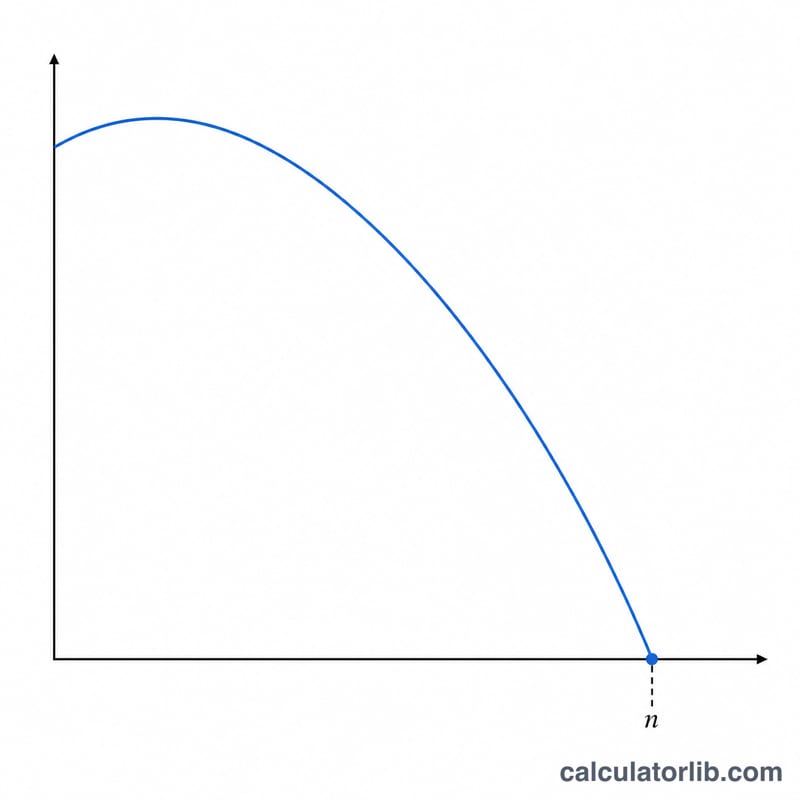
The Money Runs Out Age Calculator estimates the age at which your retirement savings will be fully depleted. By comparing how fast you withdraw money against how fast your remaining balance grows, it projects how many years your nest egg will last and the exact age when it hits zero. This is a universal financial-math tool and uses simplified assumptions (a constant return rate and a constant annual withdrawal, withdrawn at year-end).
How to Use It
Enter your retirement age, your current savings balance, the fixed amount you plan to withdraw each year, and the annual return rate you expect your investments to earn. The calculator returns the age your money runs out and the number of years the fund lasts. If your withdrawals are smaller than the growth your balance earns, the result is "Never" — the fund is sustainable.
The Formula Explained
The number of years n before depletion is found by solving the annuity-exhaustion equation:
$$n = \frac{\ln\!\left(\dfrac{W}{W - PV\cdot r}\right)}{\ln(1 + r)}$$
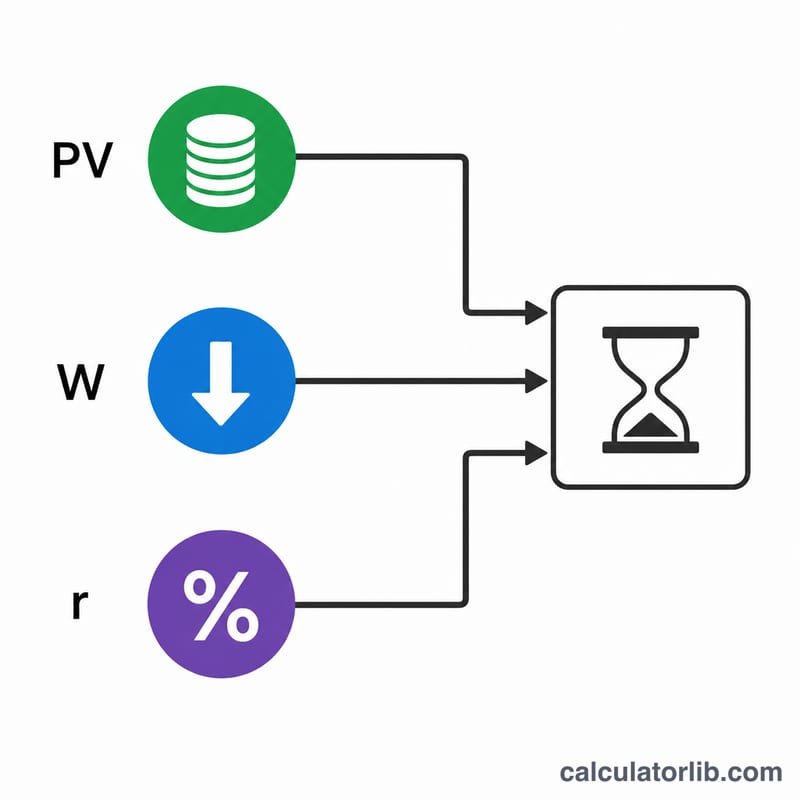
Here PV is your starting balance, W is the yearly withdrawal, and r is the annual return as a decimal. The depletion age is simply your retirement age plus n. If \(W \le PV\cdot r\), the term inside the log is non-positive and the fund never depletes.
Worked Example
Suppose you retire at 65 with $500,000, withdraw $40,000 a year, and earn 4% (0.04). Interest on the balance is \(\$500{,}000 \times 0.04 = \$20{,}000\), which is less than $40,000, so the fund will deplete. $$n = \frac{\ln\!\left(\dfrac{40000}{40000 - 20000}\right)}{\ln(1.04)} = \frac{\ln(2)}{\ln(1.04)} \approx \frac{0.6931}{0.03922} \approx 17.67 \text{ years}$$ Your money runs out at about age 82.7.
FAQ
Does this account for inflation? No — the withdrawal amount is treated as fixed. To approximate inflation, use a "real" return rate (nominal return minus inflation).
Why does it sometimes say "Never"? If your annual withdrawal is less than or equal to the growth earned on your balance, the balance never falls, so the fund is self-sustaining.
Is this financial advice? No. It is a simplified projection; real returns vary year to year. Consult a financial professional for personalized planning.