
What is the explicit formula for an arithmetic sequence?
An arithmetic sequence is a list of numbers where each term increases (or decreases) by the same fixed amount, called the common difference d. The explicit formula lets you jump straight to any term without listing every term before it. Given the first term a₁ and the common difference d, the nth term is:
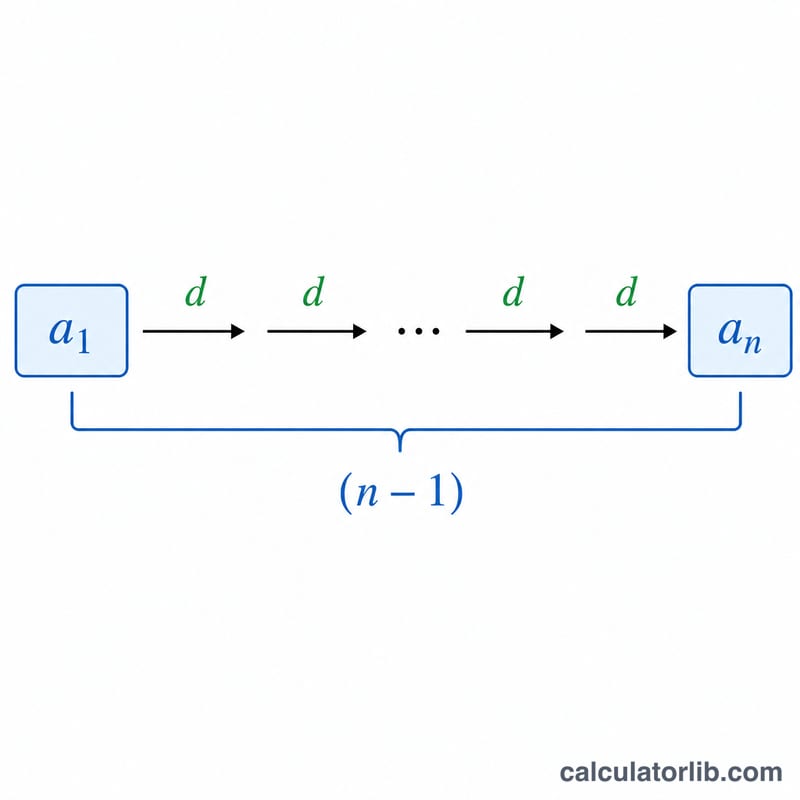
$$a_n = a_1 + (n - 1)\cdot d$$
How to use this calculator
Enter three values: the first term (a₁), the common difference (d), and the position of the term you want (n). The calculator instantly returns aₙ, and also reports the sum of the first n terms (Sₙ) for convenience. Both a₁ and d can be negative or decimal; n must be a whole number of at least 1.
The formula explained
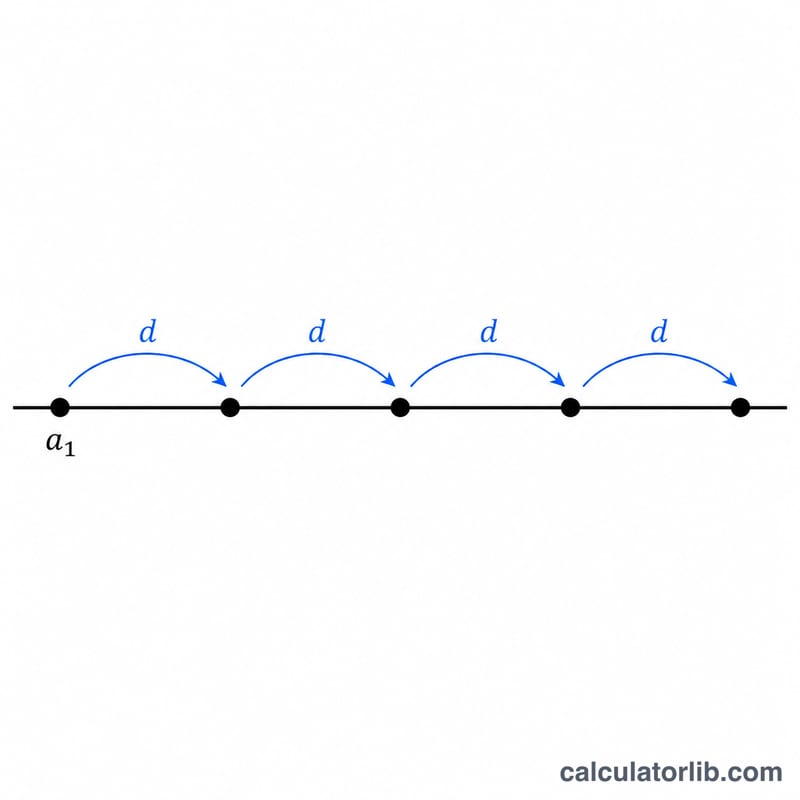
The "(n − 1)" factor matters because the first term already counts as position 1 — you only add the common difference for each step after the first. So reaching the 5th term means adding d four times to a₁. This is why we use \((n - 1)\) rather than \(n\).
Worked example
Suppose a₁ = 2 and d = 3. To find the 10th term: $$a_{10} = 2 + (10 - 1)\cdot 3 = 2 + 9\cdot 3 = 2 + 27 = 29.$$ The sum of the first 10 terms is $$S_{10} = \frac{10}{2}\left(2\cdot 2 + 9\cdot 3\right) = 5\cdot(4 + 27) = 5\cdot 31 = 155.$$
FAQ
What if the common difference is negative? A negative d simply means the sequence decreases. The formula works exactly the same way.
Can n be a fraction? No. The term index n must be a positive whole number, since sequence terms are counted with integers.
What is the difference between explicit and recursive formulas? The recursive form \((a_n = a_{n-1} + d)\) needs the previous term, while the explicit form gives any term directly from a₁, d, and n.