
What Is the Mode?
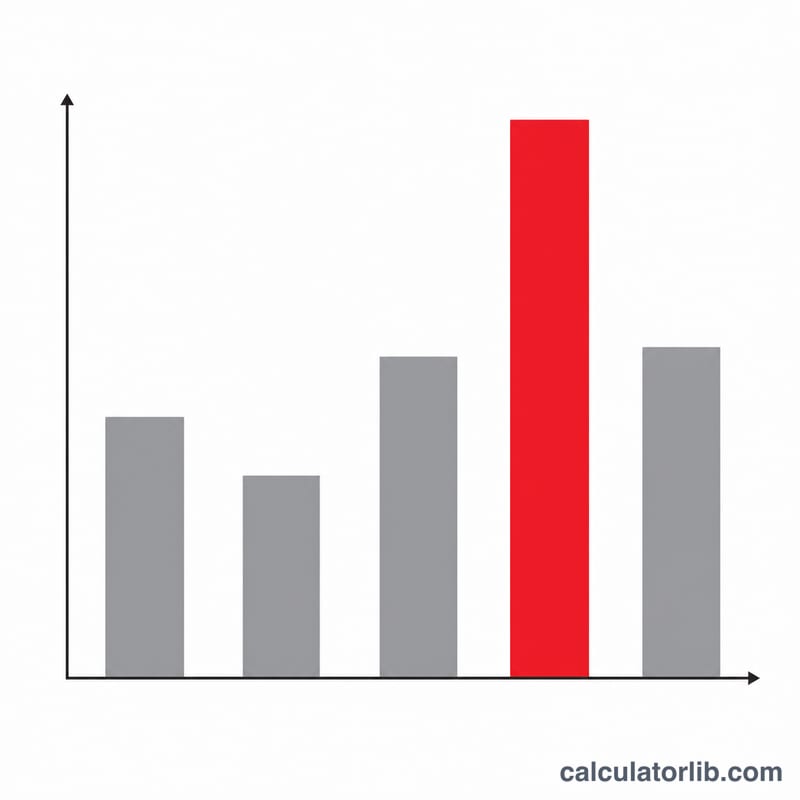
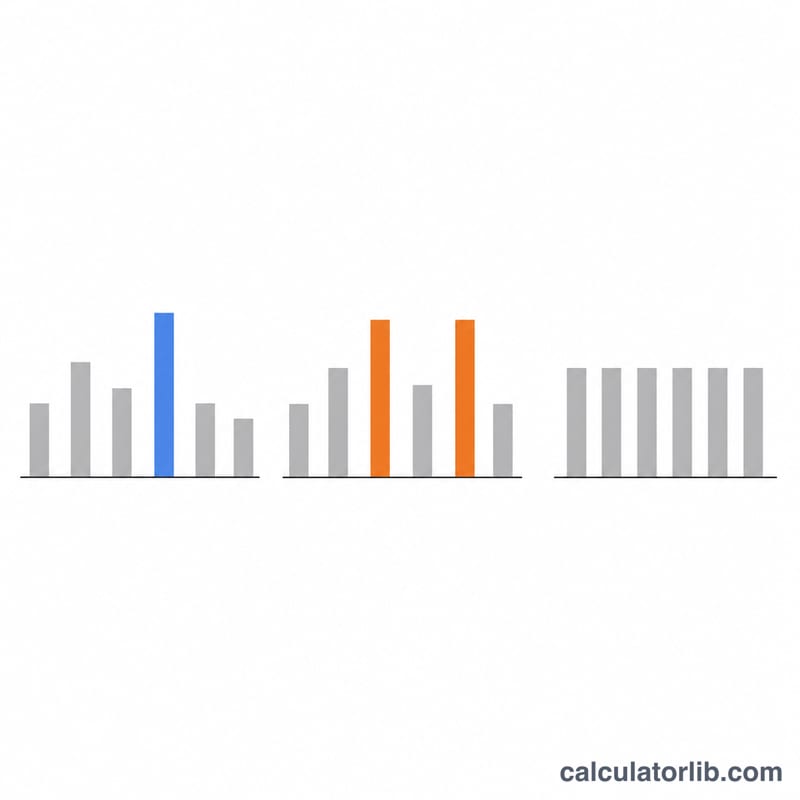
The mode is the value that appears most frequently in a data set. Unlike the mean and median, the mode works with any type of data and is the only measure of central tendency that can be used with categorical values. A data set can have one mode (unimodal), two modes (bimodal), several modes (multimodal), or no mode at all when every value appears the same number of times.
How to Use This Calculator
Type your numbers into the box, separated by commas or spaces — for example 2, 4, 4, 4, 5, 5, 7, 9. Press calculate and the tool counts how often each value occurs, then reports the value(s) tied for the highest frequency. It also shows the highest frequency, the total count of values, and how many distinct values were entered.
The Formula Explained
Mathematically, the mode is the value \(x\) that maximizes the frequency function \(\operatorname{freq}(x)\): the count of how many times \(x\) appears. If several values share the maximum count, all of them are modes. If the maximum count is 1 — meaning no value repeats — the set has no mode.
$$\text{Mode} = \underset{x \,\in\, \text{Numbers}}{\arg\max}\; \operatorname{freq}(x)$$Worked Example
Take the list 2, 4, 4, 4, 5, 5, 7, 9. The value 4 appears three times, 5 appears twice, and every other value appears once. The highest frequency is 3, achieved only by 4, so the mode is 4. If the list were 1, 1, 2, 2, 3, both 1 and 2 appear twice, making it bimodal with modes 1 and 2.
FAQ
Can a list have more than one mode? Yes. When two or more values tie for the highest frequency the set is bimodal or multimodal, and all tied values are reported.
What if no number repeats? If every value occurs exactly once, there is no mode and the calculator reports "No mode".
Does the order of numbers matter? No. The mode depends only on how often each value appears, not on their position in the list.