
What is an Oval Circumference Calculator?
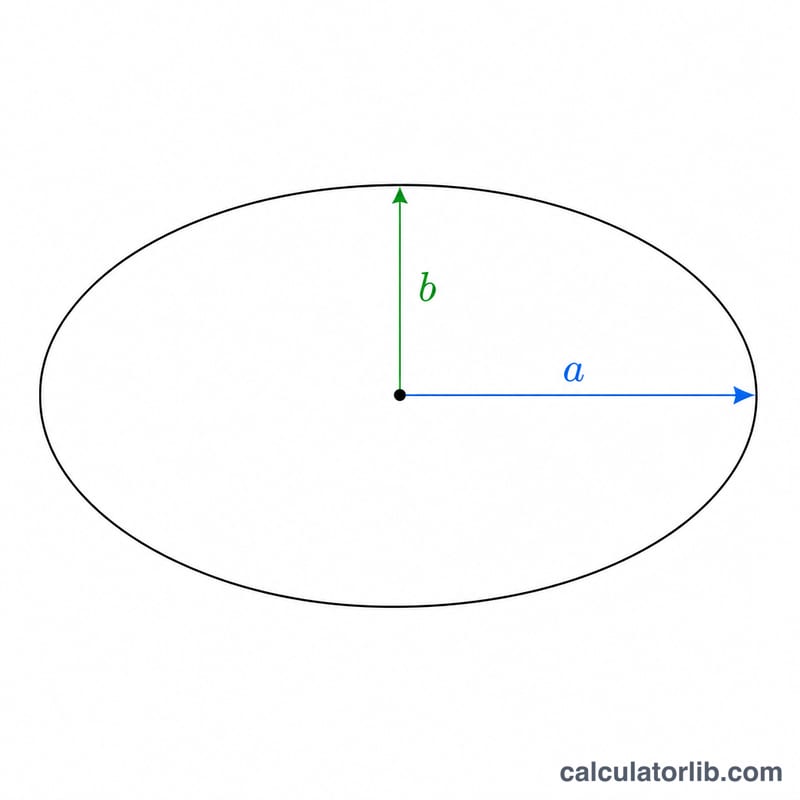
An oval circumference calculator is a tool that helps you determine the perimeter (circumference) of an oval or elliptical shape. An oval is a closed curve that resembles a stretched circle, technically known as an ellipse in mathematics. It has two axes: a major axis (longer) and a minor axis (shorter), which determine its shape and size.
When to Use an Oval Circumference Calculator
You might find this calculator useful in several scenarios:
- Architecture and construction projects involving elliptical designs or structures
- Landscaping when planning oval-shaped gardens, pools, or pathways
- Manufacturing when working with oval-shaped components or materials
How to Calculate Oval Circumference
The circumference of an oval (ellipse) can be calculated using various formulas. For this calculator, we use Ramanujan's approximation which provides excellent accuracy:
C ≈ π × [3(a+b) - √((3a+b)(a+3b))]
Where:
- C = circumference of the oval
- a = semi-major axis (half of the longest diameter)
- b = semi-minor axis (half of the shortest diameter)
- π = pi (approximately 3.14159)
The calculator also provides related calculations:
Area = π × a × b
Eccentricity = √(1 - (b²/a²)) where a > b
Examples
Example 1: Regular Ellipse
Calculate the circumference of an oval with semi-major axis 10 units and semi-minor axis 6 units.
| Parameter | Value |
|---|---|
| Semi-major axis (a) | 10 units |
| Semi-minor axis (b) | 6 units |
| Circumference | 50.83 units |
| Area | 188.50 square units |
| Eccentricity | 0.80 |
| Classification | Ellipse |
Example 2: Nearly Circular Oval
Calculate the circumference of an oval with semi-major axis 8 units and semi-minor axis 7.5 units.
| Parameter | Value |
|---|---|
| Semi-major axis (a) | 8 units |
| Semi-minor axis (b) | 7.5 units |
| Circumference | 48.75 units |
| Area | 188.50 square units |
| Eccentricity | 0.34 |
| Classification | Ellipse |
Example 3: Perfect Circle
Calculate the circumference when both semi-axes are equal at 5 units (which forms a circle).
| Parameter | Value |
|---|---|
| Semi-major axis (a) | 5 units |
| Semi-minor axis (b) | 5 units |
| Circumference | 31.42 units |
| Area | 78.54 square units |
| Eccentricity | 0.00 |
| Classification | Circle |
Shape Classification Table
| Condition | Classification | Properties |
|---|---|---|
| a = b | Circle | Perfect circle with radius = a = b, eccentricity = 0 |
| a > b | Ellipse | Oval shape with eccentricity between 0 and 1 |
| a ≫ b | Highly Eccentric Ellipse | Very elongated oval with eccentricity approaching 1 |
For other geometric calculations, you might find these tools useful: Circle Area Calculator, Circle Perimeter Calculator, or Ellipse Area Calculator.
Frequently Asked Questions
How do you calculate the circumference of an oval?
An ellipse has no simple exact formula, so calculators use Ramanujan's approximation: C ≈ π [ 3(a+b) − √((3a+b)(a+3b)) ], where a is the semi-major axis and b is the semi-minor axis. Enter both half-widths and the calculator returns the perimeter instantly with very high accuracy.
What are the semi-major axis a and semi-minor axis b?
The semi-major axis a is half the longest diameter of the oval, and the semi-minor axis b is half the shortest diameter. If you know the full lengths, divide each by two before entering them. Both values must use the same unit, and a should be greater than or equal to b.
How accurate is Ramanujan's approximation?
Very accurate. For most ovals the error is far less than 0.01%, and it stays below about 0.04% even for extremely elongated ellipses. The approximation is exact when a equals b, which gives a perfect circle. For everyday measurements the result is effectively precise.
Why isn't there an exact formula for an ellipse perimeter?
Unlike a circle, an ellipse perimeter requires a complete elliptic integral of the second kind, which has no closed-form solution in elementary functions. It can only be expressed as an infinite series. That is why practical tools rely on close approximations like Ramanujan's formula rather than a simple equation.
What happens if a and b are equal?
When the semi-major and semi-minor axes are equal, the oval is a perfect circle with radius a. The formula then reduces to the familiar C = 2πa, and Ramanujan's approximation returns the exact circumference with no error. This is the limiting case of an ellipse.
Can I work out the circumference from the full diameters?
Yes. Measure the longest diameter and the shortest diameter of the oval, then halve each to get a and b. For example, a 10 cm by 6 cm oval gives a = 5 and b = 3, producing a circumference of about 25.53 cm using the calculator.